


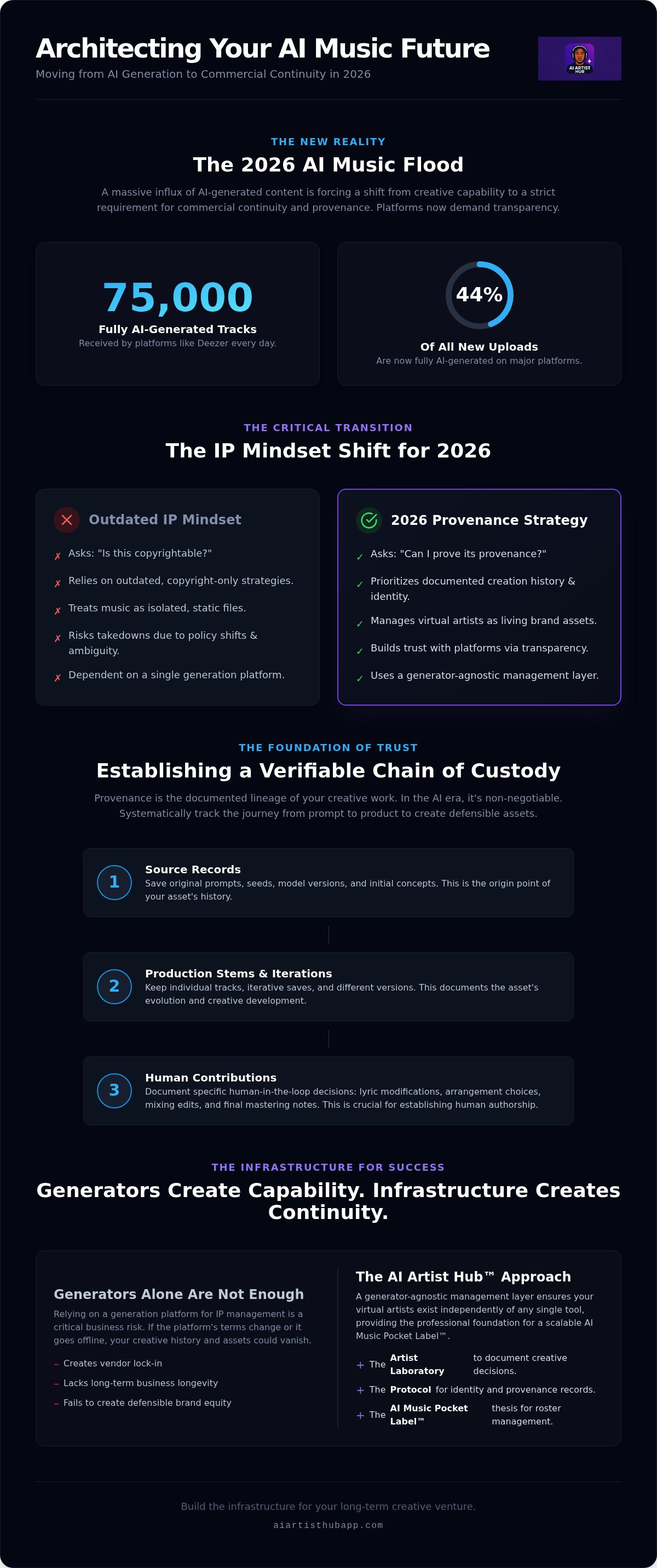
As of April 2026, platforms like Deezer report receiving approximately 75,000 fully AI-generated tracks every day, making up 44% of all new uploads. This massive influx has triggered a shift from mere creative capability to a strict requirement for commercial continuity. You've likely felt the pressure of shifting platform policies, such as the EU AI Act’s transparency mandates or Apple Music’s disclosure tags. Without a robust system for AI music intellectual property management, your virtual artists risk being treated as disposable noise rather than valuable assets.
We understand the frustration of building high-volume catalogs while facing legal ambiguity and the threat of content removal. Establish undeniable provenance and manage virtual identities with professional discipline using the frameworks in this guide. You'll learn how to utilize the Artist Laboratory to document creative history, implement the AI Music Pocket Label™ thesis for scalable roster management, and build the infrastructure necessary to invest in your brand with confidence. Let’s move past the generation phase and start architecting your long-term creative venture.
Key Takeaways
- Adopt a comprehensive system for AI music intellectual property management that prioritizes documented creation history and identity over outdated copyright-only strategies.
- Establish undeniable provenance using verification signals to build trust with major streaming platforms and satisfy 2026 transparency requirements.
- Leverage the AI Music Pocket Label™ thesis to manage portfolios of virtual artists, building defensible brand equity that exceeds the value of individual tracks.
- Utilize the Artist Laboratory to document human-in-the-loop creative decisions, providing a clear record of the human authorship needed for asset protection.
- Move beyond casual generation by implementing professional infrastructure designed to help you scale a sustainable, long-term music business.
The IP Challenge: Navigating AI Music Intellectual Property Management in 2026
Effective AI music intellectual property management involves the systematic tracking of an asset's creation history, virtual identity, and commercial rights. It's a shift from the passive "do I own this?" mindset to an active, founder-led strategy focused on continuity. Traditional copyright thinking often fails in the virtual artist space because it treats music as a static file rather than a living brand. In 2026, the primary goal for any serious creator is to ensure that their assets remain commercially viable regardless of how underlying generation technology changes.
Moving from "is it copyrightable?" to "can I prove its provenance?" is the most critical transition you'll make this year. While generators provide the capability to create music, they don't provide the infrastructure to protect it. You need a framework that treats every prompt, seed, and human-in-the-loop decision as a vital piece of evidence for your ownership records.
The Reality of AI Copyright in 2026
The global legal stance on AI-assisted works remains centered on meaningful human authorship. As of 2026, the U.S. Copyright Office continues to affirm that works created entirely by AI without human intervention fall into the public domain. Understanding the current state of AI and copyright law helps you identify which parts of your work are protectable. You must document your creative contributions, such as specific arrangement choices, lyric modifications, and mixing decisions, to establish a valid claim. Verification has replaced "immutability" as the practical standard for trust. Platforms and distributors now require clear disclosure and machine-readable markers to confirm that your content meets their transparency requirements.
Why Generators Alone Don't Create Defensible Assets
Generators create capability, but they don't create business longevity. Relying solely on a generation platform for IP storage puts your entire roster at risk. If a platform changes its terms or goes offline, your creative history could vanish. A generator-agnostic management layer is essential for maintaining control over your assets. By using the Protocol for identity and provenance, you ensure that your virtual artists exist independently of the tools used to create them. This approach protects you from vendor lock-in and provides the professional foundation needed for a scalable AI Music Pocket Label™. Focus on building a system that captures every iteration of your work. This level of organization transforms a hobbyist's collection of tracks into a professional, defensible portfolio of digital assets.
Establishing Provenance: The Foundation of AI Music IP Management
Provenance acts as the documented lineage of your creative work, detailing exactly how an asset moved from a concept to a finished track. In the context of AI music intellectual property management, establishing this history is no longer optional. It is the primary way you build trust with both distribution platforms and your audience. By using verification signals, you provide tangible proof of your human-in-the-loop decisions, turning what could be seen as "black box" generation into a transparent, professional workflow.
The Protocol serves as the standard for this identity layer. It ensures that every virtual artist in your roster carries a verifiable record of its origin. This transparency is a strategic business advantage. Platforms in 2026 are increasingly aggressive about removing content that lacks clear origin data. Being the creator who provides full disclosure makes your catalog "low risk" for distributors, ensuring your music stays live and monetizable while others face takedowns.
The Chain of Custody for AI Assets
Maintaining a clear chain of custody requires you to track the journey from the initial prompt to the final product within the Artist Laboratory. You shouldn't just save the final render. Instead, organize your assets into a structured hierarchy:
- Source Records: Save original prompts, seeds, and model versions used.
- Production Stems: Keep individual tracks for future remixing or licensing.
- Human Contributions: Document specific edits, lyrics, and arrangement changes.
This systematic approach allows you to prove which elements were human-authored. For a deeper look at the technical requirements, review our guide on AI Music Provenance Tracking. Organizing these records now prevents expensive legal headaches when you're ready to license your virtual artist's catalog.
Verification vs. Legal Ownership
It's vital to distinguish between technical verification and legal ownership. Verification tools provide a robust record of creation, but they aren't a substitute for a court's ruling. However, these records are your first line of defense during dispute resolutions. When a marketplace or streaming service flags a track, having a documented history allows you to resolve the issue quickly. The U.S. Copyright Office guidance on AI emphasizes that human authorship is the prerequisite for protection. By building a defensive portfolio through consistent record-keeping, you demonstrate that your work meets these standards. You can explore our roster management tools to see how we help founders maintain these critical records at scale. This disciplined approach ensures that your virtual identities remain valuable, defensible assets in a competitive market.
Managing Virtual Identities vs. Isolated Song Assets
Founders often make the mistake of treating AI music as a collection of disconnected audio files. This approach creates a management nightmare and leaves your work vulnerable to platform shifts. Shifting your focus toward the AI Music Pocket Label™ thesis allows you to manage portfolios with the same discipline as a traditional record label. By prioritizing the virtual identity over the individual track, you build a defensible brand that carries far more commercial weight than a standalone MP3. This distinction is the core of sophisticated AI music intellectual property management in 2026.
Virtual artist brands are inherently more resilient because they rely on a cohesive ecosystem of identity, visual style, and narrative. While an individual AI track might face copyright challenges, a fully developed virtual persona establishes a form of "trade dress" that is much harder for competitors to replicate. Managing these identities requires a shift from being a casual prompter to becoming a strategic architect of digital personas.
Building Brand Equity in Virtual Artists
Establishing a virtual artist persona involves more than just a name and a profile picture. It requires a consistent brand system that includes specific visual assets, a defined sonic signature, and a unique personality. These elements turn a digital asset into a recognizable brand. Using the Artist Laboratory, or "The Lab," helps you refine these identities before they hit the market. This environment ensures that every piece of content fits the artist’s established narrative. To get started with your own portfolio, learn how to manage an AI artist roster and brand portfolio effectively. Focus on creating durable identities that fans can connect with over the long term.
Scalable Roster Systems
Scaling from a single project to a full roster requires professional infrastructure. You can't rely on manual folders or scattered spreadsheets to track IP records for dozens of virtual artists. Software leverage is the only way to maintain control without succumbing to "roster bloat." Centralized systems allow you to manage provenance, licensing, and direct-to-fan sales from a single command center. This infrastructure supports strategic workflows for IP continuity, ensuring that as your business grows, your ownership records remain organized and accessible. By focusing on a lean, high-quality roster, you ensure that every virtual artist contributes to your bottom line without compromising your ability to defend your intellectual property.
Strategic Workflows in the Artist Laboratory for IP Continuity
Generating a track is a single event; managing a brand is a continuous process. To achieve long-term success, you must move your assets through a structured environment that prioritizes ownership clarity from day one. Implementing a professional workflow ensures that your virtual artists remain commercially viable even as the regulatory environment evolves. This disciplined approach to AI music intellectual property management separates serious founders from casual hobbyists.
The Role of 'The Lab' in IP Protection
The Artist Laboratory is a workspace for managing AI artist brand assets. Treat this environment as your primary record-keeping engine rather than a simple storage folder. By organizing every release and campaign within the Lab, you establish a public paper trail that reinforces your brand's presence. This systematic organization provides the evidence needed to resolve potential disputes on distribution platforms or marketplaces.
Follow these four steps to maintain IP continuity for every new identity in your roster:
- Step 1: Initialize the Lab. Create a dedicated workspace for every new virtual identity to keep stems, prompts, and brand guidelines isolated and organized.
- Step 2: Log human-in-the-loop decisions. Document specific creative choices, such as lyric refinements or arrangement tweaks, to prove human authorship.
- Step 3: Integrate Protocol tools. Use the Protocol to generate verifiable identity records that link your virtual artist to your ownership metadata.
- Step 4: Stage for the AI Artist Marketplace. Ensure all assets have clear, machine-readable metadata and provenance records attached before they are listed for sale or licensing.
Marketplace Readiness and Rights Clarity
Preparing assets for the AI Artist Marketplace requires more than just high-quality audio. You must ensure that every digital product has its provenance records baked into the file's metadata. This level of transparency makes your assets more attractive to buyers and collaborators who prioritize legal safety. By providing clear records, you reduce the risk of content being flagged or removed by third-party gatekeepers.
Direct-to-fan commercial activity thrives when there's an underlying layer of trust. When fans or investors know they're engaging with a professionally managed brand, they're more likely to commit to long-term support. Utilizing AI Music Copyright Protection Tools allows you to maintain this trust by providing a human-centered framework for ownership records. This infrastructure enables you to manage your customer relationships directly, giving you full control over your creative business.
Organize your roster in the Lab
Scaling Your AI Music Pocket Label™ with Professional Infrastructure
Professional infrastructure serves as the primary differentiator between a hobbyist project and a sustainable, long-term creator business. While many focus on the immediate capability of generation, successful founders prioritize the enterprise-level systems required for business continuity. Transitioning to a professional operating environment allows you to treat your creative output as a portfolio of valuable assets. This shift is essential for effective AI music intellectual property management as you scale from a single project to a diverse roster of virtual artists.
Operating as a founder means building a portable business that isn't tied to a specific tool or model. AI Artist Hub™ provides the essential management layer that stays with you even as technology evolves. By establishing a centralized command center for your IP, you ensure that your ownership records and brand identities remain secure and accessible. This foundation allows you to move beyond the "black box" of generation and into a transparent, human-centered business model where trust is a core product feature.
Moving Beyond Borrowed Audiences
Relying solely on third-party platforms for growth creates significant business volatility. To secure your future, you must build durable brand ecosystems that transcend specific algorithms or AI models. Direct-to-fan tools enable you to own your relationship with your audience, reducing the risk of sudden platform de-listing or policy changes. This independence is a hallmark of the AI Music Pocket Label™ thesis, where small teams leverage software to operate with the discipline of a major label.
Strategic growth also requires ongoing education. The Academy provides the frameworks necessary to navigate the complexities of the emerging AI economy. By mastering the business side of virtual artist management, you can focus on building brand equity that lasts. Investing in your own infrastructure today prevents the "roster bloat" and IP fragmentation that often stalls growing creator ventures.
The AI Artist Hub™ Advantage
AI Artist Hub™ provides the specific tools needed to establish undeniable provenance and maintain ownership records. Unlike competitors who view AI as an infringement risk, we provide the infrastructure for you to become a legitimate rightsholder. Our platform is designed to help you document the human-in-the-loop decisions that define your creative contributions. This human-centered approach ensures that your virtual artists are built on a foundation of clarity and professionalism.
The future of the music economy belongs to those who prioritize identity, development, and trust. By organizing your assets within our ecosystem, you gain the confidence to invest in your brand for the long term. Now is the time to move from experimentation to enterprise-level management.
Establish your AI Music Pocket Label™ and organize your roster today.
Architecting Your Future in the AI Music Economy
Moving from casual generation to professional brand management is the defining step for creators in 2026. By prioritizing provenance and establishing a clear chain of custody within the Artist Laboratory, you transform fleeting audio files into defensible digital assets. Adopting a systematic approach to AI music intellectual property management ensures that your virtual identities remain viable across any platform or model.
Building an AI Music Pocket Label™ is about more than just output; it's about owning your infrastructure and your audience. With generator-agnostic tools, Protocol-driven provenance, and a direct-to-fan commerce environment, you have the architecture needed to scale a sustainable roster. You're no longer just experimenting with tools. You're building a portable, creator-owned business designed for longevity.
Establish your AI Music Pocket Label™ and secure your artist provenance today.
The path to commercial success in this new economy is built on trust and professional discipline. Take control of your creative legacy and start building your roster with confidence.
Frequently Asked Questions
Can I copyright music created with AI in 2026?
You can register copyright for music where AI was used as a tool, provided there is meaningful human authorship. The U.S. Copyright Office policy in 2026 remains clear that protection only extends to your unique creative contributions. These include specific arrangement choices, lyric modifications, or mixing decisions. Music generated entirely by AI without human intervention falls into the public domain. Our tools are designed to help you document these human-led edits for your records.
What is the difference between provenance and copyright?
Copyright is a legal status granted by a government body, while provenance is the verifiable history of an asset's creation. Provenance acts as the foundation for AI music intellectual property management by providing a paper trail of every creative decision. While copyright offers legal protection, provenance provides the technical proof required by platforms to verify that you are the legitimate creator. Establishing provenance through the Protocol helps you resolve disputes before they reach a courtroom.
How do I prove I created an AI artist brand?
You prove creation by maintaining a rigorous record of your brand’s development within the Artist Laboratory. This includes saving original prompts, seed files, visual style guides, and iterative drafts. By using our Protocol tools, you link these assets to a verifiable identity record. This documentation functions as a chain of custody, showing that the virtual artist was developed through your strategic direction rather than being a random, isolated generation.
Does AI Artist Hub™ provide legal advice for IP disputes?
AI Artist Hub™ does not provide legal advice or legal services. We are a technology and infrastructure company that provides tools for provenance, verification, and roster management. Our platform is designed to help you organize your ownership records so you are prepared for potential disputes. If you face a complex legal challenge regarding copyright or contracts, we recommend consulting a qualified attorney who specializes in digital intellectual property and music law.
What happens to my artist's IP if I change AI generators?
Your virtual artist’s identity remains intact because our infrastructure is generator-agnostic. Since you manage your roster and provenance records within our centralized system, you aren't locked into any single generation tool. If you switch from one model to another, you simply document the new creative iterations in the Lab. This approach ensures business continuity and protects your brand equity from being tied to the lifespan of a specific software provider.
Is it necessary to disclose that my music is AI-generated?
Yes, disclosure is a strategic requirement in 2026. The EU AI Act now mandates machine-readable marking for AI-generated audio as of August 2026. Major platforms like Apple Music and Spotify also require transparency tags for content delivery. Beyond compliance, honest disclosure builds trust with your audience and prevents your tracks from being flagged or removed. Our tools are designed to help you manage these disclosures efficiently across your entire catalog.
How can I protect my virtual artist's voice from being cloned?
You protect a virtual voice by establishing a verifiable official record through our Protocol. While technology can't stop all clones, having a documented history of your artist’s sonic identity allows you to issue takedown notices with authority. Consistently releasing music through your AI Music Pocket Label™ creates a public timeline of your brand. This clear history makes it easier for platforms to distinguish your legitimate assets from unauthorized imitations or deepfakes.
Can I sell the IP rights of a virtual artist on a marketplace?
You can sell the commercial rights and brand assets of a virtual artist through the AI Artist Marketplace. Successful sales depend on having a professional infrastructure and clear AI music intellectual property management records. Buyers look for clean assets with verifiable provenance and a documented creation history. By presenting a fully organized roster with attached identity records, you significantly increase the commercial value and transferability of your virtual artist brands to potential investors.

Article by
Julius J. White (VVS Jules)
Julius J. White (VVS Jules) is the Founder & CEO of JJW AI Studios™ and builder of AI Artist Hub™, a creator-first operating platform for the emerging AI music economy. A musician, songwriter, producer, entrepreneur, and systems builder, he developed the AI Music Pocket Label™ framework around a simple idea: generation is only the beginning. His work focuses on the identity, provenance, credits, ownership context, permissions, artist development, direct-to-fan relationships, commerce, trust infrastructure, and business systems creators need to build durable AI artist brands, organized catalogs, and long-term creative ventures.
Disclaimer
This article is provided for general educational and informational purposes only and does not constitute legal, financial, tax, investment, or other professional advice. Laws, regulations, platform policies, technology, and industry practices may change over time. References to AI Artist Hub™, UP3™, UP3 PLAY™, provenance, verification, ownership assertions, permissions, creator tools, protected media, streaming or platform policies, or AI-related rules describe general information and current product capabilities where verified. They do not constitute government registration, legal adjudication, third-party rights clearance, regulatory approval, copyright ownership, guaranteed authenticity, or guaranteed permission for commercial use. Readers should independently verify current requirements, review applicable platform and rights terms, and consult qualified professionals when appropriate.
