


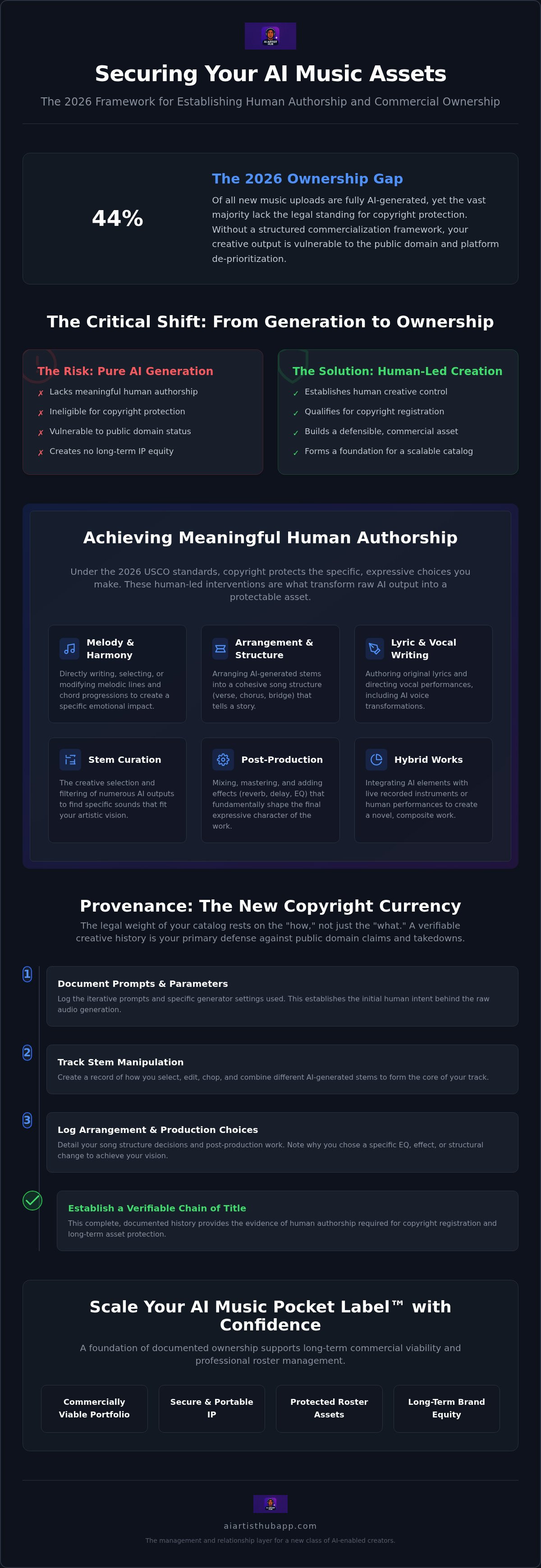
As of April 2026, fully AI-generated tracks represent 44% of all new uploads on platforms like Deezer, yet the vast majority of these assets lack the legal standing to be owned or protected. You recognize that the ability to generate sound isn't the same as the ability to own a catalog. Without a structured AI music commercialization framework, your creative output remains in a legal gray zone, vulnerable to the public domain and platform de-prioritization. You need a way to prove that your human-led decisions, not just an algorithm, drove the creative process.
We understand the frustration of building a professional roster only to face confusion over human authorship requirements. This article delivers the professional frameworks and provenance tools required to document your creative control and secure your AI-enabled music assets. Master the repeatable workflows for ownership verification and manage your digital identities with the same rigor as a traditional record label. We detail the essential infrastructure needed to transform raw synthetic media into a commercially viable, protected portfolio.
Key Takeaways
- Identify the specific expressive elements, such as melody and arrangement, that qualify as meaningful human authorship under the 2026 legal standards.
- Implement a professional AI music commercialization framework to transition from simple generation to owning a defensible catalog of music assets.
- Utilize generator-agnostic provenance tools to document your creative process and ensure your intellectual property remains portable and secure.
- Deploy The Protocol to establish a verifiable creative history, moving your workflow from casual experimentation to structured brand development.
- Scale your AI Music Pocket Label™ by building a foundation of documented ownership that supports long-term commercial viability and roster management.
The 2026 Landscape of AI Music Copyright
The legal environment for synthetic media reached a critical turning point in August 2026. While AI generators provide the capability to produce infinite audio, they don't grant the legal continuity required for commercial ownership. Current standards dictate that human authorship remains the bedrock of copyright protection. This distinction separates professional creators from casual prompt-engineers. You must adopt a professional AI music commercialization framework to transform raw outputs into protected intellectual property. Understanding The 2026 Landscape of AI Music Copyright requires a shift in perspective. You are no longer just a user of software; you are an architect of expressive works that happen to use AI as a tool. Establish your creative authority by focusing on the "Now and Then" precedent. This legal concept protects hybrid human-AI works by identifying the specific moments where your expressive intent overrode the algorithm's randomness. Without an integrated AI music commercialization framework, you risk losing these assets to the public domain.
The Role of the U.S. Copyright Office in 2026
The U.S. Copyright Office (USCO) solidified its stance in the 2026 Part 2 report on AI-generated material. The Office now explicitly accepts registrations for works where humans maintain "sufficient control" over expressive elements. This shift from "AI-created" to "AI-enabled" workflows means your creative decisions, like specific arrangement choices and lyric modifications, are what the law protects. Purely AI-generated material remains ineligible for copyright and sits dangerously in the public domain. You win protection by proving that the AI functioned as a sophisticated instrument rather than the sole author. Align your output with the human-centered doctrine of August 2026 to ensure your roster's assets remain commercially viable.
Why Provenance is the New Copyright Currency
In this high-velocity market, the final audio file is only half the story. The legal weight of your catalog rests on the "how" rather than the "what." Documenting your iterative prompts, stem manipulations, and arrangement logic creates a chain of title that generators cannot provide. This level of detail establishes the human-led narrative required for long-term equity. Professional builders use AI music provenance tracking to maintain a verifiable creative history. This documentation acts as your primary defense against public domain claims and platform takedowns. It's not enough to have a great track; you need a repeatable system that logs every human-led intervention. Secure your creative legacy by moving beyond isolated generation and toward an organized, protocol-driven brand development system. This approach ensures your intellectual property is portable across different platforms and models.
Meaningful Human Authorship: Identifying Your Protectable Expressive Portions
Owning a track requires more than a clever prompt. To build a defensible catalog, you must apply a "filtering" process to separate human-led expressive elements from machine-generated noise. The goal is to isolate the "I did that" moments within a production. This is the core of any professional AI music commercialization framework. You aren't just generating audio; you're architecting a brand. A single prompt doesn't constitute authorship because it lacks the specific creative control required by regulators. Instead, focus on melody, lyrics, and arrangement. These are the primary vehicles for Meaningful Human Authorship. By documenting these interventions, you move from being a user to being a recognized author.
Creative Decisions That Count as Authorship
Authorship resides in the specific choices you make to shape the final output. This includes the selection and arrangement of AI-generated stems into a cohesive song structure. If you take three different generations and manually weave them together to create a specific emotional arc, that arrangement belongs to you. Human-written lyrics and vocal performance "resurrection" or transformation techniques also count toward your ownership claim. Use an Artist Laboratory workspace to develop these assets within a structured environment. Post-production, mixing, and structural changes that alter the expressive output provide the necessary human "fingerprint" that the law recognizes. These actions demonstrate that you are the one steering the creative ship.
The Limits of AI-Generated Content
Purely automated workflows carry a high risk of "insufficient human control." Raw outputs from generators remain in the public domain by default. They are unprotectable because the machine, not the human, made the final expressive choices. You must maintain AI music ownership verification through every iteration of your track. By documenting your specific prompts and subsequent edits, you create a barrier between your work and generic machine outputs. You can explore professional workspaces that help you manage these human-led brand assets effectively. This disciplined approach ensures your assets remain commercially viable and legally defensible. Don't leave your intellectual property to chance; build a record of your creative labor.
Essential AI Music Copyright Protection Tools & Workflows
Professional ownership requires a clear distinction between contractual permissions and federal intellectual property rights. Many creators mistakenly believe a "Pro" subscription on a generation platform equates to legal authorship. It doesn't. A subscription grants you a license to use the output commercially, but it cannot override the federal requirement for human authorship. To secure long-term equity, you must implement a generator-agnostic AI music commercialization framework. This system ensures your assets remain protected even if a specific AI tool faces legal challenges or service disruptions. Building your catalog on independent infrastructure is the only way to maintain control over your creative narrative.
Platform Terms vs. Federal Law
Recent litigation highlights the fragility of relying solely on generator terms. On July 31, 2026, the Regional Court of Munich I ruled against the AI generator Suno, finding it infringed on copyrighted works. Similar high-profile cases from major labels remain pending in the U.S. against Suno and Udio. These events prove that platform-level permissions are secondary to federal law. You need tools that document your specific creative interventions outside of the generator's ecosystem. Relying on a "Pro" badge won't protect you in a courtroom if the underlying model is found to be infringing. Secure your work by focusing on the "how" of your process rather than the "what" of the output.
Registration Strategies for Modern Labels
Managing a growing catalog requires efficient registration workflows. Use the Group Registration for Works on an Album of Music (GRAM) strategy to register up to 20 tracks in a single application. This approach helps manage the 2026 fee increases while establishing a formal public record of your work. Follow the "Keep Your Receipts" rule by documenting every prompt, stem manipulation, and arrangement choice. Professional creators utilize The Protocol to maintain an immutable creative history. This documentation serves as the evidence required for USCO applications and platform verification. Establishing a virtual music label infrastructure allows you to manage these records at scale. By treating your creative history as a business asset, you ensure your AI music commercialization framework supports a portable and defensible brand portfolio.
How to Establish Provenance Using The Protocol
Establishing a Chain of Custody is the definitive line between a casual hobbyist and a professional digital venture. You need a technical workflow that moves beyond the act of isolated generation. By implementing a structured AI music commercialization framework, you organize your creative history into a defensible asset. This process facilitates the transition from raw experimentation to organized brand development. Use the AI Music Pocket Label™ platform to manage your portfolio with the same rigor as a traditional executive. This infrastructure ensures every track you produce is ready for commercialization and withstands the scrutiny of automated detection systems and legal audits. You aren't just making songs; you are building a managed catalog of intellectual property.
Step 1: Documenting the Seed and Iteration
Start your workflow by logging the initial human intent behind every production. This includes the conceptual seeds, specific prompt architectures, and reference materials you provided to the system. Capturing this iterative process within the Artist Laboratory creates a transparent record of your creative labor. Timestamps and version history are critical for verification because they prove the human-led decisions that drove the audio. When you can show a progression of edits, stem selections, and arrangement tweaks, you establish the foundation for authorship. This documentation acts as a digital paper trail that validates your expressive control. It separates your professional work from the 75,000 fully AI-generated tracks uploaded daily to services like Deezer as of early 2026.
Step 2: Verification and Disclosure
Once you've documented the creative process, use the AI Artist Hub™ Protocol for identity and ownership records. This system allows you to verify the human elements of your work and comply with the latest transparency requirements. As of August 2, 2026, Article 50 of the EU AI Act mandates the labeling of synthetic media and machine-readable marking. Spotify now utilizes the DDEX metadata standard for AI song credits, while Apple Music requires Transparency Tags as of March 2026. Having your provenance data organized makes it easy to present this information to distributors. This level of professional rigor ensures your releases meet global delivery requirements and avoid being excluded from personalized recommendations by default.
Secure your creative provenance with The Protocol
Scaling Your AI Music Pocket Label™ with Confidence
Scaling a catalog requires shifting your focus from individual file generation to systematic portfolio growth. A robust AI artist roster management strategy relies entirely on the ownership documentation established in previous stages. Without these records, your label remains a collection of temporary files rather than a portable business. You must ensure your assets are not tied to any single AI generator. This independence allows you to migrate your brand equity as technology evolves. Professional builders use an integrated AI music commercialization framework to maintain continuity across multiple virtual identities. This approach transforms isolated songs into a cohesive, scalable enterprise. Every decision you make should serve the long-term viability of your brand portfolio.
Building Durable Brand Ecosystems
Treat your AI artists as long-term world-building projects. Successful labels in 2026 don't just upload content; they manage complex virtual identities with consistent brand systems and systems thinking. This methodical approach reduces your reliance on borrowed audiences from major streaming platforms. By focusing on brand continuity, you build equity that survives platform algorithm changes or policy shifts. Direct-to-fan hubs allow you to capture and own your relationship with listeners directly. This shift from selling individual tracks to building an ecosystem ensures your business remains resilient. You create a high-utility environment where your creative output serves a larger strategic purpose. Move beyond the song and start building the world around it.
The Future of the AI-Enabled Creator Economy
The industry is moving toward a post-streaming, direct-to-fan commerce model. In this environment, AI Artist Hub™ serves as the essential management layer for creators who value ownership and scalability. You can leverage the AI Artist Marketplace to find new commerce opportunities and expand your reach. Taking control of your creative legacy today means implementing the systems that allow for rapid growth without sacrificing legal protection. Your AI music commercialization framework is the infrastructure that supports this expansion. Start building your portfolio with the confidence that your assets are documented, verified, and ready for global distribution. The tools are ready; the framework is yours to deploy.
Architect Your Future in AI Music
The transition from generating audio to owning a catalog requires a shift in mindset. You've seen that federal protection hinges on meaningful human authorship and a verifiable chain of custody. By documenting your creative decisions outside of the generator's ecosystem, you protect your assets from the public domain. Deploying a professional AI music commercialization framework allows you to move from casual experimentation to owning a defensible, scalable business. It's about creating continuity where raw algorithms only offer capability.
Leverage generator-agnostic infrastructure and Protocol-driven provenance tools to ensure your catalog remains portable. Academy-led business training provides the final piece of the puzzle, giving you the strategic knowledge to manage virtual identities as world-building projects. You don't have to navigate these legal and commercial shifts alone. The tools to secure your creative legacy and build a portable brand portfolio are already within your reach.
Establish your AI Music Pocket Label™ and secure your creative continuity today.
Take control of your creative output and start building your roster with confidence.
Frequently Asked Questions
Can I copyright a song I made entirely with AI prompts?
No, you cannot copyright a song created solely through AI prompts. The U.S. Copyright Office's 2025 guidelines state that protection only extends to works with meaningful human authorship. Works generated entirely by an algorithm are ineligible for copyright and remain in the public domain. To secure ownership, you must integrate significant human creativity into the process. This includes writing original lyrics, arranging specific stems, or performing parts of the track to establish your role as the primary author.
What is meaningful human authorship in the context of AI music?
Meaningful human authorship refers to the specific expressive elements of a track that a human directly controls. This includes writing the lyrics, composing the primary melody, and making final arrangement decisions. In 2026, regulators focus on whether the human or the machine made the expressive choices. Simply clicking a button or entering a generic prompt is insufficient. You must demonstrate that your creative labor dictated the final structure and emotional impact of the work.
Do I need a lawyer to register my AI-assisted music with the USCO?
You don't need a lawyer to register your work, but you do need a structured AI music commercialization framework to document your authorship. The registration process involves disclosing AI usage and identifying the human-led portions of the track. Using professional provenance tools allows you to submit applications with the necessary evidence of creative control. While legal counsel is helpful for complex litigation, most creators manage standard group registrations by maintaining rigorous internal records of their process.
How do I prove I authored the music if I used a generator like Suno or Udio?
You prove authorship by documenting the iterative steps that led to the final audio. Keep records of your initial human-written lyrics, specific prompt architectures, and the manual arrangement of generated stems. Proving you authored the work requires showing a chain of creative decisions that override the machine's random output. Timestamps and version history from your Artist Laboratory workspace provide the necessary evidence to support your claims during the copyright registration or platform verification process.
What tools are available for AI music provenance tracking?
Professional creators use generator-agnostic tools like The Protocol to record their creative history. These systems allow you to log every human intervention, from prompt engineering to final mixing. Unlike built-in platform history, independent provenance tools ensure your records are portable and defensible across different models. This infrastructure is essential for establishing a clear chain of custody. By using these tools, you build a verifiable creative narrative that supports your long-term intellectual property rights.
Will the USCO reject my application if I disclose the use of AI?
The USCO won't reject your application simply because you used AI, provided you disclose it correctly. You must identify which parts of the work were generated by a machine and which parts were authored by a human. The Office specifically looks for sufficient human control over the expressive elements. By being transparent and using an AI music commercialization framework, you align with federal guidelines. This honesty strengthens your registration by clearly defining what you own versus what is machine-generated.
How can an AI Music Pocket Label™ help me manage my copyrights?
An AI Music Pocket Label™ provides the essential infrastructure to manage a growing roster of virtual artists and their associated copyrights. It centralizes your provenance records, identity management, and ownership documentation in one professional environment. This system allows you to treat your creative output as a managed portfolio of assets rather than isolated files. By organizing your workflow through a label framework, you ensure every release is backed by the data needed for commercialization and legal protection.
What happens to my AI music if it is determined to be in the public domain?
If your music is determined to be in the public domain, you lose the exclusive right to control its use. Anyone can legally copy, distribute, or remix the track without your permission or payment. This makes it impossible to stop competitors from using your audio in their own projects or advertisements. To avoid this risk, you must document your human authorship and ensure your creative process meets federal standards for copyright protection before releasing your work.

Article by
Julius J. White (VVS Jules)
Julius J. White (VVS Jules) is the Founder & CEO of JJW AI Studios™ and builder of AI Artist Hub™, a creator-first operating platform for the emerging AI music economy. A musician, songwriter, producer, entrepreneur, and systems builder, he developed the AI Music Pocket Label™ framework around a simple idea: generation is only the beginning. His work focuses on the identity, provenance, credits, ownership context, permissions, artist development, direct-to-fan relationships, commerce, trust infrastructure, and business systems creators need to build durable AI artist brands, organized catalogs, and long-term creative ventures.
Disclaimer
This article is provided for general educational and informational purposes only and does not constitute legal, financial, tax, investment, or other professional advice. Laws, regulations, platform policies, technology, and industry practices may change over time. References to AI Artist Hub™, UP3™, UP3 PLAY™, provenance, verification, ownership assertions, permissions, creator tools, protected media, streaming or platform policies, or AI-related rules describe general information and current product capabilities where verified. They do not constitute government registration, legal adjudication, third-party rights clearance, regulatory approval, copyright ownership, guaranteed authenticity, or guaranteed permission for commercial use. Readers should independently verify current requirements, review applicable platform and rights terms, and consult qualified professionals when appropriate.
