


What if your most successful virtual artist was flagged for a takedown tomorrow because you couldn't verify the origin of its sound? Most creators treat generation as a high-stakes lottery, but professional scalability requires a rigorous AI music chain of custody to protect your creative assets. You likely feel the friction between rapid output and the growing anxiety surrounding future licensing requirements. It's a significant hurdle for founders who want to move beyond simple prompting and toward building a legitimate, durable catalog.
Establishing a verifiable creative history is the essential management layer that transforms isolated capability into artist continuity. This guide provides the strategic framework to implement a professional workflow, helping you evolve from a casual user into the head of an AI Music Pocket Label™. We'll walk through the specific steps to document artist development within the Artist Laboratory, ensuring your virtual identities are supported by the provenance records needed for direct-to-fan sales and marketplace readiness. You'll gain a clear roadmap for managing multiple identities with the precision and discipline of a visionary architect.
Key Takeaways
- Understand why provenance is the essential layer that transforms isolated generations into a durable AI Music Pocket Label™.
- Learn to establish a rigorous AI music chain of custody by tracking both training-time data and specific inference-time inputs.
- Discover how the Protocol provides a standardized framework for identity and disclosure that traditional metadata cannot support.
- Use the Artist Laboratory to capture metadata at the point of creation, ensuring every asset in your roster is verifiable.
- Prepare your catalog for the AI Artist Marketplace by building a provenance-ready infrastructure that fosters public trust.
The Critical Role of Provenance in AI Music Businesses
Generative tools provide the capability to create sound, but they don't provide the continuity required to build a brand. While a single prompt can generate a track, it remains an isolated event without a documented history. For creators aiming to scale, the focus must shift from the act of generation to the management of an AI music chain of custody. This structural discipline is what separates a hobbyist from a professional operator of an AI Music Pocket Label™.
Provenance is the record of an asset's origin and its journey through the creative process. In the emerging digital economy, this data is the foundation of creator equity. Without a verifiable history, your virtual artists exist in a vacuum, vulnerable to platform instability and licensing hurdles. Establishing a clear record-keeping system ensures that your catalog isn't just a collection of files, but a portfolio of commercially viable assets ready for direct-to-fan commerce and marketplace interest.
Moving Beyond Random Generation
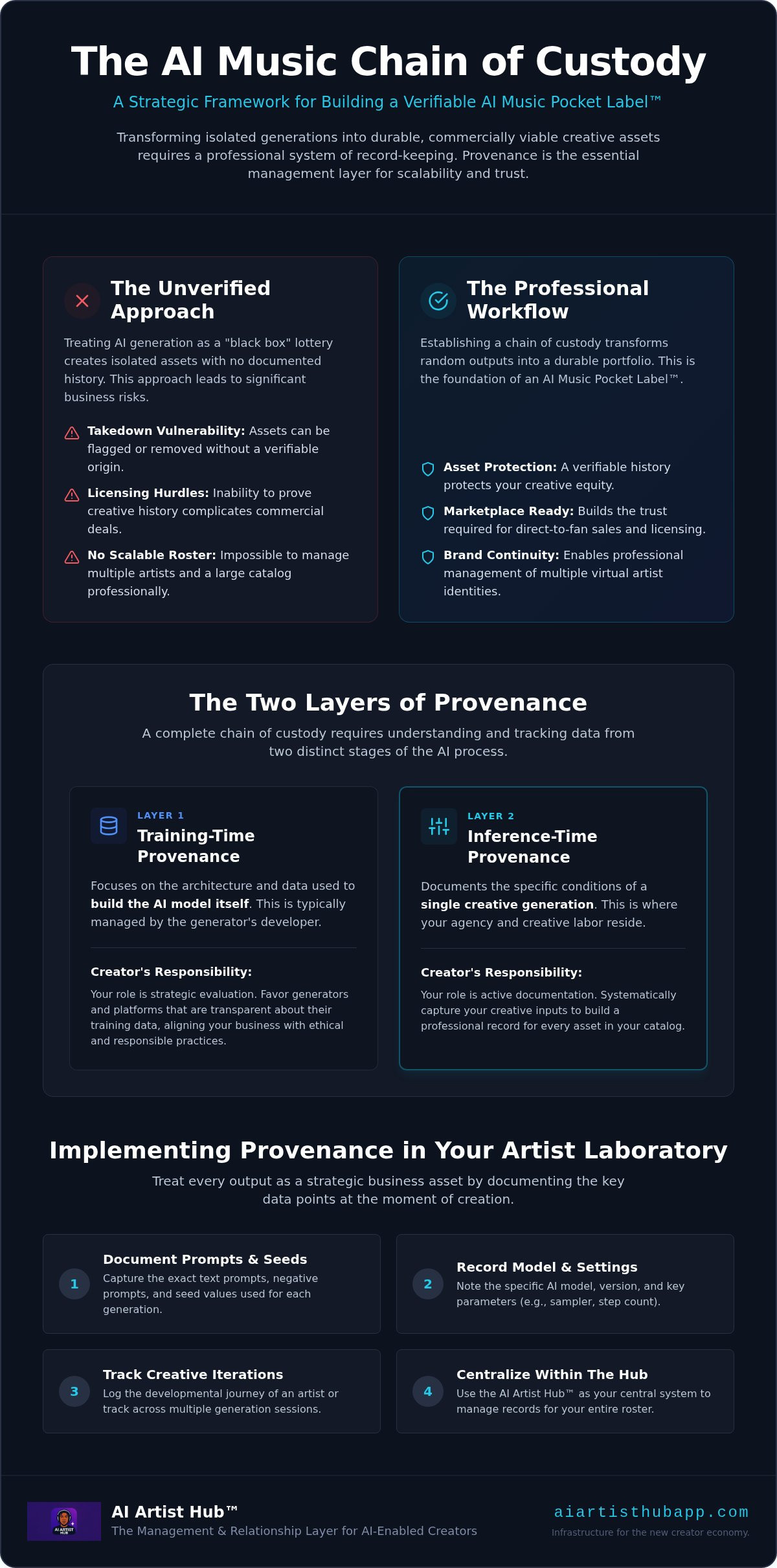
Professional labels don't rely on luck; they rely on systems. Most creators currently treat AI as a "black box" lottery, where success is found through volume rather than development. Transitioning into the Artist Laboratory means treating every output as a strategic business asset. Documentation is the key. When you record the specific inputs, model versions, and iterative steps of a virtual artist's development, you create a durable creative identity. Poor record-keeping is expensive. It leads to confusion during licensing discussions and makes your roster nearly impossible to manage at scale. By contrast, a documented workflow allows you to maintain brand continuity across hundreds of tracks and multiple virtual personas.
Establishing Public Trust and Industry Alignment
Transparency is the most effective tool for navigating industry friction. We maintain deep respect for traditional musicians and acknowledge that the future of music depends on clear attribution and disclosure. By documenting your AI-native creative processes, you position your label as a responsible participant in the broader creator economy. This isn't about replacing human artistry; it's about providing the tools for a new class of creators to operate with integrity. Utilizing the Protocol for identity and verification helps address industry concerns regarding training data and consent. This proactive approach to transparency builds the trust necessary for long-term audience relationships and sustainable licensing deals. It ensures that your business is built on a foundation of clarity rather than ambiguity.
Training-Time vs. Inference-Time Provenance: A Creator's Guide
Understanding the two distinct layers of provenance is essential for any founder managing a virtual roster. Training-time provenance focuses on the architecture and the data used to build the model itself. Inference-time provenance documents the specific conditions of a single generation. While the industry often debates the former, the latter is where your agency as a creator resides. Establishing a robust AI music chain of custody requires you to bridge these two worlds, ensuring that every song in your catalog has a verifiable origin story.
The Importance of Inference-Time Attribution
Inference-time tracking is the most actionable tool for creators today. It provides the evidence of your creative labor. When you document prompts, seed values, and model settings, you aren't just saving data; you're building a professional creative record. This paper trail is vital for every release under your AI Music Pocket Label™. Inference-time provenance is the documentation of specific creative choices. By systematically capturing these details, you ensure that your virtual artists have a consistent and documented evolution. This level of detail is exactly what facilitates trust when you're ready to explore the marketplace for new opportunities.
Navigating Training-Time Transparency
Navigating training-time transparency involves a strategic evaluation of the tools you integrate into your workflow. As a founder, you should favor generators that disclose their training data origins. This choice reflects your commitment to business ethics and long-term industry alignment. Supporting generator-agnostic platforms allows you to maintain high standards regardless of which specific AI model you use. It's about building a business that respects the contributions of traditional musicians while securing your own brand's future. Transparency in training data helps you avoid the "black box" trap, positioning your label as a leader in the responsible use of technology. Within the Artist Laboratory, you can manage these records to ensure your entire roster remains compliant with emerging standards.
Modern Standards for AI Music Identity and Verification
Traditional metadata fails the modern creator. Standard ID3 tags simply can't document the iterative prompting, model weights, or specific seed values that define a virtual artist's output. To build a scalable business, you must implement a system that captures the entire AI music chain of custody at the point of creation. This documentation moves far beyond simple file labeling. It creates a comprehensive identity record that establishes trust with fans, distribution platforms, and potential licensees.
The Protocol Framework for Trust
The AI Artist Hub™ Protocol provides the essential architecture for this new era. It functions as a standardized framework for identity, credits, and disclosure. By utilizing these records, you ensure every track in your roster carries a verifiable creative history. Consistent disclosure is a massive competitive advantage in the 2026 marketplace. It signals to partners that your label operates with professional discipline and transparency. This level of organization allows your virtual artists to develop a recognizable brand voice that isn't tied to a single generator. Learn more about the AI Artist Hub™ Protocol to see how it structures identity for the emerging economy.
Verification Signals vs. Legal Claims
Verification tools provide the evidence of your creative agency, but they don't serve as a substitute for legal advice or guaranteed copyright registration. It's vital to understand this distinction. Our infrastructure is designed to help you document the "human in the loop" elements that define your unique sound. While the legal landscape for AI music continues to evolve, having a clear record of your creative choices facilitates commercial activity. It provides the tools for you to navigate licensing discussions with a high degree of professional clarity. You aren't claiming immutable ownership; you're providing the transparency required for professional relationships.
Building a Virtual Artist Profile that carries its own creative history is the final step in establishing brand continuity. This profile acts as a living resume for your digital talent. It aggregates every verified generation, prompt sequence, and brand asset into a single, cohesive identity. This systematic approach ensures that your roster remains an asset you can manage and grow over the long term. You aren't just making songs; you're developing identities that fans can follow and support across multiple platforms. This framework transforms isolated capability into a sustainable business model.
How to Implement Provenance Tracking in Your Artist Laboratory
The Artist Laboratory is where the theoretical concept of provenance becomes a practical business workflow. It's the infrastructure that allows you to manage a complex AI music chain of custody without drowning in data. Effective tracking starts the moment you click "generate." By establishing a systematic approach within The Lab, you ensure that every track released under your AI Music Pocket Label™ is backed by a verifiable creative history. This rigor is what prepares your assets for high-value opportunities in the AI Artist Marketplace.
Documentation at the Point of Generation
Every session in the Artist Laboratory must be documented with precision. You don't just save the audio file; you save the creative context that produced it. This practice protects your brand continuity by allowing you to recreate or iterate on specific sounds with consistency. Timestamping your milestones within The Lab proves development over time, showing a clear evolution of the artist's voice. Follow these steps to secure your inference data for every track:
- Export the final audio file and name it using your label's standardized naming convention.
- Create a corresponding metadata sidecar file that includes the generator name and specific version number.
- Log the exact prompt sequence, seed values, and any parameter settings used during the session.
- Associate this record with the unique identifier of your virtual artist to maintain a clean roster history.
Organizing Roster Assets for Scalability
Managing a portfolio of virtual identities requires architectural discipline. Your Artist Laboratory should serve as the central repository for all provenance records, making your business operations portable and scalable. When you centralize these records, you can manage multiple rosters with the same efficiency as a single artist. This structure ensures that your brand portfolio remains organized even as your catalog grows into the thousands.
Organize your roster in the Artist Laboratory
Rigorous documentation is the prerequisite for marketplace readiness. Buyers and fans in the AI music economy look for signals of professional management and creative integrity. By maintaining a detailed history of your virtual artists, you provide the evidence of labor and agency that defines a premium brand. This systematic organization transforms a folder of random generations into a professional, commercial-ready catalog.
Scaling Your Business with AI Artist Hub™ Infrastructure
Scale your virtual roster by transitioning from a solo creator mindset to a systems-oriented founder. The AI Music Pocket Label™ thesis provides the essential framework for this evolution, allowing small teams to manage global-scale catalogs with significant software leverage. This discipline centers on a rigorous AI music chain of custody, ensuring that every growth phase is backed by verifiable data. By utilizing the Artist Laboratory, you move beyond the limitations of manual file management and into a high-utility operating environment. Professional business suites enable you to oversee multiple virtual identities with the same precision as a single artist, creating a scalable infrastructure for your digital venture.
Marketplace Readiness and Commerce
Build trust as the primary currency of the new music economy. When you explore the AI Artist Marketplace, you'll notice that successful virtual artists share a common trait: transparency. Clear provenance records reduce friction for buyers and licensees because they provide the necessary context for professional collaboration. These records transform a simple audio file into a commercial-grade asset. Verified artist identities also allow you to bypass traditional gatekeepers and establish direct-to-fan relationships. Fans value the documented journey behind the sound. By providing evidence of your creative history, you turn a passive listener into an active supporter of your brand's development and long-term continuity.
Future-Proofing Your Creative Venture
Future-proof your creative venture by preparing for shifting regulatory standards. Founder-led labels prioritize infrastructure today to avoid the "black box" risks of tomorrow. Maintaining high-fidelity records is the most effective way to adapt to new industry requirements as they emerge. Our platform provides the tools for you to establish these records at the point of creation, ensuring your venture remains resilient. For a deeper look at these requirements, consult our AI Music Ownership Verification Guide for Creators. Investing in identity and trust allows you to build a lasting legacy that outlives temporary trends. You're architecting the future of the music industry by focusing on commercial continuity and documented creative agency.
Architect Your Legacy in the AI Music Economy
Transitioning from a casual creator to a strategic founder requires more than just high-quality generation. It demands a professional AI music chain of custody that documents your creative labor and secures your brand's future. By implementing the creator-centered Protocol and utilizing professional Artist Laboratory workspaces, you establish the trust necessary for commercial scalability and marketplace readiness.
Our generator-agnostic infrastructure provides the tools to manage complex rosters with the discipline of a traditional label while leveraging modern software efficiency. You've seen how documenting inference-time choices transforms isolated tracks into a durable, verifiable catalog. This systematic approach ensures that your virtual artists maintain brand continuity across every release, allowing you to scale without sacrificing the integrity of your sound. Now it's time to lead the industry with transparency and intent.
Establish your AI Music Pocket Label™ and start tracking provenance today
Take control of your virtual artist identities and build a venture that lasts. Your path toward professional artist development and long-term business equity starts with clear records and a visionary mindset.
Frequently Asked Questions
What is AI music provenance tracking?
AI music provenance tracking is the systematic documentation of a track's creative history, from initial model inputs to final refinements. It creates a verifiable record of how a sound was developed, providing the continuity needed to scale a virtual roster. By maintaining an AI music chain of custody, creators transform isolated generations into professional business assets. This process ensures that every virtual artist in your portfolio has a documented identity that partners and fans can trust.
How does provenance differ from copyright?
Provenance focuses on providing evidence of the creative process, while copyright is a legal status determined by government authorities. Tracking provenance documents your agency and iterative labor as a creator, which is essential for commercial transparency. It doesn't guarantee legal protection or ownership rights. Instead, it provides the structural records necessary to facilitate licensing discussions and demonstrate your role as the "human in the loop" throughout the artist development phase.
Is provenance tracking mandatory for AI artists?
Provenance tracking isn't currently a legal requirement, but it's a commercial necessity for anyone operating an AI Music Pocket Label™. Platforms and marketplaces are increasingly prioritizing transparency regarding synthetic media. Establishing a clear AI music chain of custody today prepares your business for future regulatory shifts and licensing standards. Founders who prioritize documentation now gain a significant competitive advantage by building rosters that are inherently more verifiable and marketplace-ready than undocumented catalogs.
Can provenance tracking help with platform takedowns?
Yes, maintaining detailed provenance records provides the evidence needed to challenge automated platform takedowns. When you can prove the specific creative steps, model parameters, and iterative development of a track, you demonstrate professional intent. These records show that your music isn't a "black box" generation but a managed creative output. While it doesn't offer a legal guarantee, having a paper trail from the Artist Laboratory makes you a more credible participant in any dispute.
Does AI Artist Hub™ provide legal ownership of music?
AI Artist Hub™ provides tools for verification and record-keeping, but we don't grant or guarantee legal ownership or copyright. Our infrastructure is designed to help you document your creative journey and establish trust within the industry. Legal ownership depends on evolving regulations and your specific use of generative tools. We focus on providing the essential management layer that enables you to organize and commercialize your virtual roster with professional discipline and clarity.
What data should I include in my provenance records?
Include every technical and creative variable that contributed to the generation, such as model versions, specific prompt sequences, and seed values. You should also record timestamps of creative milestones within the Artist Laboratory to show development over time. Documenting these "inference-time" details creates a robust record of your creative labor. This granular data ensures that your virtual artist's voice remains consistent across releases and provides the transparency required for professional marketplace listings.
How do fans benefit from AI music provenance?
Fans benefit from the transparency and authenticity that provenance records provide. In a digital economy where synthetic content is abundant, verified artist identities help listeners build deeper relationships with virtual performers. Provenance allows fans to see the human agency behind the technology, fostering a sense of connection rather than confusion. By sharing the creative history of your roster, you invite your audience to support a brand that prioritizes integrity and long-term continuity.
Can I use provenance tracking with any AI music generator?
Yes, our infrastructure is generator-agnostic, allowing you to track provenance regardless of the specific AI tools you use. This flexibility ensures that your business continuity isn't tied to a single platform or model. You can manage multiple virtual identities and catalogs within the Artist Laboratory, utilizing our human-centered Protocol to standardize your records. This approach provides the tools for you to build a resilient roster that can adapt to new technology while maintaining professional standards.

Article by
Julius J. White (VVS Jules)
Julius J. White (VVS Jules) is the Founder & CEO of JJW AI Studios™ and builder of AI Artist Hub™, a creator-first operating platform for the emerging AI music economy. A musician, songwriter, producer, entrepreneur, and systems builder, he developed the AI Music Pocket Label™ framework around a simple idea: generation is only the beginning. His work focuses on the identity, provenance, credits, ownership context, permissions, artist development, direct-to-fan relationships, commerce, trust infrastructure, and business systems creators need to build durable AI artist brands, organized catalogs, and long-term creative ventures.
Disclaimer
This article is provided for general educational and informational purposes only and does not constitute legal, financial, tax, investment, or other professional advice. Laws, regulations, platform policies, technology, and industry practices may change over time. References to AI Artist Hub™, UP3™, UP3 PLAY™, provenance, verification, ownership assertions, permissions, creator tools, protected media, streaming or platform policies, or AI-related rules describe general information and current product capabilities where verified. They do not constitute government registration, legal adjudication, third-party rights clearance, regulatory approval, copyright ownership, guaranteed authenticity, or guaranteed permission for commercial use. Readers should independently verify current requirements, review applicable platform and rights terms, and consult qualified professionals when appropriate.
