


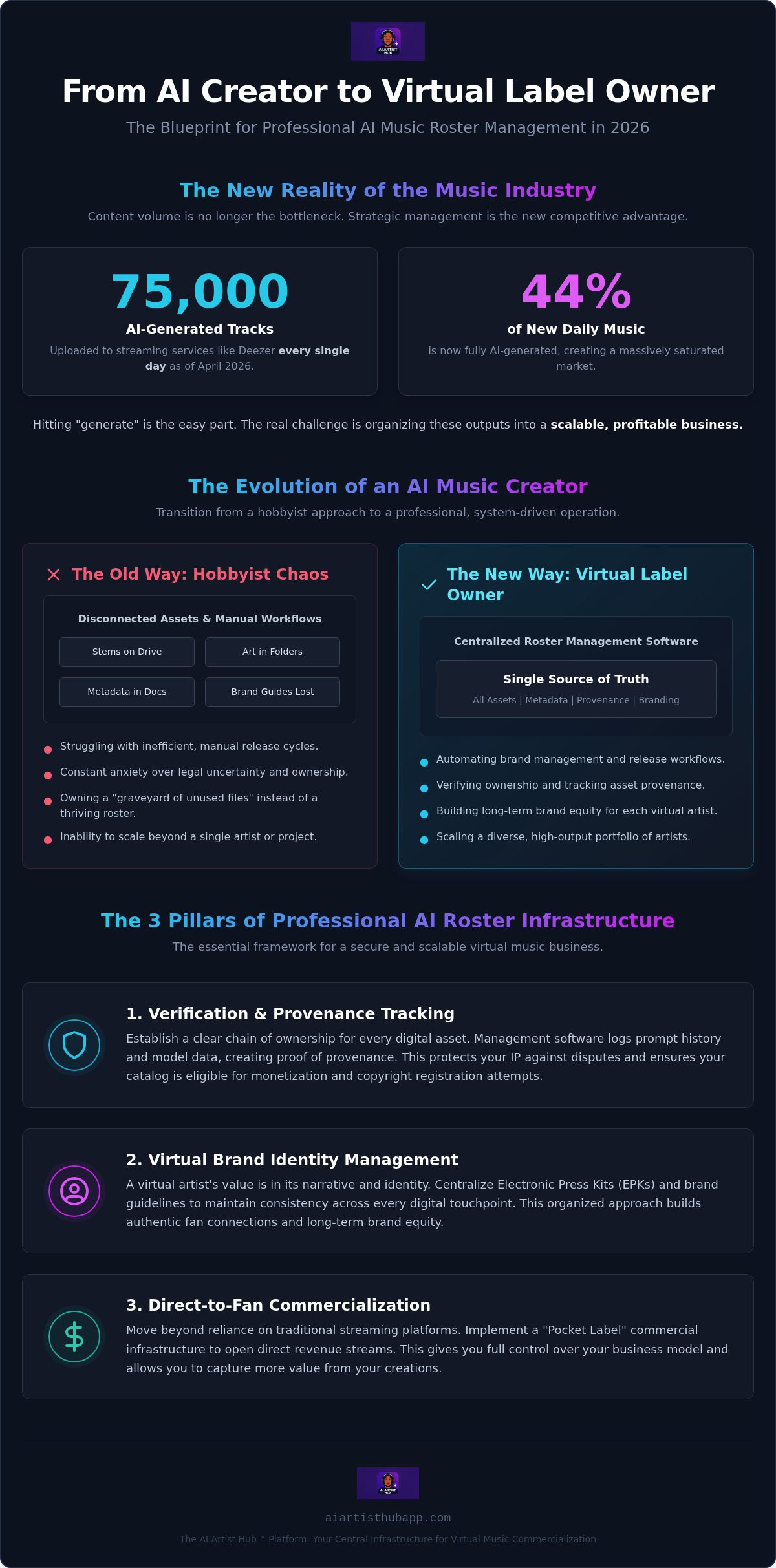
As of April 2026, 44% of new daily music uploads to streaming services like Deezer are fully AI-generated, totaling roughly 75,000 tracks every single day. While the ability to create music is now universal, the ability to manage a profitable portfolio of virtual talent remains rare. Most creators find themselves buried under a mountain of digital assets, struggling with inefficient manual workflows and the constant anxiety of legal uncertainty regarding ownership. You've likely realized that hitting "generate" is the easy part; the real challenge lies in organizing these outputs into a professional, scalable business. To succeed, you must move beyond scattered folders and adopt dedicated AI artist roster management software that acts as your central infrastructure.
This article provides the blueprint for transitioning from casual AI music generation to professional roster commercialization. We'll show you how to implement a virtual label framework that verifies ownership of your assets and automates brand management. You will learn to streamline your release cycles and open direct-to-fan revenue streams that bypass traditional industry gatekeepers. It is time to stop acting like a hobbyist and start operating as a visionary architect of the new music economy.
Key Takeaways
- Shift your focus from simple AI music generation to building long-term brand equity through professional management systems.
- Implement dedicated AI artist roster management software to centralize your digital assets and eliminate the chaos of manual release workflows.
- Establish a secure foundation with verification and provenance tools that protect your virtual artist brands and verify asset ownership.
- Unlock direct-to-fan revenue streams by moving beyond streaming platforms and utilizing a dedicated "Pocket Label" commercial infrastructure.
- Deploy the Artist Laboratory model to scale your operations from a single project to a diverse, high-output portfolio of virtual artists.
Beyond Generation: Why You Need AI Artist Roster Management Software
The music industry is entering a phase where content volume is no longer the bottleneck. With tens of thousands of tracks hitting platforms daily, the competitive advantage has shifted from those who can generate audio to those who can build and scale virtual brands. AI artist roster management software provides the necessary business infrastructure to transform a collection of digital files into a high-value portfolio. This isn't just about storage; it's about establishing a framework for virtual music brands to operate with the same strategic depth as legacy labels.
Transition from simply making AI songs to actively managing AI artist equity. In the traditional music business, Artists and repertoire (A&R) focuses on talent discovery and development. In the virtual space, you are the architect of that talent. Every virtual artist you create represents a distinct intellectual property (IP) asset with its own brand voice, visual identity, and audience demographic. Without a centralized system to track these variables, you risk owning a graveyard of unused files rather than a thriving roster of commercial entities.
The Evolution from Creator to Virtual Label Owner
By 2026, the market has matured beyond the novelty of AI generation. Success now requires a business-first approach where you view your creative outputs as a scalable enterprise. Creative tools like generators are designed for the moment of creation, but they offer zero utility for long-term brand operations. A dedicated management suite bridges this gap, allowing you to treat your AI artists as serious business units. It's the difference between a bedroom hobbyist and a virtual label owner who controls the entire value chain through structured, professional systems.
Managing the Virtual Lifecycle
Managing a single AI artist is manageable; managing twenty is a logistical nightmare without automation. Traditional CRM tools and project management software fail because they aren't built for AI-specific metadata, such as prompt histories, model seed values, or provenance logs. You need a unified dashboard that tracks the virtual lifecycle from initial concept to marketplace release.
The primary pain point for modern creators is the chaos of disconnected assets. When your stems are on one drive, your brand guidelines in a document, and your distribution metadata in a spreadsheet, you cannot scale. AI artist roster management software solves this by consolidating every operational layer into a single source of truth. Use these systems to ensure that every release is consistent, every asset is verified, and every brand stays on track for commercial growth. This organized architecture is the only way to move from experimental creation to a sustainable, revenue-generating business model.
The 3 Pillars of Professional AI Roster Infrastructure
Scaling a virtual label in 2026 demands more than just a high volume of tracks. It requires a resilient technical foundation that ensures every asset is secure, verifiable, and brand-consistent. Without this structural integrity, your roster remains a collection of files rather than a professional business. If you are just beginning, review our guide on how to start an AI music label to establish your foundational setup before implementing these advanced pillars.
Verification and Provenance Tracking
Establish a clear chain of ownership for every digital asset in your portfolio. As regulations evolve, the ability to prove human creative direction is vital for commercial viability. Current U.S. Copyright Office guidance on AI emphasizes the need for significant human authorship, making detailed logs essential for registration attempts. High-tier AI artist roster management software captures the full "Artist Laboratory" history of a track, including prompt iterations and model parameters. This metadata serves as your proof of provenance, protecting your IP against ownership disputes and ensuring your catalog remains eligible for professional monetization. Data is equity.
Virtual Brand Identity Management
Maintain consistency across every digital touchpoint to build authentic fan connections. A virtual artist's value lives in its narrative and visual identity, not just the audio output. Centralize your Electronic Press Kits (EPKs) and brand guidelines within a unified system to prevent identity drift. This approach allows you to manage the narrative arc of multiple AI personas simultaneously without losing the specific voice that defines each brand. When you treat your roster as a series of distinct IP entities, you create the social proof necessary for long-term audience growth.
Secure Data Architecture
Protect your competitive advantage by implementing a secure data architecture. Professional suites now utilize private data silos to house proprietary training data and model weights, preventing IP leakage. Enterprise-grade AI artist roster management software often supports a "Bring Your Own LLM" model, ensuring that your unique creative workflows remain entirely under your control. Systems drive growth. By isolating your data, you mitigate the risk of third-party platforms training on your assets without your consent. Secure your creative future by choosing tools that prioritize data sovereignty and strategic security. Explore how to secure your virtual assets using advanced infrastructure designed for modern labels.
Comparing Management Suites: Enterprise vs. AI-Native
Choosing the right tech stack determines your label's ability to scale. Many creators start with general project management tools like Monday.com or Trello, but these systems quickly collapse under the weight of AI-specific needs. While enterprise software excels at tracking human tasks and deadlines, it lacks the specialized fields required for virtual brand equity. AI artist roster management software is built specifically to handle high-volume music assets, provenance logs, and automated release pipelines that traditional suites ignore. Systems drive growth; generic tools often create bottlenecks.
The primary differentiator lies in how these systems handle the "Direct-to-Fan" commercialization gap. General tools treat a music file as a simple project attachment. In contrast, AI-native suites treat it as a liquid asset ready for the marketplace. This distinction is critical when managing a portfolio of ten or more artists. Manual organization in a general suite becomes a significant labor sink, whereas AI artist roster management software uses automated label pipelines to ensure every track is properly tagged, verified, and ready for revenue generation.
Operational Efficiency and Workflow Automation
Automate your label operations to maximize output without increasing your team's headcount. High-volume roster management requires business intelligence that tracks virtual artist growth across multiple platforms simultaneously. AI-native suites replace manual spreadsheet updates with dynamic dashboards that reflect real-time performance. This structural efficiency allows you to focus on strategic development rather than administrative busywork. When you move beyond manual release management, you unlock the ability to scale your roster infinitely, maintaining strict organization without the overhead of traditional label staff.
Monetization and Marketplace Integration
Turn your management dashboard into a functional storefront. Traditional enterprise software requires third-party integrations to sell products, often leading to a fragmented customer experience and heavy platform taxes. AI-native infrastructure integrates direct-to-fan digital product sales into the core management workflow. This allows you to sell stems, preset packs, or exclusive tracks directly from your artist profiles. By owning the fan relationship, you eliminate intermediaries and increase your profit margins.
Establishing commercial rights is the first step toward professional monetization. Referencing the U.S. Copyright Office guidance on AI is essential for understanding the legal landscape of these digital products. Professional suites ensure that your asset sales are backed by robust provenance tracking, giving buyers confidence in the ownership and usage rights of the virtual products they purchase. This integrated marketplace access transforms your roster from a creative experiment into a diversified revenue engine.
How to Implement Your AI Music Pocket Label™ System
Implementing a professional infrastructure is the definitive step in moving from creative experimentation to commercial scale. The AI Music Pocket Label™ system provides a modular framework designed to manage every operational layer of your virtual talent. By adopting this structured approach, you ensure that every asset created is categorized, protected, and positioned for maximum market impact. Successful implementation requires moving beyond the "one-off song" mentality and embracing a systematic pipeline for brand development.
Step 1: Establishing the Artist Laboratory
Configure the Artist Laboratory as the fundamental operational unit for each virtual persona in your portfolio. This isn't just a folder; it is a dedicated environment within your AI artist roster management software where brand identity and technical data converge. Start by establishing strict brand guidelines, including visual aesthetic, vocal characteristics, and narrative history. This ensures that every piece of content generated remains true to the artist's established identity.
Organize your provenance data before the first release hits the market. By logging model parameters, seed values, and prompt histories within the laboratory, you build a verified foundation for your intellectual property. This preparation ensures that when you scale from one artist to a roster of fifty, the structural integrity of each brand remains intact. A well-configured laboratory allows you to manage the specific "DNA" of each AI artist, ensuring consistency across every future output and providing proof of authorship for legal protection.
Step 2: Automating the Release and Marketing Pipeline
Transition from managing individual tracks to overseeing a structured release pipeline. Use automated release management tools to schedule multi-platform drops, ensuring your content reaches your target audience without manual intervention. This efficiency is the core benefit of specialized AI artist roster management software, which handles the logistical heavy lifting of distribution metadata and cross-platform scheduling. Automation allows you to maintain a high-frequency release schedule, which is vital for staying relevant in a fast-paced digital market.
Integrate audience-growth marketing tools to build social proof and scale your fan base. Automation allows you to deploy marketing assets across various channels simultaneously, maintaining the narrative arc of your virtual characters. Monitor real-time analytics across your entire roster to identify which artists are gaining traction. This data-driven approach lets you allocate resources strategically, doubling down on high-performing brands while refining those that need more development. Systems create freedom. Deploy your AI Music Pocket Label™ today to start scaling your virtual roster with professional-grade infrastructure.
Scaling Your Virtual Business with AI Artist Hub™
Deploy the full power of a virtual music empire with AI Artist Hub™. While general project tools leave you managing scattered folders and endless spreadsheets, our platform provides the definitive infrastructure for scaling a modern roster. This AI artist roster management software is built specifically for the high-tech, high-utility environment of 2026. It integrates management, verification, and commercialization into a single, cohesive ecosystem. Stop acting like a casual curator and start operating as a visionary architect of your own virtual label.
The All-in-One Infrastructure for AI Labels
Centralize your operations using the trademarked AI Music Pocket Label™ infrastructure to handle the complex layers of digital ownership and asset security. Every track moving through your Artist Laboratory is backed by integrated verification and provenance tools, creating a permanent record of human creative direction. This documentation is essential for commercializing your portfolio in the AI Artist Marketplace. Beyond basic management, you gain access to comprehensive creator education and business training. These resources are designed to guide you through the process of scaling from a single experimental project to a professional roster of 100+ virtual artists. Systems create scalability. Professional infrastructure creates long-term wealth.
Own the Fan Relationship
Own the fan relationship by prioritizing direct-to-fan sales over traditional streaming dependency. In a market where 97% of listeners can no longer distinguish between human and AI-generated music, the value lies in the brand and the direct connection to the audience. While streaming accounts for the majority of industry revenue, it often creates a fragmented relationship between the creator and the consumer. AI Artist Hub™ provides the tools for direct-to-fan music and digital product sales, allowing you to capture maximum margins. Build long-term equity in your virtual artist brands by controlling the storefront and the data. Launch your venture on a foundation of strategic development rather than third-party platform reliance.
Take control of your digital future and move beyond the limitations of manual workflows. Establish a professional business suite that treats your creativity as a serious commercial enterprise. Ready to build? Launch your AI Music Pocket Label™ today and transform your creative output into a professional, revenue-generating business suite.
Architect Your Virtual Legacy Today
The shift from casual creation to professional roster management is the definitive move for any serious virtual label owner. By establishing a robust Artist Laboratory and prioritizing provenance tracking, you move beyond scattered assets and build legitimate brand equity. High-performance AI artist roster management software provides the essential infrastructure to automate release cycles and protect your intellectual property at scale. You now have the blueprint to transition from a single track to a diversified portfolio of virtual talent.
AI Artist Hub™ offers the first comprehensive business suite for virtual labels, featuring integrated verification tools and a direct-to-fan marketplace for your assets. Don't let your creative output remain disorganized or legally vulnerable. Take control of your commercial future and build a system that works as hard as your imagination. The industry is evolving quickly, and those who own the infrastructure will own the future.
Start Building Your AI Music Pocket Label™ Today and secure your position as a leader in the next generation of the music industry. The tools are ready; the architecture is built. It's time to launch your empire.
Frequently Asked Questions
What is AI artist roster management software?
AI artist roster management software is the specialized business infrastructure used to organize, verify, and commercialize virtual music brands. It replaces scattered digital folders with a centralized dashboard that tracks brand identity, provenance data, and release schedules. This system acts as the operational backbone for a modern virtual label, ensuring every digital asset is positioned for maximum market impact through structured, professional systems.
Do I need special software if I only have one AI artist?
Use professional systems even for a single artist to establish a scalable foundation. Starting with the right architecture prevents the logistical chaos that occurs when you transition from one project to ten. It allows you to implement the Artist Laboratory model immediately, ensuring your first brand has the same structural integrity and verification history as a massive professional roster.
How does roster software help with AI music copyright?
Roster software provides the provenance tracking necessary to prove human creative direction. Current legal standards require evidence of substantial human authorship for copyright protection. By logging prompt histories, model parameters, and iteration logs, the software creates a verified audit trail. This documentation supports your ownership claims and is essential for meeting the transparency requirements of major streaming platforms and marketplaces.
Can I manage both human and AI artists in one platform?
You can manage multiple artist types, but specialized AI artist roster management software offers features that traditional human management tools lack. These platforms are optimized for AI-specific metadata and virtual brand assets. While general tools focus on tour logistics and physical contracts, AI-native suites prioritize data sovereignty and automated digital release pipelines essential for scaling virtual talent.
What is the difference between a music generator and a management platform?
Generators are creative tools for audio output, while management platforms are operational ecosystems for business growth. A generator creates a song; a management suite builds an artist's career. You need the management layer to handle the verification, marketing, and commercialization tasks that creative tools aren't designed to perform. One provides the content, the other provides the commercial infrastructure.
Is my AI training data safe in these management suites?
Professional management suites prioritize data security through private silos and enterprise-grade architecture. These systems ensure that your proprietary training data and model weights remain your exclusive property. By using a secure infrastructure, you prevent IP leakage and protect the unique creative DNA that gives your virtual roster its competitive edge. This architecture ensures your assets aren't used to train competing models.
How much does professional AI label software typically cost?
Industry pricing for management suites typically follows a tiered subscription model based on roster size and feature access. Basic tiers often cater to solo creators, while professional passes provide the advanced automation and multi-workspace support needed for growing labels. Enterprise levels offer custom solutions for large-scale operations. This structure allows you to scale your software costs in direct proportion to your business growth.
Can I sell my AI artist assets directly through the management software?
Yes, integrated marketplaces allow you to sell digital assets directly to your audience. This direct-to-fan model lets you monetize stems, preset packs, and exclusive audio without the heavy platform taxes found on traditional streaming services. By owning the storefront, you capture higher margins and build a more sustainable revenue stream. This approach turns your management dashboard into a functional revenue engine.

Article by
Julius J. White (VVS Jules)
Julius J. White (VVS Jules) is the Founder & CEO of JJW AI Studios™ and builder of AI Artist Hub™, a creator-first operating platform for the emerging AI music economy. A musician, songwriter, producer, entrepreneur, and systems builder, he developed the AI Music Pocket Label™ framework around a simple idea: generation is only the beginning. His work focuses on the identity, provenance, credits, ownership context, permissions, artist development, direct-to-fan relationships, commerce, trust infrastructure, and business systems creators need to build durable AI artist brands, organized catalogs, and long-term creative ventures.
Disclaimer
This article is provided for general educational and informational purposes only and does not constitute legal, financial, tax, investment, or other professional advice. Laws, regulations, platform policies, technology, and industry practices may change over time. References to AI Artist Hub™, UP3™, UP3 PLAY™, provenance, verification, ownership assertions, permissions, creator tools, protected media, streaming or platform policies, or AI-related rules describe general information and current product capabilities where verified. They do not constitute government registration, legal adjudication, third-party rights clearance, regulatory approval, copyright ownership, guaranteed authenticity, or guaranteed permission for commercial use. Readers should independently verify current requirements, review applicable platform and rights terms, and consult qualified professionals when appropriate.
