


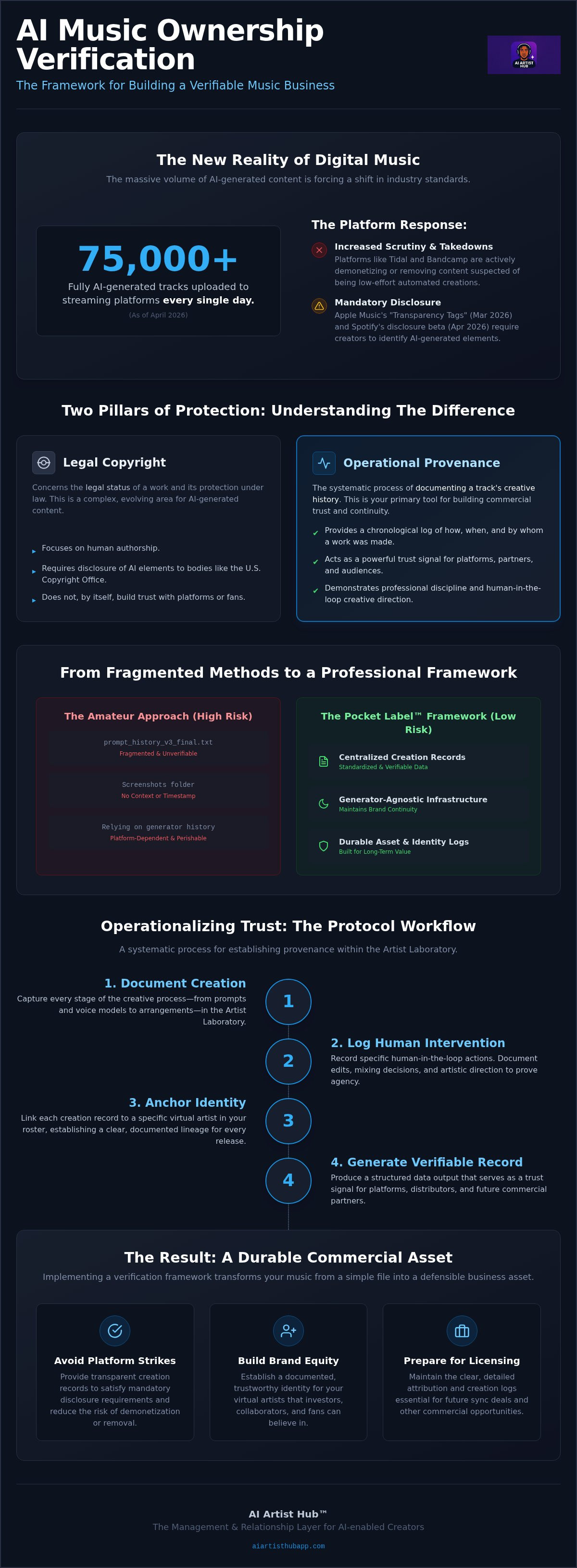
As of April 2026, over 75,000 fully AI-generated tracks are uploaded to streaming platforms every single day. This massive volume has triggered a shift in the industry, with platforms like Tidal and Bandcamp now demonetizing or removing content based on the mere suspicion of automated creation. You've likely felt the anxiety of this new environment, wondering if your virtual artist's next release will be flagged or if you can truly provide the AI music ownership verification required to protect your work. It's a valid concern because while generators create capability, they don't provide the commercial continuity required for a lasting brand.
We believe that a robust system for establishing provenance is the only way to move from a casual hobbyist to a serious business owner. This guide is designed to help you build professional records and document your creative history using the AI Artist Hub™ Protocol. You'll learn how to secure the commercial future of your AI Music Pocket Label™ by implementing verification frameworks that build trust with platforms and fans alike. We'll explore how to manage a multi-artist roster while maintaining the creator agency necessary to thrive in this high-tech landscape.
Key Takeaways
- Understand the critical distinction between legal copyright and operational provenance to secure your commercial interests.
- Implement a professional framework for AI music ownership verification by documenting your creative history within the Artist Laboratory.
- Adopt generator-agnostic infrastructure to maintain brand continuity and trust across different AI platforms and distribution channels.
- Create a verifiable record of human intervention and identity for your AI Music Pocket Label™ using the Protocol framework.
- Shift your focus from simple generation to long-term artist development by building a system designed to help manage multi-artist rosters.
The Fundamentals of AI Music Ownership Verification in 2026
AI music ownership verification is the systematic process of documenting a track's creative history from inception to release. It's the technical and operational foundation of the modern AI Music Pocket Label™. In an environment where streaming platforms process tens of thousands of automated uploads daily, simple generation is a commodity. Verification is the differentiator. It provides the structured data needed to prove human agency and creative intent, transforming a digital file into a verifiable commercial asset.
Verification vs. Copyright: Understanding the Difference
Establish a clear distinction between technical provenance and legal status. Verification tools provide a chronological log of how a work was made, but they don't automatically grant legal protection. The current landscape of AI and copyright law remains focused on human authorship. As of 2026, the U.S. Copyright Office continues to require disclosure of AI-generated elements, granting protection only to human-authored contributions. Operational provenance acts as a trust signal for platforms and fans. It demonstrates that a creator is managing their roster with professional discipline rather than just flooding the market with low-effort outputs. By documenting the human-in-the-loop process, you create a foundation for trust that legal frameworks alone cannot provide.
Why Verification is Essential for Your AI Music Pocket Label™
Protect your commercial interests by integrating verification into your daily workflow. Major platforms have shifted from passive acceptance to active enforcement. Apple Music made "Transparency Tags" mandatory in March 2026, and Spotify followed with its disclosure beta program in April. Without a verifiable record, your tracks risk demonetization or removal. Using the Protocol allows you to maintain brand continuity across multi-artist rosters and secure commercial continuity by proving significant human intervention. This documentation is designed to help you:
- Avoid platform strikes: Provide transparent creation records that satisfy mandatory disclosure requirements.
- Build brand equity: Establish a documented identity for your virtual artists that investors and fans can trust.
- Prepare for licensing: Maintain clear attribution logs that are essential for future sync and commercial opportunities.
Documenting the creative process within the Artist Laboratory ensures you're thinking several moves ahead. It shifts the focus from isolated tracks to a durable music business, ensuring your portfolio remains resilient against shifting platform policies and regulatory updates.
Establishing Provenance: The Protocol for AI Music Identity
The Protocol acts as the central nervous system for your AI Music Pocket Label™. While casual creators might rely on fragmented methods like saving prompt histories in local text files, professional founders require a standardized framework. Establishing provenance begins with the Protocol, a system designed to anchor your virtual artist's identity to a verifiable record of creation. This is not just about defending against platform takedowns. It is about building a durable asset that can be managed, scaled, and eventually commercialized through the AI Artist Marketplace.
Effective AI music ownership verification requires capturing data at the point of origin rather than attempting to reconstruct it after the fact. By integrating these trust signals into your daily operations, you demonstrate responsible participation in the emerging music economy. Transparency is not a burden; it is a competitive advantage that separates serious labels from anonymous spam. Founders who prioritize these records are better positioned to navigate the shift toward mandatory disclosure policies implemented by major DSPs.
Capturing Creation Records in the Artist Laboratory
The Artist Laboratory serves as your strategic command center for documenting the evolution of every virtual artist. Use this workspace to organize brand assets, voice models, and release histories in a centralized environment. Documenting the transition from a conceptual prompt to a finished catalog entry ensures that every release has a clear, documented lineage. This disciplined approach to creative logging provides the "human-in-the-loop" evidence necessary to support your claims of agency and artistic direction. It allows you to manage a multi-artist roster with the same level of oversight found in traditional record labels.
The Role of Metadata and Attribution Tracking
Standardizing how you record identity across different generators is essential for long-term scalability. Your release workflow should automatically integrate credits and disclosures to meet the technical requirements of modern distributors. Aligning your documentation with the U.S. Copyright Office guidance on AI ensures you are prepared for official registration processes by clearly identifying human versus machine contributions. This level of attribution tracking is a prerequisite for professional licensing and commercial continuity. To begin building your own verifiable records, you can explore the Protocol framework to see how it structures identity for the next generation of digital creators.
Comparing AI Verification Frameworks: Why Simple Metadata Isn't Enough
Standard metadata is a static label. It's easily stripped, modified, or ignored by third-party platforms. For a founder scaling an AI Music Pocket Label™, relying on the basic tags provided by a generation tool is a strategic risk. Professional AI music ownership verification requires a deeper, more resilient architecture that exists independently of the underlying AI model. While many platforms offer internal watermarking, these systems are often silos. They protect the platform's interests, not the creator's long-term business continuity.
Establishing a creator-controlled record ensures that your verification signals remain intact across the entire digital supply chain. This approach aligns with the U.S. Copyright Office AI Guidance, which emphasizes the importance of disclosing AI participation while identifying human creative control. By maintaining your own infrastructure, you move beyond "checking" for conflicts and begin "proving" your creative agency.
Generator-Agnostic vs. Model-Specific Tools
Avoid the trap of platform lock-in. Model-specific verification tools only work within their own ecosystem, leaving your virtual artist's history fragmented if you decide to switch generators. A professional label requires a centralized, portable ownership record that follows the artist, not the software. The Protocol is designed to help creators maintain this continuity. It provides a universal management layer that aggregates data from various sources into a single, cohesive identity. This flexibility allows you to evolve your sound in the Artist Laboratory without losing the documented lineage of your brand.
Proactive Provenance vs. Reactive Detection
Understand the technical difference between audio fingerprinting and provenance tracking. Fingerprinting is a reactive measure. It scans existing databases to find overlaps or potential copyright strikes. While useful for conflict detection, it does nothing to build brand equity. Provenance tracking is proactive. It establishes a verifiable chain of custody from the initial prompt to the final release. This documented history is what enables you to scale with confidence. Use these records to support direct-to-fan sales in the AI Artist Marketplace, where buyers look for professional trust signals before investing in digital music products. Building a proactive creation record transforms your catalog from a collection of files into a portfolio of verifiable assets.
Operationalizing Trust: A Workflow for AI Music Label Owners
Operationalizing trust begins with a structured workflow that turns creative activity into business assets. You don't just save files; you build a lineage. This systematic approach to AI music ownership verification ensures that every track in your catalog is backed by a verifiable chain of custody. Start by establishing the virtual artist identity within the Artist Laboratory. This creates the primary record for your brand. Next, document the specific human intervention points, such as lyric modifications, structural edits, or vocal direction. Utilize Protocol tools to generate technical verification signals that anchor these records. Finally, organize these assets within your AI Music Pocket Label™ framework to prepare for marketplace releases and direct-to-fan engagement.
Managing Roster-Wide Ownership Records
Scale requires more than just more content. It demands architecture. Managing multiple virtual artists simultaneously is impossible without a centralized infrastructure. Professional label owners use scalable systems to track human-in-the-loop contributions across dozens of releases. This move from isolated songs to organized brand development is what defines a successful AI Music Pocket Label™. By maintaining a unified catalog of verified works, you ensure that every artist in your roster maintains its commercial value and identity. This discipline prevents the data fragmentation that often plagues high-volume creators who rely on simple folder structures or screenshots.
Establishing Social Proof for Virtual Artists
Transparency functions as a premium brand signal. In an era of synthetic media, fans value knowing the origin of what they consume. Verification records are not just for legal safety; they are powerful marketing tools. Use these records to build trust through transparent attribution and creator-led branding. You can link your AI Artist Hub™ profile directly to your verification records to provide immediate social proof to your audience. This level of openness builds long-term loyalty and distinguishes your artists from anonymous AI spam. It demonstrates that there is a visionary founder behind the technology, providing the human intent that fans crave.
Organize your AI artist roster today
The AI Artist Hub™ Solution: Continuity Beyond Generation
The AI Artist Hub™ provides the essential infrastructure for creators who recognize that a successful venture requires more than just a prompt and a playback button. While many tools focus solely on the "make" phase, our platform is designed to handle the critical "manage" phase that follows. We provide a generator-agnostic ecosystem where your AI music ownership verification data isn't just a compliance log, but a foundational business asset. By utilizing our Protocol within your AI Music Pocket Label™, you shift from being a casual producer to a strategic founder who owns the narrative and the metadata of every virtual identity in your roster.
Our platform ensures that the creative intent you've documented in the Artist Laboratory remains connected to your commercial releases. This connection is vital for maintaining brand continuity as you scale. We don't just provide tools; we provide a visionary operating environment that respects the human-in-the-loop process. By establishing professional AI music ownership verification records, you're building a durable brand ecosystem rather than temporary content that risks being lost in the noise of automated platforms.
Integrating Provenance with the Marketplace
Direct-to-fan commerce thrives on trust. When you list your works in the AI Artist Marketplace, you aren't just selling audio; you're selling a verified brand experience. Verified records facilitate this exchange by providing buyers with the assurance that the music they're purchasing has a clear, documented lineage. This transparency reduces friction in the buyer journey, as fans and collectors can see the creative history established during your production workflow. Establishing this level of trust is what allows your digital products to command premium value in a marketplace often saturated with unverified, anonymous content.
Building Long-Term Brand Equity
Transforming a series of isolated tracks into a durable music business requires a move from capability to continuity. Capability is what the AI generator provides, but continuity is what AI Artist Hub™ enables through professional label tools and business education. Our Academy offers the strategic training needed to navigate the complexities of the emerging AI economy, focusing on ownership strategy and roster development. As you organize your roster, you're building a human-centered infrastructure that respects traditional artistry while leveraging modern software. This long-term approach ensures that your brand equity grows alongside your catalog, creating a scalable venture that remains resilient regardless of how the underlying technology evolves.
Secure Your Commercial Future in the AI Music Economy
Establishing a professional standard for AI music ownership verification is no longer optional for serious creators. By moving beyond isolated generation and adopting a structured provenance framework, you protect your virtual artists from platform volatility. Documenting creative intent within the Artist Laboratory transforms a simple file into a verifiable business asset. This disciplined approach ensures your work stands up to the transparency requirements of 2026 and beyond, providing the foundation for long-term creator agency.
Our generator-agnostic infrastructure ensures your brand remains portable across any tool you choose. The Protocol anchors your identity, providing the trust signals required for commercial success. Through the Academy, you gain access to professional business education designed to help you manage a multi-artist roster with precision. You aren't just generating content; you're building a durable ecosystem that prioritizes human intent and brand continuity.
Take control of your creative legacy today. The future of music belongs to the founders who prioritize identity and professional infrastructure.
Frequently Asked Questions
Does AI music ownership verification guarantee legal copyright?
Verification tools don't automatically grant legal copyright. They're designed to document the creative history and provenance of a work. Current U.S. Copyright Office guidance states that works generated entirely by AI are ineligible for protection. However, having a robust record of AI music ownership verification helps you identify human-authored contributions. This documentation is essential for asserting rights over specific creative elements you added during the production process.
How does AI Artist Hub™ help with provenance tracking?
AI Artist Hub™ provides a centralized infrastructure through the Artist Laboratory and the Protocol. The Lab allows you to organize brand assets and log every stage of a virtual artist's development. By capturing data at the point of origin, the platform creates a verifiable lineage for your music. This system enables you to maintain a professional chain of custody that remains independent of the specific generation software you use.
What is the Protocol for AI music identity?
The Protocol is our human-centered framework for establishing identity and ownership records. It functions as a management layer that anchors your virtual artist's brand to a verifiable history. Instead of relying on fragmented files, the Protocol structures your roster data into a professional format. This framework is intended to provide public trust signals and ensure your commercial continuity as the industry moves toward mandatory disclosure standards.
Can I use verification tools for music created with any AI generator?
Yes, our infrastructure is entirely generator-agnostic. You can implement AI music ownership verification regardless of whether you use cloud-based creation platforms, specialized vocal synthesis tools, or custom local models. We focus on the management and relationship layer that happens after generation. This flexibility allows you to switch tools or evolve your sound in the Artist Laboratory without losing the documented history of your virtual artist's identity.
Why is provenance more important than just having the audio file?
An audio file is a static output, but provenance is a verifiable history of origin. In an environment where platforms like Tidal demonetize tracks identified as purely AI-generated, a file alone isn't enough. Provenance proves the human intent and creative agency behind the work. It transforms a digital commodity into a professional asset that platforms, fans, and potential investors can trust as a legitimate part of your brand.
How do I prove human intervention in the AI music creation process?
You prove intervention by documenting specific creative decisions within the Artist Laboratory. This includes logging lyric modifications, structural edits, vocal direction, and the selection of specific outputs. By maintaining a consistent creative log, you create a trail of human-in-the-loop evidence. This documentation aligns with transparency requirements and provides the necessary proof to support your claims of authorship for the human-led portions of the work.
What happens if I don’t have verification records for my AI artists?
Without verification records, you face a higher risk of copyright strikes and demonetization. Platforms like Apple Music and Spotify now require standardized AI disclosures through mandatory metadata tags. If you can't provide a clear record of provenance, your tracks may be flagged as spam or removed during automated reviews. Lack of documentation also limits your ability to secure professional licensing deals or build long-term equity for your virtual artists.
Is AI music ownership verification necessary for selling direct-to-fans?
Verification is essential for direct-to-fan commerce because it establishes social proof. Fans are more likely to invest in digital products when they have clear evidence of the creator's identity and intent. By displaying provenance records in the AI Artist Marketplace, you reduce buyer friction and build professional trust. This transparency distinguishes your AI Music Pocket Label™ from anonymous automated content and fosters a more loyal audience relationship.

Article by
Julius J. White (VVS Jules)
Julius J. White (VVS Jules) is the Founder & CEO of JJW AI Studios™ and builder of AI Artist Hub™, a creator-first operating platform for the emerging AI music economy. A musician, songwriter, producer, entrepreneur, and systems builder, he developed the AI Music Pocket Label™ framework around a simple idea: generation is only the beginning. His work focuses on the identity, provenance, credits, ownership context, permissions, artist development, direct-to-fan relationships, commerce, trust infrastructure, and business systems creators need to build durable AI artist brands, organized catalogs, and long-term creative ventures.
Disclaimer
This article is provided for general educational and informational purposes only and does not constitute legal, financial, tax, investment, or other professional advice. Laws, regulations, platform policies, technology, and industry practices may change over time. References to AI Artist Hub™, UP3™, UP3 PLAY™, provenance, verification, ownership assertions, permissions, creator tools, protected media, streaming or platform policies, or AI-related rules describe general information and current product capabilities where verified. They do not constitute government registration, legal adjudication, third-party rights clearance, regulatory approval, copyright ownership, guaranteed authenticity, or guaranteed permission for commercial use. Readers should independently verify current requirements, review applicable platform and rights terms, and consult qualified professionals when appropriate.
