


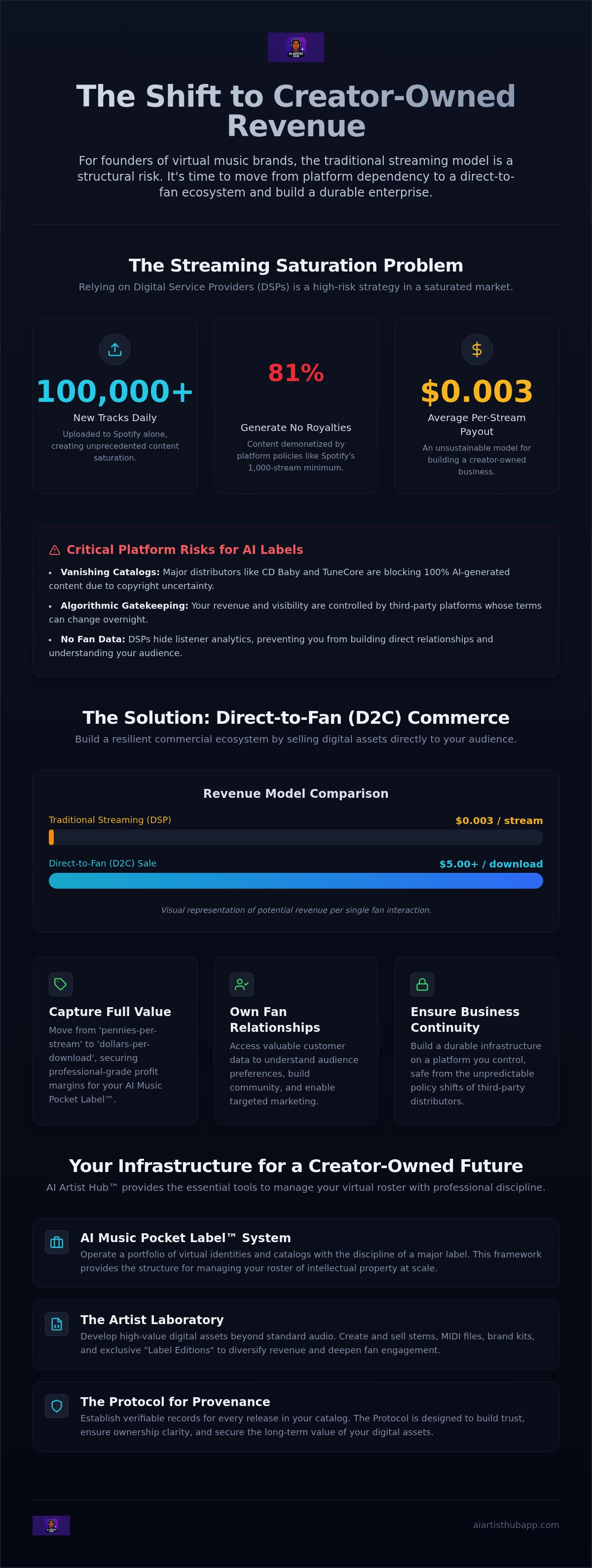
Did you know that over 100,000 new tracks are uploaded to Spotify every single day, yet 81% of content on the platform now fails to generate a single cent in royalties? For founders of virtual music brands, relying on an average payout of $0.003 per stream isn't just difficult; it's a structural risk to your business continuity. You likely feel that the traditional streaming path is increasingly saturated and unpredictable for synthetic media. Transitioning to a direct to fan revenue model for AI labels allows you to bypass these gatekeepers and capture the full value of your creative output. By focusing on direct-to-consumer (D2C) systems, you move from being a passive recipient of diluted royalty pools to an active architect of your own commercial ecosystem.
We agree that the current landscape feels like a race to the bottom where volume often trumps value. This guide provides a clear roadmap to help you build a sustainable, creator-owned revenue model that prioritizes higher profit margins and long-term brand equity. You'll discover how to leverage the AI Artist Hub™ infrastructure to manage your AI Music Pocket Label™ with the discipline of a professional enterprise. We will explore strategic frameworks for selling digital products, establishing provenance through our Protocol, and utilizing the Artist Laboratory to develop virtual identities that fans actually want to support. It's time to stop chasing play counts and start building a durable infrastructure for your virtual roster.
Key Takeaways
- Understand why implementing a direct to fan revenue model for AI labels is essential for bypassing algorithmic gatekeepers and securing professional-grade profit margins.
- Identify high-value digital assets beyond standard audio files to diversify your commercial offerings within the Artist Laboratory.
- Execute a 5-step framework to launch a professional storefront on the AI Artist Marketplace while maintaining brand continuity and ownership clarity.
- Transition from a solo creator to a micro-enterprise owner by scaling your virtual roster through the AI Music Pocket Label™ system.
- Leverage the Protocol to establish verifiable provenance records, ensuring trust and long-term value for every release in your catalog.
Why AI Labels Shift to Direct-to-Fan Revenue Models
Transitioning to a direct to fan revenue model for AI labels prioritizes the sale of digital assets directly to your audience. This shift represents a move from platform dependency to true ownership. While generators provide the initial capability to create music, a robust direct-to-fan business model provides the continuity needed to build a durable enterprise. By selling directly, you capture the full commercial value of your virtual artists rather than waiting for a fraction of a cent from a streaming provider. It's about moving your label from a speculative venture to a structured, revenue-generating business.
Relying on third-party algorithms is a high-risk strategy for AI-enabled creators. In 2024, Spotify implemented a policy requiring 1,000 streams before a track generates royalties, effectively demonetizing 81% of content. For an AI music label, this 'Streaming Trap' is compounded by platform uncertainty. Major distributors like CD Baby and TuneCore have already begun blocking 100% AI-generated content due to copyright concerns. You need an environment where your catalog is safe and your revenue is predictable. Direct sales provide that stability by removing the middleman.
We view this evolution through the AI Music Pocket Label™ thesis. This framework enables small teams to operate portfolios of virtual identities with the same discipline as a traditional major label. You aren't just generating songs; you're managing a roster of intellectual property. Direct sales provide the capital and data necessary to scale these virtual artists with precision. By utilizing the Artist Laboratory, you can refine your brand identity and ensure every release contributes to long-term equity rather than a temporary spike in play counts.
The Limitations of Traditional DSP Distribution
Digital Service Providers (DSPs) offer massive reach but minimal control. The fragility of AI music listings means your entire catalog could vanish overnight if a platform shifts its terms of service. Contrast the 'pennies-per-stream' reality with the 'dollars-per-download' opportunity. High-margin D2C music sales ensure that your business remains viable even if external algorithms change. This approach moves your revenue from a speculative pool to a structured storefront where you set the terms.
Building Continuity Through Direct Fan Relationships
Owning your customer data is the most valuable asset you can possess. Traditional platforms hide your listeners behind a wall of proprietary analytics, leaving you blind to your audience's true preferences. Direct relationships allow you to see exactly who is buying and why. You can move from isolated song generation to organized artist development. This direct access facilitates targeted marketing and faster audience growth because you aren't guessing what your fans want; you're building a community around your virtual roster with verifiable provenance via the Protocol.
How to Sell Digital Music Products Directly: A 5-Step Framework
Implementing a direct to fan revenue model for AI labels requires a strategic transition from passive distribution to active digital commerce. You need a structured framework to turn generative capability into a sustainable, scalable business. This five-step process ensures your virtual artists operate with the commercial discipline of a professional label while capturing the highest possible margins. By focusing on direct sales, you maintain control over the entire fan experience and the resulting revenue streams.
Defining Your Digital Product Suite
Success in the modern digital economy depends on offering value that extends far beyond a standard audio file. You should curate high-fidelity audio releases as exclusive "Label Editions" that fans can't find on streaming platforms. Think about selling the functional assets of your virtual artists, such as stems, MIDI files, and brand kits, which provide high utility for other creators. You can also package digital collectibles or virtual artist "lore" packs to deepen fan engagement. These diverse offerings transform a single release into a multi-layered product suite that drives higher revenue per fan.
Creating Your Artist Laboratory Workspace
Efficiency at scale requires a centralized environment for organizing your virtual identities and roster. The Artist Laboratory serves as your command center for managing brand assets, metadata, and catalogs. Use professional AI artist roster management software to track multiple revenue streams across your entire portfolio. This organization allows you to prepare releases for direct-to-fan distribution with professional-grade precision. By treating each virtual identity as a distinct business unit within "The Lab," you ensure long-term brand continuity and operational clarity.
Once your products are defined and organized, establish a professional storefront using the AI Artist Hub Marketplace. This environment is built specifically for the unique needs of AI-enabled creators. It provides the essential infrastructure for digital product sales while maintaining your brand’s visual identity. As we move deeper into The Direct-to-Fan Era, having a dedicated hub for your commercial activity is a foundational requirement for growth.
Trust is the core currency of the emerging AI music economy. Implement provenance and verification records for every release to build buyer confidence and ensure ownership clarity. Use the Protocol to establish a verifiable history for your assets. Finally, design a release campaign that directs all traffic to your owned hub and automate the fulfillment and customer relationship management (CRM) process. This systematic approach ensures that as your label grows, your workload remains manageable. To begin organizing your roster for commercial success, access your dashboard today.
Direct Sales vs. Third-Party Platforms for AI Artists
Choosing between third-party distribution and an owned marketplace defines the structural integrity of your business. While major streaming platforms offer massive discovery potential, they operate as closed ecosystems with restrictive policies toward synthetic media. Adopting a direct-to-fan business model allows you to move beyond these limitations. You transition from being a tenant on a third-party platform to being the landlord of your own digital estate. This shift is critical for establishing a sustainable direct to fan revenue model for AI labels, as it ensures your virtual artists aren't subject to the shifting whims of algorithmic gatekeepers.
Profit Margin and Revenue Retention
The financial disparity between direct sales and streaming is stark. On Spotify, an average stream pays between $0.003 and $0.005, meaning you'll need thousands of plays just to cover basic operational costs. In contrast, selling a single high-fidelity track or "Label Edition" directly can yield the equivalent of 2,000 streams in a single transaction. Traditional aggregators often hide costs through subscription fees or revenue splits that don't account for the high-volume nature of an AI Music Pocket Label™. Direct sales provide instant payouts, which drastically improves your cash flow. This immediate liquidity allows you to reinvest in the Artist Laboratory and scale your roster faster than any royalty-based system would permit.
Brand Control and Identity Provenance
Control over your narrative is just as important as your profit margin. Major social and streaming hubs frequently implement shadow bans or restrictive hosting policies for AI-generated content. If your business depends entirely on these platforms, you're building on borrowed ground. Creating a permanent home for your virtual artists ensures that your brand continuity remains intact regardless of external platform changes. You can dictate the exact lore, visual aesthetic, and fan experience without compromise.
Trust remains the primary barrier to entry in the AI music economy. The AI Artist Hub Protocol solves this by providing a public layer of provenance. It establishes clear ownership records and creative history for every asset you release. These records deter unauthorized re-uploads and demonstrate to your audience that your virtual identities are managed with professional integrity. While a hybrid approach utilizing DSPs for discovery can be useful, your primary commercial activity must reside in your owned hub to ensure long-term brand equity. This strategy positions your direct to fan revenue model for AI labels as a definitive management layer rather than a casual participant in a volatile market.
Actionable Guidance: Setting Up Your AI Artist Hub Marketplace
Establishing your label profile is the first tactical step in activating a direct to fan revenue model for AI labels. Begin by configuring your commercial identity within the AI Artist Marketplace. This process requires more than just a name; you must define the infrastructure of your AI Music Pocket Label™. Ensure your profile reflects the professional discipline of a global music entity. Upload your core catalog and organize digital products within the Hub to maintain structural clarity as your roster expands. It's a strategic move that shifts your focus from simple generation to long-term asset management.
Verification signals are the backbone of trust in a generator-agnostic economy. Integrate provenance records for every release to reassure fans of the music's origin and your rights as a creator. The AI Artist Hub™ Protocol provides the tools to establish these records, effectively deterring unauthorized re-uploads. Scaling this direct to fan revenue model for AI labels depends on your ability to automate the relationship between your roster and your buyers. Use the built-in planner and release tools to coordinate multi-artist launches. This systematic approach ensures brand continuity and operational efficiency, allowing you to manage complex portfolios without increasing your manual workload.
Optimizing Your Storefront for Conversion
Write compelling product descriptions that focus on the lore and identity of your virtual artists. Casual listeners become fans when they connect with a narrative, so treat your artist bios as essential brand assets. Select high-end, cinematic visuals that avoid common AI clichés like robots or glowing brains. Implement tiered pricing to cater to different segments of your audience. You can offer standard high-fidelity audio for casual fans while providing exclusive, high-value bundles for super-collectors. These collectors often want deep access to stems or MIDI files directly from the Artist Laboratory.
Leveraging Audience-Growth Marketing Tools
Drive traffic to your owned hub by creating direct-to-fan funnels through social media and newsletters. Don't leave your discovery to chance by relying solely on third-party algorithms. Instead, use specific how to sell AI artist assets strategies to move digital merchandise and brand kits. Building social proof through verified ownership records encourages new buyers to commit to your ecosystem. This direct connection ensures that your marketing spend builds your own database rather than feeding a third-party platform's data set. Every sale reinforces the continuity of your virtual roster.
Organize your virtual roster in the Hub
Scaling Your Revenue Model: From Single Tracks to Global Rosters
Scaling an AI-enabled music business requires a fundamental shift in perspective. Transition from being a solo creator focused on individual outputs to a micro-enterprise owner managing a global roster. Managing high-volume catalogs becomes impossible without software-leveraged systems that ensure every release aligns with your commercial objectives. Adopting a direct to fan revenue model for AI labels allows you to build a scalable architecture that handles dozens of virtual identities with the same efficiency as one. This approach allows you to focus on strategic development while the infrastructure handles the complexities of distribution and sales.
Refining your business strategy is a continuous process. Use the AI Artist Hub Academy to access frameworks on market positioning and advanced digital commerce. The future of AI music entrepreneurship belongs to those who build durable brand ecosystems rather than chasing transient viral moments. You're no longer just producing audio. You're architecting a sustainable music economy.
Developing Long-Term Creator Equity
Focus on brand continuity to ensure your business survives inevitable shifts in technology. While generators create capability, your infrastructure creates the continuity required for long-term growth. Build a portable business that remains generator-agnostic. This ensures your virtual artists and their catalogs aren't tied to a specific software provider or model. Maintaining a human-centered infrastructure allows you to respect the craft while leveraging the speed of modern technology. This layer of development transforms a collection of tracks into a valuable, tradable asset class.
Next Steps for Your AI Music Pocket Label™
Take immediate action to formalize your business structure. Establish your first Artist Laboratory today to begin organizing your virtual identities and brand assets. This centralized workspace allows you to manage rosters with professional discipline from day one. Invite fans into your ecosystem through direct-to-fan commerce. Offer them exclusive access and high-fidelity products that streaming services cannot provide.
Your final objective is to move from speculation to operation. Organize your roster within the Hub and establish provenance records through the Protocol to secure your creative history. Every record you create adds a layer of trust and value to your label. Start building your infrastructure now to lead the emerging AI music economy.
Architecting Your Sustainable Music Future
The shift from platform dependency to creator agency is no longer optional for serious virtual label founders. By moving away from diluted royalty pools and toward direct commerce, you secure the financial foundation of your creative venture. Implementing a direct to fan revenue model for AI labels is the definitive step toward operational independence. You've learned how to define a digital product suite, establish provenance via our Protocol, and scale from single releases to global rosters with professional discipline.
Success in this new economy requires more than just generation; it demands continuity. Our generator-agnostic infrastructure provides the durable brand ecosystem tools necessary to manage virtual identities with founder-led precision. You can refine your strategic approach through the professional business training provided in our Academy. This foundation ensures your business remains portable and resilient as technology evolves. The infrastructure is ready. The roadmap is clear. It's time to take control of your commercial destiny.
Start building your AI Music Pocket Label™ and sell directly to fans today.
Take the first step toward building a lasting legacy in the emerging AI music economy. We're here to provide the framework for your success.
Frequently Asked Questions
Can I really sell AI-generated music directly to fans without a traditional label?
Yes, you can operate as a self-contained entity using the AI Music Pocket Label™ framework. This system allows you to manage everything from brand identity to commerce without third-party gatekeepers. By establishing your own storefront, you bypass traditional label contracts and retain full control over your creative and commercial decisions. Our infrastructure provides the professional tools needed to manage your virtual roster with enterprise-level discipline.
What are the best digital products to sell as an AI music label owner?
Focus on high-fidelity audio, stems, and MIDI files that provide utility to other creators. You should also offer exclusive digital merchandise like virtual artist brand kits or lore-based content packs. These assets drive higher margins than standard audio files and help diversify your income streams within the AI Artist Marketplace. Offering utility-based products transforms your catalog from simple listening material into a functional toolkit for your audience.
How do I handle the legal questions around AI music ownership when selling directly?
Establish clear provenance records for every release using our Protocol to track the origin and history of your assets. While we don't provide legal advice, our tools are designed to help you organize ownership-record documentation. This transparency builds trust with buyers by demonstrating a professional approach to identity and development. Maintaining organized records is essential for proving the continuity and legitimacy of your virtual artist brands.
Do I need a specific AI generator to use the AI Artist Hub Marketplace?
No, our infrastructure is entirely generator-agnostic and supports assets created with any AI technology. You can bring your existing catalog into our environment to manage rosters and execute sales. This flexibility ensures your business continuity remains intact even if you switch generation tools or models in the future. We provide the essential management layer that works regardless of which capability-generating software you choose to utilize.
What is an AI Music Pocket Label™ and how does it help with revenue?
An AI Music Pocket Label™ is a strategic framework that enables small teams to manage portfolios of virtual identities with professional discipline. Implementing a direct to fan revenue model for AI labels through this framework maximizes your margins. It shifts your focus from chasing streaming play counts to building a scalable roster of high-value digital assets. This model ensures that every release contributes to long-term creator equity rather than temporary viral spikes.
How can I prove to my fans that my AI music is legitimate and verified?
Utilize our Protocol to provide public verification and provenance records for every piece of content you release. These tools allow fans to see the verified history of a virtual artist and its catalog. Providing this level of transparency deters unauthorized re-uploads and establishes your brand as a trusted authority in the synthetic media space. Trust becomes your primary currency when you move beyond the anonymous nature of traditional streaming platforms.
Is direct-to-fan revenue more profitable than Spotify or Apple Music for AI artists?
Direct sales typically offer significantly higher profit margins per transaction compared to the average $0.003 payout per stream on platforms like Spotify. A single digital download generates the same revenue as approximately 1,600 streams. Transitioning to a direct to fan revenue model for AI labels ensures you capture the full value of your audience's support. This immediate cash flow provides the liquidity needed to scale your roster and reinvest in the Artist Laboratory.
What tools do I need to start selling digital music products directly today?
Access the AI Artist Hub™ to utilize the Artist Laboratory for roster management and the Marketplace for commerce. You'll need our integrated release tools to coordinate launches and the Protocol for establishing provenance. These essential infrastructure layers provide everything required to transition from a solo creator to a professional micro-enterprise label. Our Academy also offers the business training necessary to refine your strategy and execute your commercial vision with confidence.

Article by
Julius J. White (VVS Jules)
Julius J. White (VVS Jules) is the Founder & CEO of JJW AI Studios™ and builder of AI Artist Hub™, a creator-first operating platform for the emerging AI music economy. A musician, songwriter, producer, entrepreneur, and systems builder, he developed the AI Music Pocket Label™ framework around a simple idea: generation is only the beginning. His work focuses on the identity, provenance, credits, ownership context, permissions, artist development, direct-to-fan relationships, commerce, trust infrastructure, and business systems creators need to build durable AI artist brands, organized catalogs, and long-term creative ventures.
Disclaimer
This article is provided for general educational and informational purposes only and does not constitute legal, financial, tax, investment, or other professional advice. Laws, regulations, platform policies, technology, and industry practices may change over time. References to AI Artist Hub™, UP3™, UP3 PLAY™, provenance, verification, ownership assertions, permissions, creator tools, protected media, streaming or platform policies, or AI-related rules describe general information and current product capabilities where verified. They do not constitute government registration, legal adjudication, third-party rights clearance, regulatory approval, copyright ownership, guaranteed authenticity, or guaranteed permission for commercial use. Readers should independently verify current requirements, review applicable platform and rights terms, and consult qualified professionals when appropriate.
