


In 2026, the market value of an AI asset has shifted from the novelty of the generation to the integrity of the provenance behind it. You’ve likely realized that posting generic tracks to crowded marketplaces yields diminishing returns and leaves you vulnerable to sudden platform bans. It is frustrating to build a creative portfolio only to face copyright uncertainty and razor-thin margins. You want more than a side hustle; you want a sustainable business model that honors your creative agency.
This guide teaches you how to sell AI artist assets by transitioning from a casual creator to a professional founder of an AI Music Pocket Label™. We provide the strategic framework to move beyond basic files and into the world of verified digital products. You will learn how to secure provenance for every asset, manage a scalable roster of virtual artists, and establish direct-to-fan revenue streams that you actually control.
We will break down the essential steps to professionalize your output using the Artist Laboratory. From establishing ownership records to deploying sophisticated brand identities, this roadmap ensures your venture is built on a solid architectural foundation. Prepare to treat your AI-enabled creations as the high-value commercial assets they are.
Key Takeaways
- Transition from selling one-off prompts to managing high-value virtual brand equity, music stems, and complete digital personas.
- Prioritize direct-to-fan hubs over generic marketplaces to maintain creative control and secure higher profit margins for your catalog.
- Master how to sell AI artist assets by utilizing the Artist Laboratory to implement rigorous provenance and verification standards for every release.
- Foster brand continuity for virtual personas using specialized audience-growth tools designed specifically for the emerging AI music economy.
- Centralize your operations with the AI Music Pocket Label™ platform, enabling you to manage a global roster from a unified, professional dashboard.
The Evolution of Selling AI Artist Assets in 2026
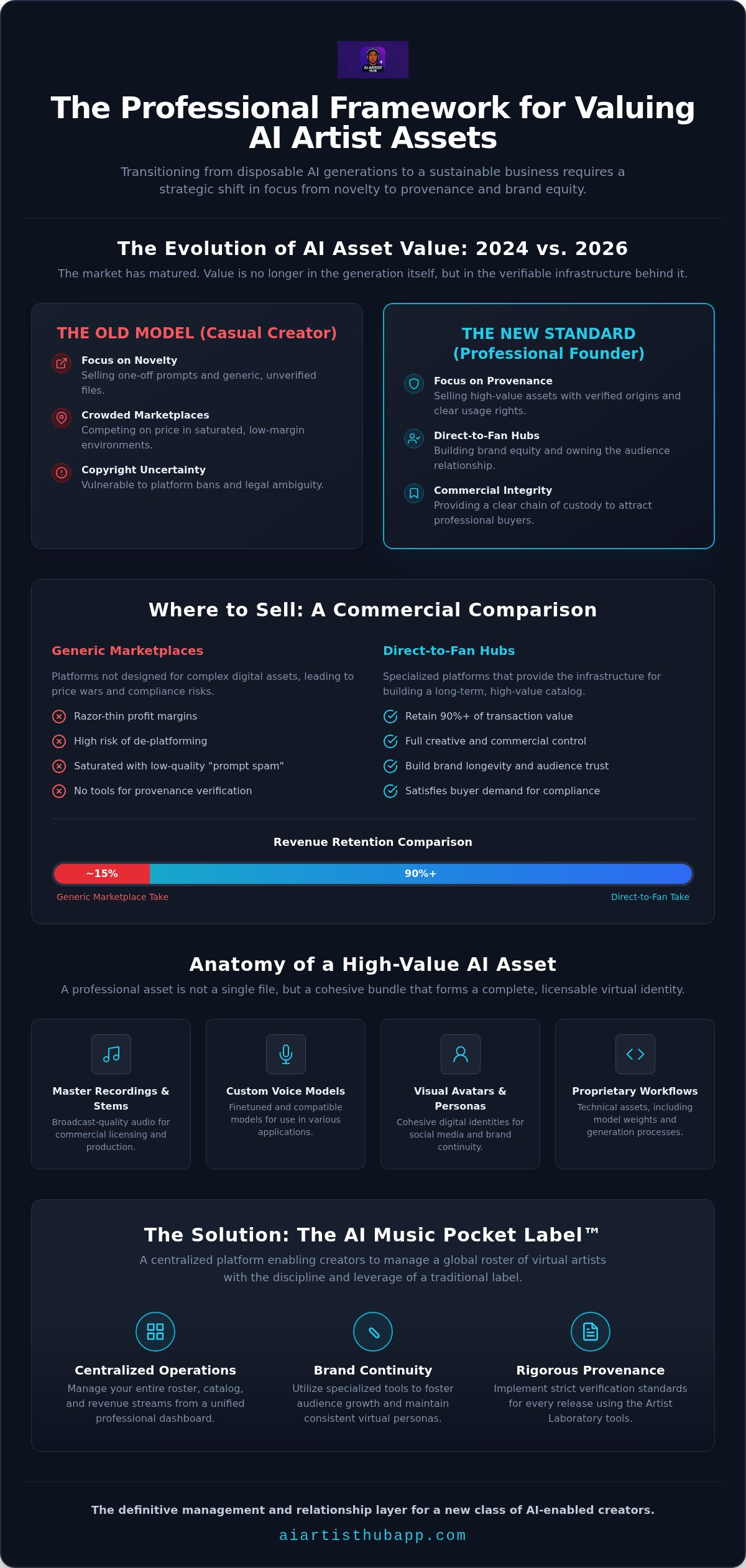
The market for AI-generated content has moved past the experimental phase. Professional creators have shifted their focus from selling simple prompts to managing complex brand equity. Understanding how to sell AI artist assets now requires a deep dive into identity, continuity, and technical utility. While early marketplaces were flooded with low-quality, generic outputs, the current economy rewards those who treat their digital creations as structured business assets. You aren't just selling a file; you're selling the infrastructure of a virtual performer.
Successful commercialization in 2026 relies on three specific pillars:
- Quality: Assets must meet professional broadcast and production standards, moving beyond "good enough" to "studio grade."
- Utility: The asset must be functional within a buyer's professional workflow, such as providing multi-track stems or compatible voice models.
- Verified Origin: Buyers demand a clear chain of custody to mitigate risks associated with copyright law for AI art and training data transparency.
What Counts as a High-Value AI Asset?
In the current market, an "asset" is rarely a single standalone file. High-value transactions usually involve a bundle of related items that form a cohesive virtual identity. This includes master recordings and stems for commercial licensing, custom-tuned voice models, and visual avatars that maintain social media personas. Technical assets, such as proprietary workflows and specific model weights, have also become staple products in the AI Artist Marketplace. The value lies in the relationship between these elements, creating a "plug-and-play" artist brand for agencies and labels.
Why Marketplaces are Changing
Generic stock sites are losing ground to curated, niche environments. Buyers in 2026 prioritize provenance over the lowest price point. They seek assets with established ownership records and clear usage rights. This shift has facilitated the rise of the independent virtual artist label. By adopting the AI Music Pocket Label™ model, you can move away from being a "maker" and start operating as a "label owner." This infrastructure provides the continuity needed to scale a roster of virtual artists while maintaining deep respect for the broader music ecosystem. It's about building a sustainable business that survives the next wave of technological change.
Where to Sell: Generic Marketplaces vs. Direct-to-Fan Hubs
Deciding where to host your digital portfolio is the most critical commercial decision you'll make. Many creators start on mass-market platforms, but these environments often fail to support the nuances of virtual personas. When researching how to sell AI artist assets, you must distinguish between high-volume, low-margin "stock" sites and high-value, direct-to-fan environments. The goal is to move beyond being a vendor on someone else's land and become the owner of your own digital territory.
The Pitfalls of Generic Marketplaces
Generic marketplaces like Etsy or Fiverr are built for physical goods or simple freelance services. They lack the technical infrastructure to handle complex AI music stems, custom-tuned voice models, or brand identities securely. These platforms are currently saturated with low-quality "prompt spam," which forces professional creators into a race to the bottom on pricing. Furthermore, these sites often have volatile terms of service regarding AI-generated content. Without specialized tools for verification, your assets are at constant risk of being de-platformed.
Compliance is another major hurdle in generic spaces. Professional buyers in 2026 require strict adherence to official U.S. Copyright Office AI guidelines to ensure their commercial use is protected. Generic marketplaces rarely provide the provenance tools necessary to satisfy these legal requirements, leaving both the seller and the buyer in a state of uncertainty. This lack of professional rigor prevents you from commanding the premium prices your high-quality work deserves.
The Direct-to-Fan Advantage
The Direct-to-Fan (D2F) model represents the gold standard for revenue retention and brand longevity. While traditional streaming platforms pay fractions of a cent per play, a D2F hub allows you to sell digital products directly to your audience, often keeping 90% or more of the transaction value. This model is the foundation of the AI Music Pocket Label™ thesis. It shifts the focus from passive consumption to active ownership, where fans buy into the brand continuity of your virtual artists.
- Audience Ownership: You collect first-party data, such as email addresses and purchase histories, which are essential for long-term marketing.
- Brand Control: You dictate the visual aesthetic and user experience of your storefront without competing for attention against millions of unrelated listings.
- Higher Margins: By cutting out the middleman, you maximize the profit from every stem, license, and virtual merchandise item sold.
Building a community around your roster requires a dedicated environment that understands the technology. Consider exploring a specialized AI Artist Marketplace to see how professional infrastructure supports higher margins and verified asset sales. Transitioning to a D2F strategy ensures that your business remains resilient regardless of how third-party platform policies evolve.
How to Prepare Your AI Assets for Professional Sale
High-value sales don't happen by accident. They require a rigorous preparation process that transforms raw outputs into commercial products. If you want to master how to sell AI artist assets, you must treat your workspace like a professional studio. Start by establishing your Artist Laboratory. This is your command center for roster management, where you refine assets before they ever hit the marketplace. This environment allows you to move beyond simple generation and into the territory of professional asset development.
Securing Provenance and Ownership
Buyers in 2026 are risk-averse. They demand a clear chain of title for any AI content they license. Use specialized verification tools to create a definitive ownership record for your music. This process proves the origin of your assets and ensures that your workflows are transparent. Drafting commercial use licenses that protect both your agency and the buyer's investment is a non-negotiable step. Without this legal clarity, your assets are essentially unmarketable to serious enterprise clients. Providing this level of professional insurance sets you apart from casual hobbyists.
Packaging Assets for Scale
Perceived value increases when you move from selling individual files to comprehensive Artist Kits. These bundles should include high-resolution master recordings, multi-track stems, visual brand assets, and detailed backstories for each virtual persona. This holistic approach makes it easier for buyers to integrate your work into their projects instantly. It's about providing a complete solution rather than a raw component. Optimize your metadata for discoverability, ensuring every tag reflects the specific technical and creative attributes of the asset within the AI Artist Marketplace.
Establishing a virtual music label infrastructure is the final step in professional preparation. The AI Music Pocket Label™ model allows you to manage multiple identities with the same discipline as a traditional record label. This structure provides the continuity that fans and commercial partners expect from a long-term venture. For a deeper dive into organizing your portfolio, read our guide on How to Manage an AI Artist Roster and Brand Portfolio. By following these steps, you ensure your assets are not just generated, but built for commercial longevity.
Marketing and Growing Your Virtual Artist Brand
Generating high-quality files is only the first step. To maximize how to sell AI artist assets, you must cultivate a brand that fans and commercial partners actually trust. In 2026, the market has matured beyond the initial fascination with the technology. Buyers now seek continuity and identity. Growing a virtual artist brand requires a shift in focus from technical specs to emotional resonance and narrative depth. You are not just marketing a model; you are developing a persona with a distinct voice and aesthetic trajectory.
Building Social Proof for Non-Human Artists
Establishing trust for a non-human artist requires transparency and engagement. Use your Artist Laboratory as a source of "behind-the-scenes" content. Showcasing the curation and creative direction involved in your process humanizes the brand and justifies premium pricing. This transparency builds a bridge between your technical expertise and the final artistic output. Fans in 2026 value the human-AI collaboration rather than the "black box" approach of early generators.
Engage your audience directly through the social profiles of your virtual personas. This creates a sense of presence and continuity that traditional stock assets lack. Collaborations are another powerful tool for social proof. Partnering your AI roster with human creators or established digital influencers grounds your brand in the wider cultural conversation. These interactions validate the virtual artist's place in the music ecosystem and provide the "real-world" context that commercial buyers look for when licensing assets.
Strategic Release Management
Move away from the "upload and pray" method of distribution. Professional labels use structured release cycles to drive urgency and value. Implement "drops" for limited edition stems or exclusive brand kits to create a sense of scarcity. This strategy encourages early adoption and rewards your most loyal supporters. By controlling the release cadence, you maintain the perceived value of your catalog and prevent the market saturation that plagues generic marketplaces.
Transition your fans from social media followers to paying subscribers using a direct-to-fan model. Offering early access to new releases or exclusive content through your own infrastructure ensures you own the relationship with your audience. This recurring revenue stream provides the stability needed to scale your operations. For a comprehensive roadmap on building this infrastructure, consult our How to Start an AI Music Label: Complete 2026 Guide. Mastering these release strategies turns a collection of files into a functioning commercial entity.
Organize your virtual artist roster today
Scaling Your Revenue with AI Artist Hub™
Scaling a digital business requires moving beyond manual workflows and fragmented tools. As your catalog grows, the challenge of how to sell AI artist assets shifts from individual transactions to systemized roster management. AI Artist Hub™ provides the professional infrastructure necessary to handle this complexity. By centralizing your operations within the AI Music Pocket Label™ platform, you gain the ability to manage multiple virtual identities and global catalogs with the discipline of a traditional record label but the leverage of modern software.
Efficiency is the primary driver of profitability in the 2026 creator economy. Our platform automates the listing and sales process, ensuring your assets are visible in the AI Artist Marketplace without requiring constant manual oversight. This automation allows you to focus on high-level strategy and artist development while the system handles the technical heavy lifting of distribution and payment processing. Accessing professional education through our business training modules ensures you stay ahead of shifting industry trends and regulatory changes.
The Label Owner's Dashboard
Visibility is essential for any strategic mentor or business owner. The unified dashboard enables you to track sales and performance metrics across your entire roster of virtual artists from a single interface. You don't need to navigate multiple sites to understand which personas are resonating with fans. This centralized environment streamlines the verification and provenance workflow, making it simple to establish ownership records for every new release. Managing direct-to-fan music and digital product sales becomes a seamless part of your daily operations rather than a logistical hurdle.
Your Path to AI Entrepreneurship
The transition from a solo creator to the CEO of a virtual talent agency represents a fundamental shift in your professional trajectory. It's a move away from the "side hustle" mindset toward building a sustainable, high-growth venture. AI Artist Hub™ acts as the definitive management layer for this new class of entrepreneur, providing the tools needed to maintain brand continuity and creator agency. We've built the system so you can focus on the vision, providing the keys to a modern digital venture that respects the traditions of music while embracing the possibilities of technology.
The future of the industry belongs to those who build on solid foundations. By establishing a professional operating environment, you ensure that your virtual artists are positioned for long-term commercial success. This isn't just about making sales; it's about building a legacy of verified, high-value digital assets that you fully control.
The Future of Your Virtual Artist Roster
The transition from a hobbyist creator to a professional label owner requires more than just high-quality generators. Success in 2026 depends on your ability to establish brand continuity and verified provenance for every digital asset you release. You've learned that moving away from generic marketplaces toward a direct-to-fan model secures your margins and protects your creative agency. By mastering how to sell AI artist assets through a structured system, you transform individual files into a scalable portfolio of virtual identities.
AI Artist Hub™ provides the essential architecture to manage this evolution. Our trademarked AI Music Pocket Label™ systems and integrated marketplace offer the professional provenance tracking needed to satisfy commercial buyers and fans alike. You don't have to build the infrastructure from scratch; you simply need to lead the vision. The system is designed to help you manage rosters with the discipline of a global music company.
Take control of your creative output and start building a legacy that lasts. The tools are in your hands, and the market is ready for verified, professional AI artistry. Step into your role as a founder and architect of the new music economy today.
Frequently Asked Questions
Is it legal to sell AI-generated music and artist assets in 2026?
Yes, selling AI-generated assets is legal provided you comply with the terms of service of your generation tools and local regulatory guidelines. The focus in 2026 remains on transparency and training data consent. You must verify that your workflow aligns with current copyright office requirements to ensure commercial viability. Establishing clear provenance records helps mitigate legal risks for both you and your buyers while building professional trust.
Do I need to disclose that an artist is AI-generated when selling assets?
Disclosure is a professional requirement in 2026 to maintain market integrity and meet platform standards. Most specialized marketplaces and direct-to-fan hubs require clear labeling of AI-generated content to ensure transparency for consumers and commercial licensees. Proper attribution protects your brand continuity. It also helps buyers understand the technical nature of the assets they're purchasing, such as specific voice models or multi-track music stems.
What is the best platform for selling AI music stems and voice models?
Direct-to-fan hubs and specialized environments like the AI Artist Marketplace are the most effective platforms for professional sales. These spaces provide the technical infrastructure needed to handle complex audio files and verification records. Unlike generic stock sites, these platforms are designed to support virtual artist brands. They enable you to retain a higher percentage of revenue while building a dedicated community around your roster.
How do I protect my AI artist assets from being stolen or copied?
Protect your assets by implementing professional provenance tracking and ownership-record tools. Use the AI Artist Hub™ protocol to establish a definitive chain of title for every release. Secure your files with encrypted distribution methods and clear commercial licensing agreements. While technology can't prevent all copying, having a verified record of origin provides the professional foundation needed to enforce your rights and maintain high asset value.
Can I sell AI artist assets if I used a subscription-based generation tool?
You can generally sell assets if your subscription tier explicitly grants commercial usage rights. Always review the specific licensing agreement of your generator, as many hobbyist tiers prohibit commercialization. Professional creators typically use enterprise-level tools that provide clearer paths for asset commercialization. Verification tools in your Artist Laboratory help document that your outputs were created using commercially licensed software, which is essential for high-value enterprise sales.
What is an AI Music Pocket Label™ and how does it help with sales?
An AI Music Pocket Label™ is a trademarked infrastructure that enables creators to manage portfolios of virtual identities with professional discipline. This model centralizes your brand management, provenance tracking, and sales data into a single dashboard. It helps you master how to sell AI artist assets by providing a scalable framework for roster growth. This system moves you from being a one-off maker to a strategic label owner with long-term revenue.
How much can I realistically earn from selling AI artist assets?
Earnings vary based on the utility, quality, and brand equity of your virtual artist roster. Professional creators focusing on high-value Artist Kits and commercial licensing often see significantly higher margins than those selling individual tracks. By utilizing a direct-to-fan model, you can retain over 90% of your sales revenue. Success depends on building a verified catalog and implementing the audience-growth strategies outlined in our professional frameworks to ensure consistent demand.

Article by
Julius J. White (VVS Jules)
Julius J. White (VVS Jules) is the Founder & CEO of JJW AI Studios™ and builder of AI Artist Hub™, a creator-first operating platform for the emerging AI music economy. A musician, songwriter, producer, entrepreneur, and systems builder, he developed the AI Music Pocket Label™ framework around a simple idea: generation is only the beginning. His work focuses on the identity, provenance, credits, ownership context, permissions, artist development, direct-to-fan relationships, commerce, trust infrastructure, and business systems creators need to build durable AI artist brands, organized catalogs, and long-term creative ventures.
Disclaimer
This article is provided for general educational and informational purposes only and does not constitute legal, financial, tax, investment, or other professional advice. Laws, regulations, platform policies, technology, and industry practices may change over time. References to AI Artist Hub™, UP3™, UP3 PLAY™, provenance, verification, ownership assertions, permissions, creator tools, protected media, streaming or platform policies, or AI-related rules describe general information and current product capabilities where verified. They do not constitute government registration, legal adjudication, third-party rights clearance, regulatory approval, copyright ownership, guaranteed authenticity, or guaranteed permission for commercial use. Readers should independently verify current requirements, review applicable platform and rights terms, and consult qualified professionals when appropriate.
