


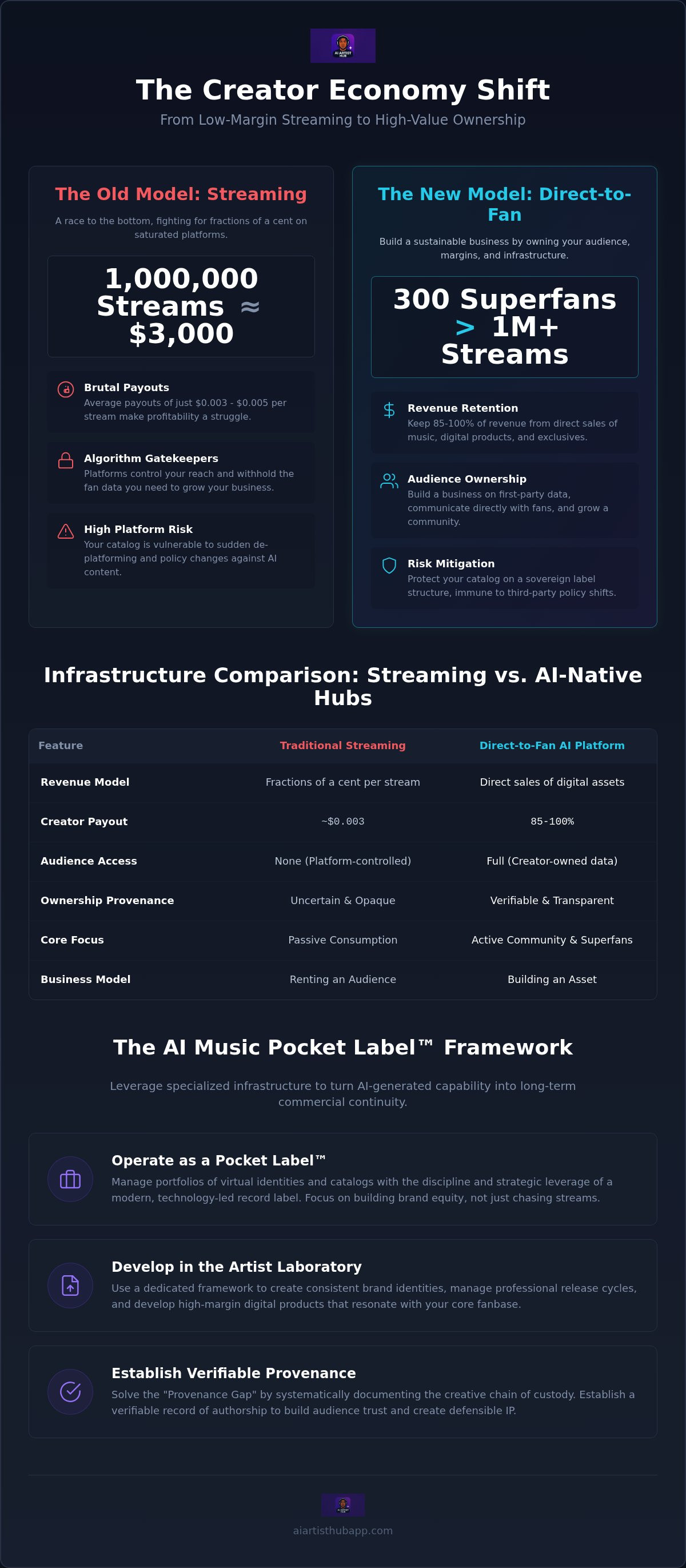
Why chase a million streams for a $3,000 payout when 300 dedicated fans can generate more revenue in a single release cycle? The current streaming model forces creators to fight for fractions of a cent while platforms withhold the very fan data you need to grow. You've likely felt the sting of algorithm gatekeeping and the uncertainty of copyright provenance in an increasingly crowded market. It's a system designed for passive consumption, not for building a sustainable, founder-led business.
This guide provides the blueprint to bypass these digital bottlenecks by leveraging a direct to fan AI music platform to own your audience and your margins. We'll show you how to establish a professional AI Music Pocket Label™ that prioritizes brand continuity and verifiable ownership. You'll discover the specific frameworks needed to manage an Artist Laboratory, develop a scalable virtual artist roster, and transform AI-generated capability into long-term commercial continuity. It's time to stop renting your career from a black box and start building your own infrastructure.
Key Takeaways
- Analyze the economic shift from low-margin streaming to high-margin direct sales and why this transition is essential for sustainable AI-driven business models.
- Discover how to utilize a direct to fan AI music platform to solve the "Provenance Gap" and establish verifiable trust with your audience through ownership-record tools.
- Compare traditional music marketplaces with AI-native hubs to determine which infrastructure best supports scalable virtual artist management and roster growth.
- Apply the Artist Laboratory framework to create consistent brand identities and manage professional release cycles for your virtual identities.
- Master the AI Music Pocket Label™ thesis to operate your creative output with the discipline and strategic leverage of a modern, technology-led record label.
The Shift to Direct to Consumer Music Sales in the AI Era
Direct-to-consumer (D2C) music sales represent a fundamental pivot from passive consumption to active ownership. In this model, the transaction occurs directly between the label and the fan, removing the intermediaries that traditionally captured the lion's share of value. For the modern AI entrepreneur, this shift isn't just about higher margins; it's about survival. The Direct-to-fan model allows you to build a business on a foundation of first-party data rather than relying on the shifting sands of third-party algorithms.
Traditional streaming platforms are increasingly saturated. In April 2026, services like Deezer reported receiving nearly 75,000 AI-generated tracks every single day. This volume creates an environment where Algorithm Fatigue is inevitable. When the supply of music is effectively infinite, the value of a single stream trends toward zero. For a direct to fan AI music platform, the goal is to bypass this race to the bottom by focusing on high-value relationships rather than low-value impressions. Ownership of fan data is the only path to long-term label equity.
Why Streaming Royalties Fail AI Creators
The math of streaming is brutal for independent labels. Payouts average between $0.003 and $0.005 per stream, meaning you need millions of plays just to cover basic operational costs. Relying on these platforms also introduces significant platform risk. Distributors like CD Baby and TuneCore have historically implemented strict policies against 100% AI-generated content, creating a precarious environment for virtual artist rosters. Transitioning to a sovereign music label structure ensures that your revenue isn't subject to the whims of a distributor's updated Terms of Service. Consider these advantages of direct sales:
- Revenue Retention: Keep up to 85-100% of sales compared to fractions of a cent.
- Risk Mitigation: Protect your catalog from sudden de-platforming or distributor bans.
- Audience Access: Communicate directly with fans without algorithmic gatekeepers.
The Superfan Economy and Virtual Artists
Virtual artists thrive when they offer more than just audio files. Fans of AI-driven identities often seek exclusive digital products, limited-edition provenance records, and direct access to the Artist Laboratory process. This community-driven social proof is what transforms a generated track into a culturally relevant brand. By utilizing a direct to fan AI music platform, you can offer these high-margin assets directly to your core supporters. If you're just starting, review our How to Start an AI Music Label: Complete 2026 Guide to establish your professional infrastructure. Building a profitable roster requires shifting your focus from mass reach to deep engagement.
Why AI Music Labels Need Specialized D2C Infrastructure
Traditional storefronts weren't built for the velocity of AI-assisted creation. While generic platforms handle physical vinyl well, they lack the specific metadata fields required to document the creative chain of custody. A dedicated direct to fan AI music platform provides the technical layer necessary to prove human creative input and training data transparency. This distinction is critical as AI's impact on the music industry forces a shift toward stricter licensing and attribution standards. Without specialized infrastructure, labels risk building their brand on legally fragile ground.
Verification has become the currency of trust in 2026. Fans are increasingly sophisticated; they want to know that the virtual artists they support operate within ethical frameworks. Professional AI music business suites offer integrated tools to attach ownership records directly to audio assets. This goes beyond a simple checkout page. It creates a secure environment where IP is protected through metadata verification or blockchain-based timestamping, ensuring your label's assets remain defensible in an evolving regulatory landscape.
Solving the Provenance and Ownership Challenge
AI music provenance tracking is the systematic documentation of every human and machine contribution within the creative workflow to establish a verifiable record of authorship. This documentation is your primary defense against copyright uncertainty. Generic storefronts treat music as a simple file, but a professional suite treats it as a complex asset with a history. By securing your IP at the point of sale, you provide fans with the confidence that they are purchasing authentic, authorized content from your Artist Laboratory. This transparency is what separates hobbyist creators from serious label owners.
Managing the Virtual Artist Roster
Operating an AI Music Pocket Label™ often involves managing dozens of distinct personas across various genres. Releasing music for multiple AI identities simultaneously requires a level of automation that traditional artist dashboards don't offer. You need a centralized command center to coordinate brand assets, social proof, and release schedules. This prevents the administrative bloat that typically kills small, high-output teams. For a deeper look at these workflows, read our guide on How to Manage an AI Artist Roster and Brand Portfolio. Centralization allows you to scale your output without sacrificing the unique identity of each virtual artist.
Successful founders prioritize systems over manual tasks. Using an integrated direct to fan AI music platform enables you to automate the release cycle while maintaining absolute clarity on asset provenance. If you're ready to move beyond basic storefronts, you can explore the Protocol for establishing professional-grade roster management.
Comparing D2C Models: Traditional Platforms vs. AI-Native Hubs
Select the right direct to fan AI music platform to determine your label's commercial trajectory. While legacy platforms offer established audiences, they often lack the technical flexibility required for virtual artist development. Professional founders must weigh the benefits of existing discovery against the necessity of specialized label infrastructure. The choice between a generic storefront and an AI-native hub impacts everything from your profit margins to your legal defensibility.
Generic Storefronts (Bandcamp, EVEN, Shopify)
Evaluate Bandcamp and EVEN for their suitability within an AI-driven workflow. Bandcamp remains a powerful tool for traditional musicians; it typically allows creators to receive approximately 85% of revenue after fees. However, its infrastructure isn't designed to handle the specific metadata requirements of AI music provenance. Generic storefronts often force a "Discovery vs. Ownership" trade-off where you sacrifice data control for visibility. Using non-AI platforms also presents a real risk of content flagging. Major distributors have historically blocked 100% AI-generated tracks, and legacy marketplaces don't provide the verification tools to prove human creative input. Managing dozens of virtual identities on a platform built for single-human artists quickly becomes an administrative bottleneck.
The AI-Native Advantage: AI Artist Hub™
AI Artist Hub™ provides the definitive management and relationship layer for AI-enabled creators. Our AI Music Pocket Label™ tools integrate verification and provenance records directly into the sales process. This creates a secure environment for your IP while providing fans with the transparency they expect in 2026. Prioritizing an AI-native hub allows you to move beyond simple storefronts and establish a scalable roster system. Explore our AI Artist Marketplace to see how we prioritize identity and brand continuity. Professional labels require more than a checkout page; they need a comprehensive business suite that understands the economics of the emerging AI music economy. Accessing the pricing for these professional tools is a strategic move toward transitioning from a casual creator to a serious label owner.
Contrast generic marketplace fees with professional label subscription models to maximize your ROI. Traditional platforms often take a percentage of every sale, which can erode margins as your roster scales. In contrast, specialized hubs utilize subscription-based models that provide predictable costs and professional-grade automation. This shift in financial structure empowers you to reinvest in your Artist Laboratory rather than losing revenue to transaction-heavy legacy systems. By adopting the Protocol, you ensure your business is built for the volume and velocity of the modern AI era.
Building Your Direct-to-Fan Strategy for Virtual Artists
Establishing a successful label requires a shift from sporadic content creation to structured brand development. Begin by defining the specific archetype and target audience for each virtual identity in your roster. A direct to fan AI music platform enables you to capture high-intent data that streaming services simply won't share. This data is the foundation of your marketing roadmap. By prioritizing AI-native infrastructure, you ensure that every release includes a verifiable provenance record, securing your IP at the point of transaction.
Your strategy should move beyond simple track sales. Implement a tiered product offering that caters to different levels of fan engagement. While casual listeners might purchase a digital download, power users and fellow creators often seek exclusive stems, MIDI files, or high-fidelity masters. Providing these modular assets increases your average order value and positions your label as a resource for the broader creator economy. Establish a consistent release cadence to maintain brand continuity across your entire portfolio.
Pricing and Product Bundling for AI Music
Strategic pricing reflects the utility and scarcity of the asset. High-quality masters serve the general listener, but stems and MIDI files offer interactive value for other producers and creators. You can significantly increase margins by creating "Superfan Bundles." These packages should integrate virtual artist lore, exclusive visual assets, and early access to the Artist Laboratory process. This narrative layer justifies a premium price point and fosters deeper fan loyalty. Refer to our guide on How to Sell AI Artist Assets: A Professional Guide for 2026 for specific pricing frameworks and bundling strategies.
Automating the Fan Relationship
Scaling a multi-artist roster requires removing manual friction from your marketing workflows. Use CRM tools specifically designed for music labels to segment your audience based on their purchase history and engagement levels. This allows for personalized communication that feels authentic to each virtual persona. Utilize Artist Laboratories to incubate and test new talent in a controlled environment before committing to a full-scale launch. This iterative approach reduces risk and ensures that only the most resonant identities receive significant marketing spend. Daily payouts are essential for maintaining the liquidity required to scale label operations and reinvest in your infrastructure rapidly.
Organize your virtual artist roster
Launching Your AI Music Pocket Label™ for Maximum ROI
Maximizing ROI in the AI music economy requires a shift in mindset from casual production to professional label management. While generators provide the initial capability, the AI Music Pocket Label™ platform provides the continuity needed to build a defensible business. By utilizing a direct to fan AI music platform, you transform your creative output into a structured portfolio of assets. This transition from creator to label owner is the key to capturing long-term value and establishing a scalable presence in the digital marketplace. This shift is essential for long-term growth.
The AI Artist Marketplace serves as a critical engine for this expansion. It provides the visibility needed to scale your roster while maintaining the high margins associated with direct sales. Traditional models don't treat releases as part of a larger ecosystem. Professional infrastructure does. This allows you to leverage cross-promotional strategies and unified brand management across dozens of virtual identities simultaneously.
Scaling from 1 to 100 Virtual Artists
High-volume roster management is only possible when you remove manual friction from the release cycle. Professional infrastructure allows you to oversee the development, release, and marketing of multiple personas without increasing your administrative overhead. Scale requires systems. Mastering this new music economy requires a commitment to business education and strategic development. Through the Academy, entrepreneurs gain the insights needed to navigate complex licensing and attribution standards. This visionary approach defines the modern AI music founder. It turns technological possibility into tangible commercial results.
Ready to Own Your Music Future?
Launching your direct-to-fan sales channel is the final step in securing your music future. Before you go live, ensure your verification and provenance records are established for every asset in your catalog. This professional transparency is your primary competitive advantage, building trust with fans and establishing your label as a reliable source of authentic content. Use the following checklist to ensure your infrastructure is ready for market:
- Finalize brand identities for your core virtual artist roster.
- Establish tiered product bundles including masters, stems, and MIDI files.
- Secure all provenance records within your Artist Laboratory workspace.
- Configure your automated release and fan engagement workflows.
Secure Your Position in the New Music Economy
The shift toward direct-to-fan sales is the definitive move for creators who prioritize agency and long-term equity. Building a sustainable business in 2026 requires total control over your distribution, audience data, and digital assets. By deploying a direct to fan AI music platform, you establish the essential management layer for a professional virtual artist roster. This infrastructure ensures that brand continuity and asset provenance remain at the forefront of your commercial strategy. You're no longer just generating tracks; you're architecting a scalable digital venture.
Professional infrastructure allows you to solve the "Provenance Gap" and implement tiered product bundling for maximum ROI. The AI Music Pocket Label™ system provides the trademarked framework and professional verification tools necessary to scale a global portfolio. Combined with comprehensive business education, these systems enable you to move beyond the limitations of legacy distributors. It's time to take the keys to your own infrastructure and lead the next generation of music entrepreneurs.
Your path to commercial continuity starts with a single, strategic decision. The systems are built, the framework is proven, and the tools are ready for your vision. Establish your label today and own your future.
Frequently Asked Questions
Is it legal to sell AI-generated music directly to fans?
Yes, selling music created with AI tools is legal provided you have the commercial rights from your software provider. While the U.S. Copyright Office maintains that music generated entirely by AI without human creative input cannot be copyrighted, you can still sell these tracks as digital products. Professional labels use hybrid workflows to ensure their catalog remains defensible and eligible for authorship protection under current 2026 regulations.
How do direct to consumer music sales compare to streaming royalties in 2026?
Direct sales offer significantly higher margins by removing the intermediaries that often capture 30% or more of your earnings. In 2026, an artist needs roughly one million streams to earn between $3,000 and $5,000. Conversely, selling 300 digital albums at $15 each generates $4,500 immediately. A direct to fan AI music platform allows you to retain up to 100% of your revenue depending on your infrastructure.
What is an AI Music Pocket Label™ and how does it work?
An AI Music Pocket Label™ is a trademarked system designed to help creators operate portfolios of virtual identities with professional discipline. It functions as a comprehensive business suite that integrates roster management, asset provenance, and direct sales tools into a single workflow. This system enables small teams to manage high-volume catalogs while maintaining the brand continuity and software leverage typically reserved for major record labels.
Do I need a business license to start an AI music label?
Requirements vary by jurisdiction, but establishing a formal business entity like an LLC is recommended for professional label operations. This structure provides liability protection and allows you to open business banking accounts for daily payouts. You should consult local regulations in your specific region to determine if a general business license is required for digital commerce and software-led music ventures.
How can I prove that I own the rights to my AI-generated music?
You can prove ownership by maintaining detailed provenance records and creative chain-of-custody documentation. Professional tools within our platform allow you to attach verification records directly to your audio assets. These records document human creative contributions, such as arranging and editing. This evidence is essential for establishing authorship under current U.S. and EU regulatory frameworks that require human creative input for copyright eligibility.
What are the best digital products to sell for a virtual artist brand?
Successful virtual brands sell a mix of high-fidelity masters, stems, and interactive MIDI files. You can also offer "Superfan Bundles" that include exclusive virtual artist lore, high-end visual concept art, and access to the Artist Laboratory process. These assets cater to both general listeners and other creators. This strategy effectively diversifies your revenue streams beyond simple audio downloads and increases average order value.
Can I use AI Artist Hub™ alongside traditional distribution like DistroKid?
Yes, you can use our infrastructure as your primary direct-to-fan engine while using traditional distributors for broad DSP reach. This hybrid approach allows you to capture high-margin revenue and fan data through your direct to fan AI music platform while maintaining a presence on services like Spotify. It's a strategic way to balance mass discovery with the long-term sustainability of your own business infrastructure.
How do I build a fan base for an artist that isn’t human?
Building a fan base for virtual artists requires focusing on world-building and brand continuity rather than traditional touring. You develop social proof by sharing the creative process within "The Lab" and engaging fans through digital storytelling. Successful founders treat their virtual artists as intellectual property brands. They use CRM tools and automated marketing to foster deep community engagement across social channels and exclusive digital environments.

Article by
Julius J. White (VVS Jules)
Julius J. White (VVS Jules) is the Founder & CEO of JJW AI Studios™ and builder of AI Artist Hub™, a creator-first operating platform for the emerging AI music economy. A musician, songwriter, producer, entrepreneur, and systems builder, he developed the AI Music Pocket Label™ framework around a simple idea: generation is only the beginning. His work focuses on the identity, provenance, credits, ownership context, permissions, artist development, direct-to-fan relationships, commerce, trust infrastructure, and business systems creators need to build durable AI artist brands, organized catalogs, and long-term creative ventures.
Disclaimer
This article is provided for general educational and informational purposes only and does not constitute legal, financial, tax, investment, or other professional advice. Laws, regulations, platform policies, technology, and industry practices may change over time. References to AI Artist Hub™, UP3™, UP3 PLAY™, provenance, verification, ownership assertions, permissions, creator tools, protected media, streaming or platform policies, or AI-related rules describe general information and current product capabilities where verified. They do not constitute government registration, legal adjudication, third-party rights clearance, regulatory approval, copyright ownership, guaranteed authenticity, or guaranteed permission for commercial use. Readers should independently verify current requirements, review applicable platform and rights terms, and consult qualified professionals when appropriate.
