


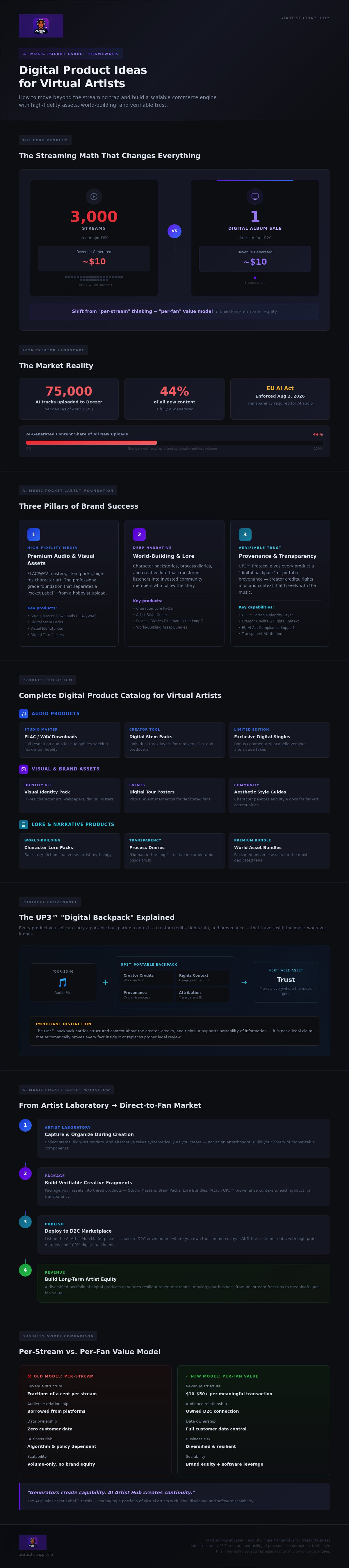
Selling just one $10 digital album to a single dedicated fan generates the same revenue as 3,000 streams on a major platform. For creators building AI-driven rosters, relying on fractions of a cent from DSPs isn't just frustrating; it's a structural weakness. You've likely felt the disconnect when listeners treat AI content as a fleeting novelty, making it hard to find viable digital product ideas for virtual artists. We agree that the current streaming economy fails to reward the strategic work of a modern music founder.
This article provides a blueprint to transform your creative output into a scalable commerce engine. You'll learn how to use the AI Music Pocket Label™ framework to move beyond the "upload and pray" strategy and establish true business continuity. We'll explore how to package "verifiable creative fragments" and narrative-driven assets that solve transparency concerns while deepening fan connection. By the end of this guide, you'll know how to build a professional-grade brand where every song travels with a portable backpack of context and rights, turning your music into a verifiable, profitable asset.
Key Takeaways
- Shift your focus from isolated song generation to long-term brand continuity using the AI Music Pocket Label™ framework.
- Explore high-value digital product ideas for virtual artists, such as high-fidelity stem packs and master-quality audio files for audiophiles.
- Learn how to monetize your world-building efforts by packaging character lore and "human-in-the-loop" process diaries as premium digital assets.
- Use the UP3™ Protocol to give your products a "digital backpack" of portable provenance, building trust and transparency with your audience.
- Establish a professional-grade workflow to transition your creations from the Artist Laboratory to a direct-to-fan marketplace efficiently.
The Virtual Artist Economy: Beyond the Streaming Trap
Generators create capability; AI Artist Hub creates continuity. In 2026, the digital music market is flooded with isolated tracks that lack a cohesive business structure. By April 2026, data showed that approximately 75,000 fully AI-generated tracks were uploaded to Deezer daily, representing 44% of all new content. Standing out in this volume requires a fundamental shift from releasing individual songs to building a professional brand. This is where the AI Music Pocket Label™ thesis changes your trajectory. It allows you to manage a portfolio of virtual artists with the same discipline as a traditional label, but with the scalability of software. To succeed, your brand must stand on three pillars: high-fidelity media, deep narrative, and verifiable trust.
Why Virtual Artists Need a Product Ecosystem
Relying on streaming revenue is no longer a viable survival strategy for independent founders. Selling one $10 digital album generates the same revenue as 2,000 to 3,000 streams on major platforms. Transition your business from a "per-stream" mindset to a "per-fan" value model to build long-term artist equity. Implementing diverse digital product ideas for virtual artists ensures that your revenue streams remain diversified and resilient. To ensure the lyrical depth of these products matches their commercial potential, you can visit Ilena - A writing companion for serious lyricists to support your creative process. The AI Music Pocket Label™ framework organizes these assets into a structured ecosystem, allowing you to capture the full commercial value of your creative output without needing a major label's permission.
The 2026 Creator Landscape: Owning the Commerce Layer
Building on "borrowed audiences" from social media platforms leaves your business vulnerable to algorithm shifts and policy changes. Virtual artists have a unique advantage because they are native to the digital-only marketplace, allowing for 100% digital fulfillment and high profit margins. However, the regulatory environment is tightening. As of August 2, 2026, the EU AI Act enforces transparency via machine-readable marking for AI-generated audio. You can find a detailed overview of AI in music to see how these technological and legal standards have evolved. To protect your revenue, move your transactions to the AI Artist Hub Marketplace. This secure D2C environment allows you to own the commerce layer and the customer data, providing the essential infrastructure for your digital product ideas for virtual artists to thrive in a competitive landscape.
Core Audio and Visual Assets: Monetizing the Foundation
Every track your virtual artist generates is more than just a streaming file. It's a collection of raw assets that hold significant commercial value when packaged correctly. Adopting an "Artist Laboratory" approach means you organize these materials during the creation phase rather than treating them as afterthoughts. This systematic collection allows you to deploy diverse digital product ideas for virtual artists that go beyond the basic MP3. By capturing stems, high-res renders, and alternative takes as they happen, you build a library of monetizable components for every release. To maintain your inspiration outside the digital workspace, check out Art Therapy for workshops that promote creative wellness and offer new perspectives for your artistic brand.
Audiophiles and fellow creators seek the highest possible fidelity. Offering FLAC or WAV "Studio Master" downloads creates a premium tier for fans who want to hear every nuance of your production. Digital Stem Packs are another powerful tool, allowing fans to remix tracks or DJs to use specific layers in their sets. These assets capitalize on the growing impact of AI on the arts by inviting the audience into the creative process. You can also release limited edition "Digital Singles" that include exclusive bonus commentary or alternative "Acapella" versions. High-fidelity audio serves as a premium tier that distinguishes your professional Pocket Label™ from casual hobbyist uploads.
Visual and Brand Assets
A virtual artist's appeal is as much visual as it is auditory. You can monetize this by selling Visual Identity Kits that include high-resolution character art, desktop wallpapers, and digital posters. For virtual events, exclusive "Tour Posters" serve as digital mementos for your most dedicated fans. If you want to foster a fan-art community, consider selling "Style Guides" that detail the character's aesthetic and color palettes. These assets aren't just filler; they are the building blocks of your brand's world. By listing these visual products on the AI Artist Hub Marketplace, you establish a direct commerce line that streaming platforms simply can't match. Organizing these assets early in the Artist Laboratory ensures you have a pipeline of ready-to-sell products for every release. If you're ready to scale your roster's commercial reach, you can explore the infrastructure needed to manage your digital inventory effectively.
Lore, World-Building, and Process: Selling the Narrative
Virtual artists don't just exist in sound files; they inhabit entire universes. To build a sustainable brand, you must transition from being a content uploader to a visionary world-builder. Fans of virtual personas crave the narrative context that makes the music feel grounded and intentional. This shift opens up a range of high-margin digital product ideas for virtual artists that rely on storytelling rather than just rhythm. By selling the lore, you're selling the soul of the project, creating a layer of brand equity that is difficult for generic generators to replicate. For creators looking to turn these world-building documents into premium educational content, you can visit Spacewize to transform static materials into interactive e-learning courses.
When building these digital worlds, studying the curation of physical art can provide a unique perspective on space and presence; you can discover Artgal.Online to see how curators use stone and space to tell a story, offering inspiration for your own virtual environments.
Your creative process is a product in itself. Transparency regarding the "human-in-the-loop" journey provides the provenance that modern audiences demand. You can monetize this by selling Process Diaries or "Laboratory Access" passes. These digital products offer a deep dive into your prompt engineering, curation logic, and the iterative shaping of generative music engines that led to a final master. Documenting these steps proves your creative agency and turns the "how" into a premium experience. Digital "Zines" can further expand on album themes, offering behind-the-scenes insights that fans can't find elsewhere. If you're managing multiple personas, understanding how to manage an AI artist roster effectively ensures each narrative remains distinct and commercially viable.
World-Building as a Product
Expand your revenue by turning your artist's backstory into a Lore Book or an interactive digital map. These assets allow fans to explore the character's arc and the world they inhabit. You can also release Script or Dialogue Packs, giving fans the ability to interact with the persona's specific voice and personality traits. Exclusive fan club badges can unlock "narrative secrets" or hidden wiki pages, rewarding your most dedicated supporters with deeper access to the universe. Use Virtual Artist Community Guides to foster this growth and keep your audience engaged between musical releases. By treating world-building as a core business function, you ensure that your digital product ideas for virtual artists provide value that spans far beyond the initial song generation. This narrative continuity is what transforms a one-off track into a scalable digital empire.
Verifiable Utility: Leveraging the UP3™ Protocol for Trust
The primary hurdle for monetizing AI-assisted assets is the "trust gap." Consumers and collaborators need verification of who orchestrated the creative process and how the rights are structured. This is where UP3™ Passports redefine the value proposition of your catalog. Think of it as a "digital backpack" that travels with your music. This backpack contains machine-readable provenance, credits, and permissions, ensuring that your work's identity remains intact across the digital ecosystem. When you integrate this protocol, you aren't just selling audio; you're selling a verifiable asset with a clear creative history.
Selling "Verified Credits" is a powerful way to prove creator agency. By documenting your specific contributions, you provide the "human-in-the-loop" evidence that buyers now expect. This transparency doesn't just satisfy curiosity; it builds the professional reputation of your AI Music Pocket Label™. Portable provenance significantly increases the resale or collectible value of a digital asset. Buyers feel more secure when they can verify the origin and rights status of what they own, turning a simple song into a high-utility collectible.
Provenance as a Product Feature
Interoperable trust is the most valuable digital commodity in 2026. By using the backpack analogy, you provide a product that carries its own history and rights data wherever it goes. This portability ensures that your work remains identifiable even when shared across different platforms. It's a significant upgrade from standard MP3s that lose all context once they leave the original store. You can explore more about this in our guide on Universal Provenance and UP3™ Passports. This infrastructure allows you to deploy digital product ideas for virtual artists that focus on transparency and long-term utility.
Utility-Based Digital Goods
The UP3™ ecosystem enables new types of utility-based goods. You can sell digital "Keys" that grant exclusive access to listening sessions on UP3 PLAY™, the passport-native playback experience. Another high-value offering is the Verified Creator Work Passport. This documents the entire creative history of a virtual artist, proving the involvement that establishes brand authority. As of August 2026, the patent-pending status of the UP3™ protocol highlights its role as a leading innovation in creator infrastructure. These tools transform your music into a functional passport-native format (.up3), ensuring your digital product ideas for virtual artists are built on a foundation of verifiable trust.
Secure your artist's provenance with UP3™ Passports
The AI Music Pocket Label™ Workflow: From Lab to Market
Transforming creative capability into commercial commerce requires a disciplined, repeatable process. The AI Music Pocket Label™ workflow moves your projects from the conceptual Artist Laboratory to a revenue-generating marketplace in four distinct stages. Start by developing a robust identity in the Lab. This is where you define the aesthetic and sonic boundaries of your virtual artist, ensuring every output aligns with a specific brand vision. Once the core media is ready, move to Step 2: package your assets with UP3™ provenance records. Using the backpack analogy, this ensures every file carries its own history, rights, and credits, providing the transparency that 2026 buyers demand.
Step 3 involves deploying these finished goods to the AI Artist Hub Marketplace. This direct-to-fan environment bypasses the low-yield streaming loop, allowing you to capture the full value of your work. Finally, Step 4 focuses on scaling your roster using an AI Music Subscription Model. This approach converts one-time buyers into recurring supporters, providing the predictable cash flow needed for long-term expansion. By following this structured roadmap, you turn digital product ideas for virtual artists into a functional, scalable business model.
Organizing Your Digital Roster
Managing multiple virtual brands requires high-tech organization to avoid creative burnout and operational friction. You must treat each artist as a separate business unit with its own release schedule and product pipeline. Use integrated planner tools to schedule your digital product drops alongside your music releases. This ensures a steady stream of content without losing focus on individual brand identities. If you are just beginning this journey, consult our How to Start an AI Music Label guide to set up your infrastructure correctly from day one. Proper organization allows you to manage a diverse portfolio of catalogs with label-like discipline and software leverage.
Direct-to-Fan Marketing Strategy
A durable brand ecosystem survives algorithm changes by focusing on direct fan relationships rather than third-party platforms. Your primary goal is to convert casual streaming listeners into dedicated digital product customers who value the lore, world-building, and provenance you provide. This conversion is the engine behind your digital product ideas for virtual artists, turning passive consumption into active participation. To manage your label's growth with professional precision, Biz Infographs provides high-quality dashboard templates and infographics to track business performance. Focus on building "community-first" marketing campaigns that reward early adopters with exclusive access to your UP3™-enabled assets. AI Artist Hub™ creates the continuity needed for long-term success by providing the essential business infrastructure that standalone generators lack.
Success in the 2026 music economy requires more than just high-quality generation. It demands a structured business framework that prioritizes brand continuity over isolated releases. By integrating the digital product ideas for virtual artists we've discussed, you establish a diversified revenue model that isn't dependent on volatile streaming payouts. You've seen how character lore, stem packs, and process diaries create multiple touchpoints for fan engagement and monetization.
Leveraging our generator-agnostic infrastructure and the UP3™ patent-pending provenance protocol gives your label the professional edge needed to build trust. You're no longer just an uploader; you're a founder managing a portfolio of verifiable digital assets. The tools are ready, and the direct-to-fan marketplace is waiting for your unique vision.
Start building your AI Music Pocket Label™ and sell your first digital product today.
The transition from creator to music entrepreneur starts with owning your commerce layer. Don't leave your artist's future to the algorithms. Build your ecosystem on a foundation of trust and start scaling your digital empire today.
Frequently Asked Questions
What are the most profitable digital products for a virtual artist starting out?
High-fidelity Studio Master files and Stem Packs are often the most profitable digital product ideas for virtual artists. These assets cater to audiophiles and other creators who value raw, high-quality materials for remixing or professional use. Additionally, Lore Books that detail your artist's backstory turn a simple track into a premium narrative experience. By selling these directly on a marketplace, you capture significantly higher margins than the fractions of a cent offered by traditional streaming services.
How do I prove that I created the AI music I am selling?
You can document your creative history using the Provenance and Verification tools within the AI Artist Hub. While these tools don't automatically grant legal copyright, they provide machine-readable signals that prove your "human-in-the-loop" agency. By capturing your prompts, iterations, and curation logic in the Artist Laboratory, you build a verifiable record of your work. This transparency is essential for establishing trust with buyers who want to know the origin of the assets they purchase.
Do I need a special platform to sell digital music products?
While you can sell on generic platforms, using a dedicated environment like the AI Artist Hub Marketplace is recommended for virtual artists. This platform is specifically designed to handle the unique metadata and provenance requirements of AI-driven media. It allows you to build a cohesive brand ecosystem where your music, lore, and visual assets are organized under your AI Music Pocket Label™. This focus helps you maintain professional continuity and fosters direct relationships with your audience.
Can I sell digital products if I don't own the AI model used?
Yes, you can sell products created with third-party models as long as you comply with that generator's specific terms of service. Most commercial AI generators grant users rights to the output they produce. The value of your brand comes from your role as a visionary architect who curates the sound and builds the artist's narrative. Focus on the unique identity and world-building you provide, as these are the elements that drive long-term commercial success in the creator economy.
What is the difference between a digital product and a streaming release?
A streaming release is a passive consumption model where you earn small royalties per play on a third-party platform. A digital product is an ownership-based asset that you sell directly to your fans for a set price. Digital products often include high-fidelity audio, exclusive artwork, or interactive lore that provides more value than a standard stream. This direct-to-fan approach allows you to shift from a "per-stream" revenue model to a much more sustainable "per-fan" value system.
How does the UP3™ Protocol help me sell more digital products?
The UP3™ Protocol increases the value of your digital products by providing portable trust through a "digital backpack" of information. This protocol allows your provenance records and credits to travel with the media file across different platforms. When fans see that a product has a UP3™ Passport, they have access to verifiable data about its creation and rights. This transparency makes your digital product ideas for virtual artists more collectible and professional, distinguishing them from unverified content.
Is it legal to sell AI-generated stems and samples?
Selling AI-generated stems and samples is legal provided you have the necessary commercial rights from your AI generator. You should always verify the licensing terms of the software you use to ensure commercial resale is permitted. Documenting your creative process and using provenance tools helps you clarify the rights and permissions you are passing on to the buyer. This level of transparency is crucial for avoiding disputes and maintaining a professional reputation in the marketplace as a serious business owner.

Article by
Julius J. White (VVS Jules)
Julius J. White (VVS Jules) is the Founder & CEO of JJW AI Studios™ and builder of AI Artist Hub™, a creator-first operating platform for the emerging AI music economy. A musician, songwriter, producer, entrepreneur, and systems builder, he developed the AI Music Pocket Label™ framework around a simple idea: generation is only the beginning. His work focuses on the identity, provenance, credits, ownership context, permissions, artist development, direct-to-fan relationships, commerce, trust infrastructure, and business systems creators need to build durable AI artist brands, organized catalogs, and long-term creative ventures.
Disclaimer
This article is provided for general educational and informational purposes only and does not constitute legal, financial, tax, investment, or other professional advice. Laws, regulations, platform policies, technology, and industry practices may change over time. References to AI Artist Hub™, UP3™, UP3 PLAY™, provenance, verification, ownership assertions, permissions, creator tools, protected media, streaming or platform policies, or AI-related rules describe general information and current product capabilities where verified. They do not constitute government registration, legal adjudication, third-party rights clearance, regulatory approval, copyright ownership, guaranteed authenticity, or guaranteed permission for commercial use. Readers should independently verify current requirements, review applicable platform and rights terms, and consult qualified professionals when appropriate.
