


Generators create capability, but only provenance creates continuity for a professional music career. You likely recognize that the industry is shifting from a wild west of generation to a structured economy where AI music provenance verification serves as the primary currency. Many creators worry about being dismissed as low-effort generators or getting caught in the crosshairs of the EU AI Act's mandatory labeling requirements. You want your work to be respected as a serious commercial asset, not a disposable file.
This article outlines how to use portable creator passports to secure your creative legacy and commercial rights. You'll learn how the UP3™ Protocol functions as a digital backpack that carries your credits, permissions, and history wherever your music travels. We'll examine the transition from simple generation to building a scalable AI Music Pocket Label™ that maintains trust with your audience and stays compliant with evolving global standards.
Key Takeaways
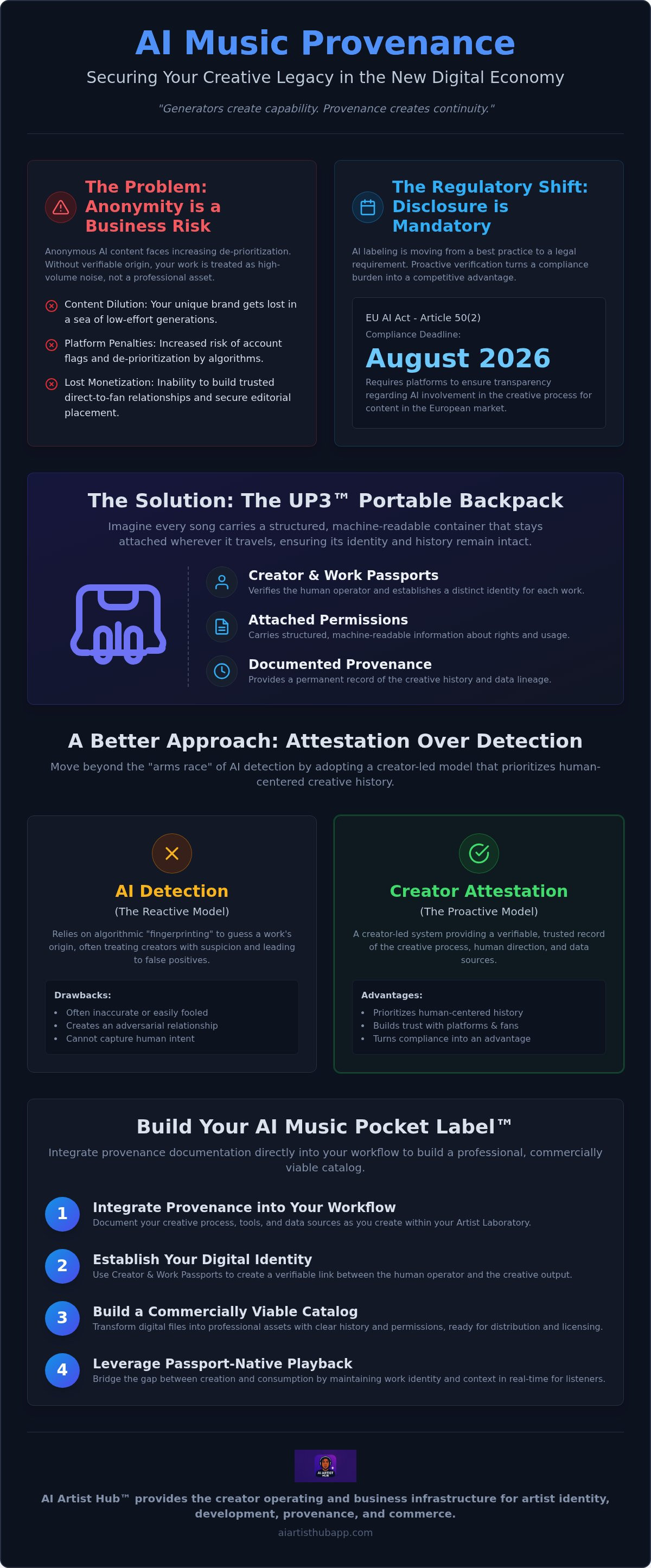
- Learn how to navigate the 2026 regulatory landscape by implementing AI music provenance verification to meet mandatory labeling requirements like the EU AI Act.
- Discover the "portable backpack" framework for your music, ensuring that creator identity and rights travel with every song across the digital economy.
- Move beyond the "arms race" of AI detection by adopting a creator-led attestation model that prioritizes human-centered creative history over algorithmic fingerprints.
- Integrate provenance documentation directly into your Artist Laboratory workflow to build a professional, commercially viable AI Music Pocket Label™.
- Bridge the gap between creation and consumption by leveraging passport-native playback experiences that maintain work identity in real-time.
Understanding AI Music Provenance Verification in the 2026 Landscape
AI music provenance is the documented creative history and identity of a digital work. It functions as a permanent record of how a song was built, who directed the process, and what permissions are attached to it. For creators managing an AI Music Pocket Label™, this creates identity continuity for virtual artists. Without this foundation, your work is just a set of floating bits with no tether to a creator brand. True verification moves beyond simple metadata by establishing a chain of data provenance that stands up to platform scrutiny.
We're entering what industry leaders call the "Year of Trust." As AI tools become ubiquitous, value shifts from the ability to generate a sound to the ability to prove its origin. Implementing AI music provenance verification provides the infrastructure needed to turn a digital file into a professional commercial asset. It ensures that your creative voice remains distinct in an increasingly crowded marketplace.
The Problem: Why Anonymity is a Business Risk
Anonymous AI content faces increasing de-prioritization by DSPs and social algorithms. Platforms are evolving to favor "known" entities to protect their user experience from bot-driven saturation. If a platform can't verify the origin of a track, it often treats the content as high-volume noise rather than a professional asset. This leads to content dilution. Your unique artist brand gets lost in a sea of low-effort generations when there's no verifiable link between the creator and the output.
- Difficulty in securing editorial playlisting on major streaming services.
- Increased risk of account flags for coordinated inauthentic behavior.
- Inability to claim and verify official artist channels.
Professional creators recognize that anonymity prevents the formation of direct-to-fan relationships. You can't monetize a community if that community doesn't trust the source of the music. Trust is the baseline for all digital commerce.
The Regulatory Shift: From Optional to Mandatory Disclosure
The industry is rapidly approaching the August 2026 compliance deadline set by the EU AI Act Article 50(2). This regulation moves AI labeling from a voluntary best practice to a mandatory legal requirement for any content interacting with the European market. Platforms are now obligated to provide transparency regarding AI involvement in the creative process. Adopting AI music provenance verification today isn't just about following rules. It's a strategic move to stay ahead of the curve.
By using the UP3™ Protocol, creators provide a verifiable record that distinguishes their work from unmanaged AI output. This proactive transparency builds trust with distributors and listeners alike. It ensures that your portfolio remains commercially viable as regulations tighten globally. You don't want to wait for a platform to pull your catalog because you lacked the proper documentation. Proactive verification turns a compliance burden into a competitive advantage.
The Mechanics of Portable Music Provenance: The Backpack Analogy
Imagine every song you release carries a portable backpack. This backpack isn't just a simple metadata tag or a hidden comment in a digital file. It's a structured, machine-readable container that stays attached to the audio wherever it travels. Within the UP3™ Protocol, this system ensures that AI music provenance verification is as mobile as the music itself. Whether your track lives on a streaming platform, a social media clip, or a private server, its identity remains intact and accessible to the systems that need to verify it.
This portable infrastructure provides the essential context about the creator, the credits, and the intended rights. It's important to understand that this system documents history rather than replacing legal adjudication. It offers a clear, structured record of "how it happened" so that platforms and fans can see the human intent behind the machine. By providing this level of transparency, you differentiate your work from anonymous, unverified AI generations that often face distribution hurdles or algorithmic suppression. You can examine the technical framework of the UP3™ Protocol to see how these backpacks secure your catalog's future.
Creator and Work Passports: Your Digital Identity
The system operates through two primary layers: the Creator Passport and the Work Passport. Your Creator Passport serves as your portable identity, verifying the human operator behind the AI Music Pocket Label™. It establishes your reputation and continuity across the entire ecosystem. In contrast, the Work Passport is a specific record for an individual track or release. It details the specific journey of that work from the initial prompt to the final master. These passports interact to create an interoperable trust layer that functions across different platforms without technical friction.
What Lives Inside the Passport?
The passport contains granular data points that build a complete picture of the work's origin. This includes the specific generation tools used, the level of human oversight applied during the process, and clear rights declarations. You can also integrate industry standards like ISRC codes and session IDs directly into the provenance record. This level of detail is crucial when navigating the U.S. Copyright Office guidance on AI, which emphasizes the importance of documenting human creative control. These passports provide interoperable trust by ensuring that every stakeholder in the music economy can read and respect the work's identity through a standardized, machine-readable format.
Attestation vs. Detection: Why Identity Trumps Fingerprinting
Stop playing defense against detection algorithms. The current industry focus on AI detection is a digital arms race that creators will eventually lose. As generative models evolve, the gap between human and machine output narrows until detection tools produce more false positives than accurate results. This reactive approach relies on third parties guessing the origin of your work. True authority comes from attestation, a creator-led declaration of facts backed by the UP3™ Protocol. This framework shifts the power back to you by prioritizing creator-controlled records over algorithmic guesswork.
Proactive attestation builds a durable brand because it establishes a permanent link between the creator and the output from the moment of inception. While detection tools try to catch you in the act of using AI, AI music provenance verification allows you to own the narrative. You aren't hiding the technology; you're documenting its professional application within your creative workflow. This transparency fosters a high-utility environment where trust is a feature of the product rather than a side effect of a scan.
The Limitations of AI Watermarking
Audio watermarking and fingerprinting are fragile solutions for a complex economy. These technical markers often get stripped or corrupted during distribution, especially when tracks are compressed for social media or re-recorded. More importantly, fingerprinting fails to distinguish between ethical AI use and extractive practices. It labels the sound but ignores the process. Attestation provides a richer narrative, allowing you to prove the level of human oversight and the specific tools used. This level of detail is essential for creators who want to demonstrate their role as a visionary architect of their sound.
Building Interoperable Trust via Attestation
Attestation allows for full disclosure without sacrificing the magic of a virtual artist brand. You can maintain the mystery of a persona while providing the machine-readable data that platforms require for compliance. This system ensures your credits stay attached to your music even when it goes viral across unlinked platforms. Verification tools help you maintain a scalable portfolio of artists with label-like discipline. For a deeper look at the legal and strategic implications of this shift, consult our AI music ownership verification guide. By leading with identity rather than hiding from detection, you secure a AI music provenance verification record that survives platform shifts and model updates.
Implementing Provenance in Your AI Music Pocket Label™
Integrate provenance directly into your Artist Laboratory workflow to transform a raw audio file into a verified commercial asset. This process begins the moment you initiate a generation and continues through the final mix and master. By documenting every stage of the creative history, you provide the necessary evidence of human oversight that platforms and distributors now demand. This systematic approach to AI music provenance verification ensures that your work isn't just another disposable file but a structured part of a professional catalog.
Assets listed on the AI Artist Hub Marketplace command higher value when they include these verification signals. Buyers and collaborators look for the "provenance seal" to ensure they're acquiring music with a clean, documented history. This transparency allows you to differentiate your roster of virtual artists by proving each one has a unique, managed identity. It moves your operation from a casual experiment to a scalable business infrastructure.
Establishing Trust with Your Fan Base
Proven identity converts casual listeners into loyal fans by removing the "uncanny valley" of anonymous AI generation. When fans see a verification badge or a Creator Passport on an artist profile, they understand there's a human visionary architecting the experience. This psychological benefit of transparency shouldn't be underestimated. In an economy flooded with low-effort content, your willingness to provide a record of your process builds a bridge of authenticity. It tells your audience that you value their time and trust enough to be professional about your tools.
Provenance as a Foundation for Commercial Licensing
Commercial licensing requires a level of due diligence that anonymous AI content simply can't satisfy. Sync agents, brands, and film supervisors need to know the origin of a track before they'll risk a contract. Using a UP3™ Passport speeds up this vetting process by providing a machine-readable record of the work's history. It gives partners the confidence to move forward, knowing that the AI music provenance verification has already been handled. For more insights on scaling your business, explore our guide to starting an AI music label.
Access the Artist Laboratory infrastructure
Securing Your Creative Legacy with AI Artist Hub™ and UP3™
AI Artist Hub™ provides the business infrastructure to scale your pocket label, while the UP3™ Protocol ensures that your AI music provenance verification travels with every track. This combination allows you to build long-term equity in your catalog. A verified catalog isn't just a collection of songs; it's a portfolio of assets with clear, portable identities. Treat provenance as essential product infrastructure. It's the foundation of your business, not an optional add-on you consider after the fact.
The ecosystem reaches its full potential with UP3 PLAY™, which delivers a passport-native playback experience. This ensures that the audio and its provenance are inseparable during consumption. Listeners and platforms can access the identity of the work in real-time, reinforcing the trust you've built throughout the production process. By securing your creative legacy through these systems, you ensure that your work remains identifiable and valuable in a rapidly evolving digital economy.
Integrating Verification into the Release Workflow
Professional release management requires a disciplined approach to documentation. Use the following checklist to ensure every new track is ready for the market:
- Finalize the master in your Artist Laboratory workspace.
- Generate and attach the UP3™ Passport to the audio file.
- Sync the provenance record with your Release Planner and marketing tools.
- List the verified asset in the AI Artist Marketplace for commercial visibility.
This workflow transforms a simple output into a durable asset. Our core philosophy is clear: Generators create capability. AI Artist Hub creates continuity. By linking your provenance records to your broader business tools, you maintain a seamless chain of identity from the first prompt to the final stream.
The Future: Passport-Native Music and Interoperable Trust
We're moving toward a future where all music travels with its own passport for instant verification. This infrastructure supports a human-centered, creator-controlled economy where your reputation is as portable as your audio. It eliminates the friction of manual rights checks and provides a standardized way to carry credits across different platforms. We invite you to explore the protocol to learn more about the UP3™ framework and how it secures the future of your AI music career. Adopting AI music provenance verification today sets the standard for the industry's next decade.
Lead the Future of Verifiable Music
The transition toward a transparent AI music economy is inevitable. By adopting AI music provenance verification today, you position your portfolio for the August 2026 compliance standards and global regulatory shifts. You've learned that generators create capability, but only a structured business infrastructure creates continuity. Moving from simple audio files to passport-native assets secures your reputation and commercial rights in a competitive global marketplace.
Leverage patent-pending UP3™ technology to ensure your creative intent travels with every track. This creator-centered approach replaces the uncertainty of detection with the authority of attestation. You aren't just making music; you're building a scalable digital venture backed by verifiable history and professional label-like discipline.
Take control of your creative output and lead the next era of digital artistry with total confidence.
Frequently Asked Questions
What is AI music provenance and why do I need it in 2026?
AI music provenance is the documented record of a digital work's creative history and origin. You need it in 2026 because global regulations, specifically the EU AI Act, move from voluntary guidelines to mandatory disclosure requirements. Implementing AI music provenance verification ensures your work remains commercially viable. It distinguishes your professional output from anonymous, low-effort generations that platforms are increasingly likely to deprioritize or flag for non-compliance.
Does a UP3™ Passport prove that I legally own my AI music?
No, a UP3™ Passport does not legally prove ownership or grant copyright. It serves as a portable record of the work's history, documenting the tools used and the level of human creative control involved. While this information is valuable for due diligence and transparency, it doesn't replace government registration, legal review, or platform-specific rights clearance. Think of it as a detailed logbook rather than a legal deed of title.
Is AI music labeling mandatory under the EU AI Act?
Yes, AI music labeling becomes mandatory under Article 50(2) of the EU AI Act by August 2026. Platforms and creators will be legally obligated to provide transparency about AI involvement in the creative process. Proactive AI music provenance verification helps you meet these transparency standards before they become a barrier to distribution. Failing to provide verifiable labels could result in catalog removals or restricted access to European markets and major digital service providers.
How is attestation different from AI detection software?
Attestation is a creator-led declaration of facts, whereas detection software uses algorithms to guess if content is AI-generated. Detection is an arms race where tools often produce false positives as models improve. Attestation provides a richer, more durable narrative because you control the record from the moment of creation. It moves your brand from a defensive posture to one of professional transparency, building long-term trust with your audience.
Can I use provenance verification for music generated on any platform?
Yes, the UP3™ Protocol is a generator-agnostic infrastructure designed to work with music created on any platform. You can document the creative history regardless of the specific software used in your Artist Laboratory. This flexibility allows you to maintain a consistent provenance standard across your entire portfolio of virtual artists. It ensures that your identity and rights context remain portable even if you switch generation tools or workflows in the future.
How does portable provenance help me sell music on a marketplace?
Portable provenance increases the market value of your assets by providing immediate trust signals to potential buyers. In the AI Artist Marketplace, verified tracks command more attention because they include a documented history of human oversight and clear rights declarations. This transparency speeds up the due diligence process for commercial deals. Buyers feel more confident acquiring music that carries a machine-readable record of its origin and intended permissions.
What is the "backpack" analogy for music provenance?
The backpack analogy describes how data travels with a song as a portable, attached container. Just as a traveler carries essential items in a backpack, your music carries structured context about its creator, credits, and rights wherever it is played. This ensures the information is always available to platforms and listeners without requiring a central database check. It's a system for portability of information, making the work's identity as mobile as the audio itself.
Will having a verification passport help me get my music on Spotify?
Having a verification passport helps you meet the growing transparency demands of major DSPs like Spotify. While it doesn't guarantee playlisting or bypass platform-specific policies, it provides the documentation needed to prove your work is a managed professional asset. As platforms evolve to protect their ecosystems from anonymous bot content, being a known creator with verifiable provenance becomes a significant competitive advantage. It helps you build a reputable artist brand that distributors can trust.

Article by
Julius J. White (VVS Jules)
Julius J. White (VVS Jules) is the Founder & CEO of JJW AI Studios™ and builder of AI Artist Hub™, a creator-first operating platform for the emerging AI music economy. A musician, songwriter, producer, entrepreneur, and systems builder, he developed the AI Music Pocket Label™ framework around a simple idea: generation is only the beginning. His work focuses on the identity, provenance, credits, ownership context, permissions, artist development, direct-to-fan relationships, commerce, trust infrastructure, and business systems creators need to build durable AI artist brands, organized catalogs, and long-term creative ventures.
Disclaimer
This article is provided for general educational and informational purposes only and does not constitute legal, financial, tax, investment, or other professional advice. Laws, regulations, platform policies, technology, and industry practices may change over time. References to AI Artist Hub™, UP3™, UP3 PLAY™, provenance, verification, ownership assertions, permissions, creator tools, protected media, streaming or platform policies, or AI-related rules describe general information and current product capabilities where verified. They do not constitute government registration, legal adjudication, third-party rights clearance, regulatory approval, copyright ownership, guaranteed authenticity, or guaranteed permission for commercial use. Readers should independently verify current requirements, review applicable platform and rights terms, and consult qualified professionals when appropriate.
