


Generative tools give you the capability to produce endless tracks, but they don't provide the business continuity needed to build a lasting brand. You've likely felt the frustration of managing complex metadata across multiple virtual personas while worrying about the shifting sands of legal standing. Without professional systems in place, AI music ownership management quickly becomes a disorganized mess of files rather than a valuable commercial catalog. You need a way to treat your digital creations with the same strategic discipline as a traditional record label.
This guide shows you how to navigate the complexities of virtual artist rights and metadata using the AI Music Pocket Label™ framework. You'll learn to establish a professional rights management workflow and clarify provenance for every track you release. We'll also introduce the UP3™ protocol, which acts like a portable backpack for your music; it carries essential context about creators and permissions wherever the file travels. It's time to stop just generating content and start building a scalable, structured virtual artist business that's ready for the high-tech future of the music industry.
Key Takeaways
- Identify the "Generator Gap" and understand why traditional human-centric rights models are insufficient for the speed and scale of virtual artist creation.
- Adopt the AI Music Pocket Label™ thesis to manage portfolios of virtual personas with the professional discipline and software leverage of a modern record label.
- Establish a robust AI music ownership management workflow that prioritizes identity-centered provenance and machine-readable metadata over simple file storage.
- Utilize the UP3™ Universal Provenance Passport Protocol to provide your tracks with a "portable backpack" of context, credits, and permissions that stays with the media.
- Implement a rights-ready production cycle within an Artist Laboratory to document the creative history and verification of your digital assets from the moment of inception.
Why Traditional Rights Management Fails AI Music Creators
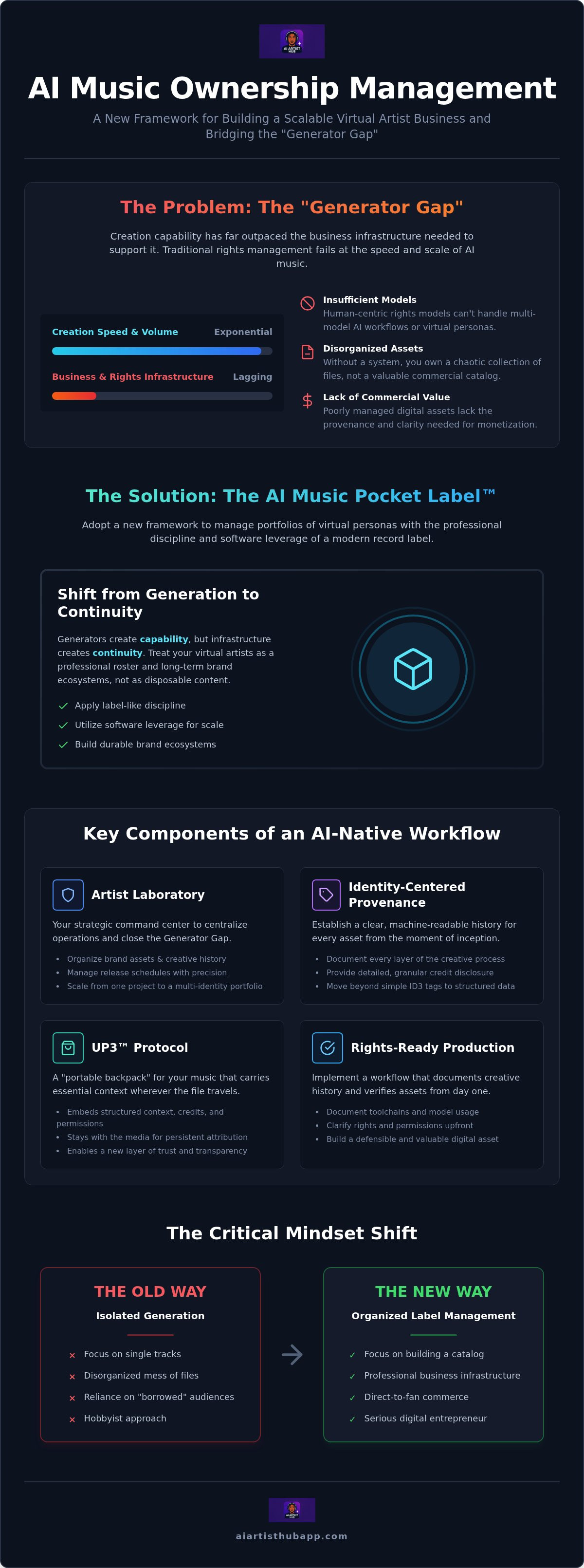
Traditional rights management architectures were built for a human-centric era. They prioritize physical performance and mechanical rights models that don't translate to the speed of generative media. For decades, the industry relied on the physical presence of a songwriter or performer to anchor legal claims. Today, that anchor is gone. We've entered a period known as the "Generator Gap," where creation capability has far outpaced the business infrastructure needed to support it. You can now produce a year's worth of music in a single afternoon, but without a system to manage that volume, you own a collection of files rather than a commercial asset.
Effective AI music ownership management bridges this gap. It's a structured system for identity, trust, and business continuity. Rather than relying on simple ID3 tags, creators need granular provenance. This includes detailed credit disclosure and a record of the creative process that legacy systems aren't equipped to handle. Establishing this framework is the only way to turn raw output into a scalable, professional catalog that maintains its value over time.
The Problem of Rights Clarity in Generative Media
Attribution is the primary challenge in multi-model AI workflows. When you use one model for a melody and another for a specific vocal timbre, legacy models for attribution break down. Traditional Performing Rights Organizations (PROs) are designed for human members, often leaving virtual artists in a legal gray area. To build a valuable creator-owned catalog for the 2026 economy, you must move beyond these limitations. You need a way to document every layer of the creative process, ensuring that your context and permissions are clear from the moment of inception.
Moving from Song Generation to Business Continuity
Generators create capability, but infrastructure creates continuity. Many creators make the mistake of focusing solely on the "isolated generation" of tracks. This approach lacks the strategic depth required to build a lasting brand. By shifting to an "organized label management" mindset, you treat your AI artists as a professional roster. This requires a business infrastructure layer that follows the music after it leaves the generator. A human-centered system creates a reliable paper trail, allowing you to manage portfolios of artists with the same discipline as a major label. This shift is what transforms a hobbyist into a serious digital entrepreneur.
The AI Music Pocket Label™: A New Framework for Ownership Management
The AI Music Pocket Label™ thesis represents a fundamental shift in how digital entrepreneurs approach the market. It moves beyond the idea of simply making a song and into the territory of building a robust business infrastructure. By applying label-like discipline, you can manage multiple virtual identities simultaneously without the overhead of a traditional record company. This framework ensures that AI music ownership management isn't just about filing digital paperwork; it's about creating a durable brand ecosystem that thrives on software leverage.
Virtual artists are not disposable content. They are valuable intellectual property assets that require active, strategic management. When you treat these identities as long-term brand ecosystems rather than one-off outputs, you unlock the ability to scale your creative business. You aren't just a creator. You are the architect of a digital roster, using professional systems to maintain control over your creative trajectory and commercial potential.
Establishing Artist Laboratories for Roster Management
The core of this system is the Artist Laboratory. Think of the Lab as your strategic command center where you organize brand assets, creative history, and release schedules. It's the environment where the "Generator Gap" mentioned earlier is effectively closed. By centralizing your operations, you can learn how to manage an AI artist roster and brand portfolio with precision. This structured environment allows you to scale from a single project to a multi-identity empire without a linear increase in administrative work.
Direct-to-Fan Commerce and Rights Control
A successful label doesn't just produce music; it controls its distribution and audience relationships. Relying on "borrowed audiences" from massive social platforms is a significant risk to your business continuity. Instead, use the AI Artist Hub Marketplace to establish direct-to-fan commerce. This gives you direct ownership of your audience data and reinforces the commercial value of your virtual artist brands. By integrating your commerce systems with your ownership records, you create a seamless loop of trust and transaction. You can explore current market-ready virtual artists to see how these professional principles are applied in a live commercial environment.
Key Components of AI-Native Ownership Management Software
Generic enterprise resource planning tools aren't enough for the high-velocity world of generative media. You need software specifically designed to handle the nuances of synthetic assets. Professional AI music ownership management requires a suite of tools that go beyond simple file storage. It demands a system capable of tracking the evolution of an artist identity while maintaining a rigorous record of every track origin. For larger entities managing vast catalogs, you can explore Enterprise Knowledge Graph solutions to unify complex data into a structured, actionable format.
Effective software must integrate several core functions to ensure commercial viability:
- Provenance and Verification: This is the foundation of trust, documenting the specific models, prompts, and human interventions that shaped a work.
- Machine-Readable Metadata: Records must travel with the media, ensuring that credits and permissions aren't lost when a file moves across different platforms.
- Identity Management: This binds specific releases to consistent virtual personas, preventing your roster from becoming a disjointed collection of anonymous tracks.
- Release Planning: You need tools to organize commercial milestones and marketing campaigns with the same precision as a major label.
Provenance vs. Legal Ownership
It's vital to distinguish between documenting history and claiming legal rights. Provenance is the creative paper trail of a digital asset. While these tools provide essential transparency and disclosure, they don't replace government copyright registration or guarantee legal standing. Instead, they build public trust by showing exactly how a work was made. This clarity is your greatest asset when navigating a market that increasingly values transparency around training data and creative attribution. By establishing this record early, you prepare your catalog for future licensing opportunities that require high levels of trust.
Identity Binding and Verification Signals
Building a brand in the digital-native economy requires more than just audio output. You must establish verification signals that prove your virtual artist is a continuous, managed entity. Identity binding ensures that every song released under a specific persona contributes to a larger brand lore. This moves you away from being a "capable generator" and toward being a "continuous brand." By managing these systems within a central operating environment like the AI Artist Hub operating layer, you ensure that your roster maintains its integrity as it scales. You can check our pricing to see how different tiers support these advanced identity and verification features, allowing you to choose the infrastructure that matches your current growth stage.
Implementing a Rights-Ready Workflow for Virtual Artists
Transitioning from a casual creator to a professional label owner requires a repeatable, high-integrity workflow. You can't manage a scaling catalog with spreadsheets and manual file naming. A rights-ready workflow ensures that every asset you produce is commercially viable and backed by a clear record of its creation. By integrating AI music ownership management directly into your production cycle, you protect your business from the "Generator Gap" and build long-term value.
Follow these five steps to establish a professional operating environment:
- Step 1: Define the Brand System. Use an Artist Laboratory Workspace to establish visual and sonic consistency for your virtual persona.
- Step 2: Document the Creative Process. Utilize provenance tools to record the specific inputs and human interventions during the track's development.
- Step 3: Organize Interoperable Metadata. Implement the UP3™ Universal Provenance Passport Protocol. This acts like a portable backpack, ensuring your credits and permissions stay with the song.
- Step 4: Secure Audience Data. Establish direct-to-fan commerce channels via the AI Artist Hub Marketplace to reduce reliance on third-party platforms.
- Step 5: Monitor Performance. Use a central dashboard to track your roster's growth and maintain your ownership records in one location.
Best Practices for AI Metadata Disclosure
Transparency builds brand equity. When you disclose the collaborative nature of your human-AI workflows, you foster trust with digital-native audiences. Standardize your credits within the metadata layer to clearly distinguish between human creative direction and model-generated capability. Avoid the pitfall of "borrowed provenance," where identity records are inconsistent or poorly documented. Clear disclosure isn't just a hurdle; it's a verification signal that your brand is professional and reliable.
Scaling Your Roster with Software Automation
Software provides the leverage. It's the key to managing multiple virtual brands without a linear increase in workload. Automate your release schedules and commerce workflows to maintain a consistent market presence. While you use AI-enabled scale to expand your reach, keep your approach human-centered. You are the architect of the system, using software to handle the administrative heavy lifting while you focus on strategic development and brand lore.
Deploy your rights-ready workflow in the AI Artist Hub
Leveraging AI Artist Hub™ and UP3™ for Portable Provenance
Generators create the audio, but the UP3™ Universal Provenance Passport Protocol creates the portability. Effective AI music ownership management relies on information that moves as fast as the media does. Within the AI Artist Hub™ ecosystem, we utilize the "backpack analogy" to describe this functionality. Imagine every song you produce travels with a portable backpack. Inside this backpack is structured context about the creator, the specific credits, and the associated permissions. The purpose is portability of information, not a claim that the backpack legally proves every fact inside it.
The Hub provides the essential business infrastructure to generate and manage these records at scale. You aren't just tagging files with static data. You are building a verifiable history that stays attached to your assets as they move through the digital supply chain. This interoperable trust is the foundation of the 2026 music economy. In this emerging landscape, synthetic and human-led works must coexist with clear attribution and consistent identity records. Establishing this "continuity layer" now ensures your virtual roster is ready for commercial expansion.
Portable Provenance and the Future of Music Identity
The .up3 file format packages provenance data directly with audio playback. This ensures that wherever your music is heard, the identity of the virtual artist remains intact and recognizable. To understand the deeper mechanics of this system, read our guide on Universal Provenance: How UP3™ Passports Preserve Your Work’s Identity and History. This technology is a core part of our infrastructure, currently covered by U.S. Provisional Patent Application No. 64/137,095. By binding history to playback, you prevent your work from becoming "anonymous audio" in an increasingly crowded market.
Interoperable Trust: Moving Beyond Single Platforms
Build a portable creator passport that travels across the entire music ecosystem. Machine-readable rights and permissions are essential for AI-native music to move beyond single platforms or closed silos. UP3™ serves as the "trust layer" for the emerging economy, allowing different services to recognize the credits and context you've established in your Artist Laboratory. This interoperability ensures that your AI music ownership management strategy isn't limited to a single dashboard. It prepares your virtual roster for a future where music identity is as fluid and portable as the listeners themselves. You can view the technical protocol details to see how this infrastructure supports long-term business continuity.
Building for Long-Term Digital Continuity
Secure your creative legacy by establishing a professional foundation for your output. The transition from isolated generation to structured AI music ownership management defines the successful digital entrepreneur. Use the AI Music Pocket Label™ thesis to transform your virtual artists into durable brands rather than disposable content. You now hold the framework to document provenance through the patent-pending UP3™ Protocol, providing your work with the portable trust required for the 2026 economy.
Our generator-agnostic infrastructure prioritizes human-centered creative continuity. It allows you to maintain strategic control while scaling your roster across multiple identities with label-like discipline. You've learned how to close the Generator Gap by building a business layer that travels with your music. Take the final step toward commercializing your catalog and securing your creative future in this high-tech landscape. Your journey from creator to label owner starts with the right systems.
Build your AI Music Pocket Label™ on AI Artist Hub™ today
Frequently Asked Questions
Does AI music ownership management software guarantee copyright?
No, AI music ownership management software does not guarantee legal copyright or replace official government registration. It provides a structured record of creative history and provenance to support your business operations and internal continuity. Legal standing for AI works remains a complex and evolving area. You should always consult with qualified legal counsel regarding specific contracts or intellectual property claims.
What is the difference between traditional rights management and AI provenance?
Traditional rights management relies on human-centric performance and mechanical models to track royalty splits. In contrast, AI provenance documents the digital "birth" of a work, including specific model inputs and human creative direction. While legacy systems focus on human performers, provenance tools create a creative paper trail for synthetic assets to ensure transparency in the digital supply chain.
How does the UP3™ Protocol help with AI music metadata?
The UP3™ Protocol standardizes metadata into a portable identity and permissions layer. It ensures that essential context about the creator and the work stays attached to the media file as it moves across the ecosystem. This interoperable framework prevents your credits and permissions from being stripped away, which is a common failure point when using legacy ID3 tags.
Can I manage multiple AI artists using a single platform?
Yes, the AI Music Pocket Label™ framework is designed specifically for managing portfolios of virtual personas. You can operate multiple artist identities from a central dashboard, treating each as a distinct brand ecosystem. This software leverage allows you to scale a multi-artist roster with professional discipline without the administrative overhead associated with a traditional record label.
Why do I need a "Pocket Label" if I already use an AI music generator?
Generators create capability, but labels create continuity. While a generator produces a raw track, a Pocket Label provides the business infrastructure needed to turn that track into a commercial asset. Without a management layer, you own a disorganized collection of files. With one, you build a scalable virtual artist business with organized records, brand lore, and commercial structure.
Is AI music ownership management software compatible with traditional DSPs?
Most AI music ownership management tools act as the internal record-keeping layer rather than a direct distribution service. They provide the metadata and provenance records you need to satisfy the verification requirements of modern platforms. While the software manages your internal business continuity, you typically still use specialized distribution services to deliver the actual audio to major streaming platforms.
What is the "backpack analogy" for music provenance?
The backpack analogy describes how a song travels with its own portable context. Imagine every music file wears a "backpack" containing structured data about the creator, credits, and usage permissions. This ensures that the information is portable and accessible wherever the song is played. It moves the data with the file rather than keeping it locked in a single, isolated database.
How do I build trust with my audience using verification tools?
You build trust by providing transparency through documented creative processes. Verification signals prove to your audience that your virtual artist is a managed, continuous entity rather than a series of random, low-effort outputs. This disclosure builds long-term brand equity, as digital-native listeners increasingly value clarity regarding how synthetic media is produced, attributed, and managed by human creators.

Article by
Julius J. White (VVS Jules)
Julius J. White (VVS Jules) is the Founder & CEO of JJW AI Studios™ and builder of AI Artist Hub™, a creator-first operating platform for the emerging AI music economy. A musician, songwriter, producer, entrepreneur, and systems builder, he developed the AI Music Pocket Label™ framework around a simple idea: generation is only the beginning. His work focuses on the identity, provenance, credits, ownership context, permissions, artist development, direct-to-fan relationships, commerce, trust infrastructure, and business systems creators need to build durable AI artist brands, organized catalogs, and long-term creative ventures.
Disclaimer
This article is provided for general educational and informational purposes only and does not constitute legal, financial, tax, investment, or other professional advice. Laws, regulations, platform policies, technology, and industry practices may change over time. References to AI Artist Hub™, UP3™, UP3 PLAY™, provenance, verification, ownership assertions, permissions, creator tools, protected media, streaming or platform policies, or AI-related rules describe general information and current product capabilities where verified. They do not constitute government registration, legal adjudication, third-party rights clearance, regulatory approval, copyright ownership, guaranteed authenticity, or guaranteed permission for commercial use. Readers should independently verify current requirements, review applicable platform and rights terms, and consult qualified professionals when appropriate.
