


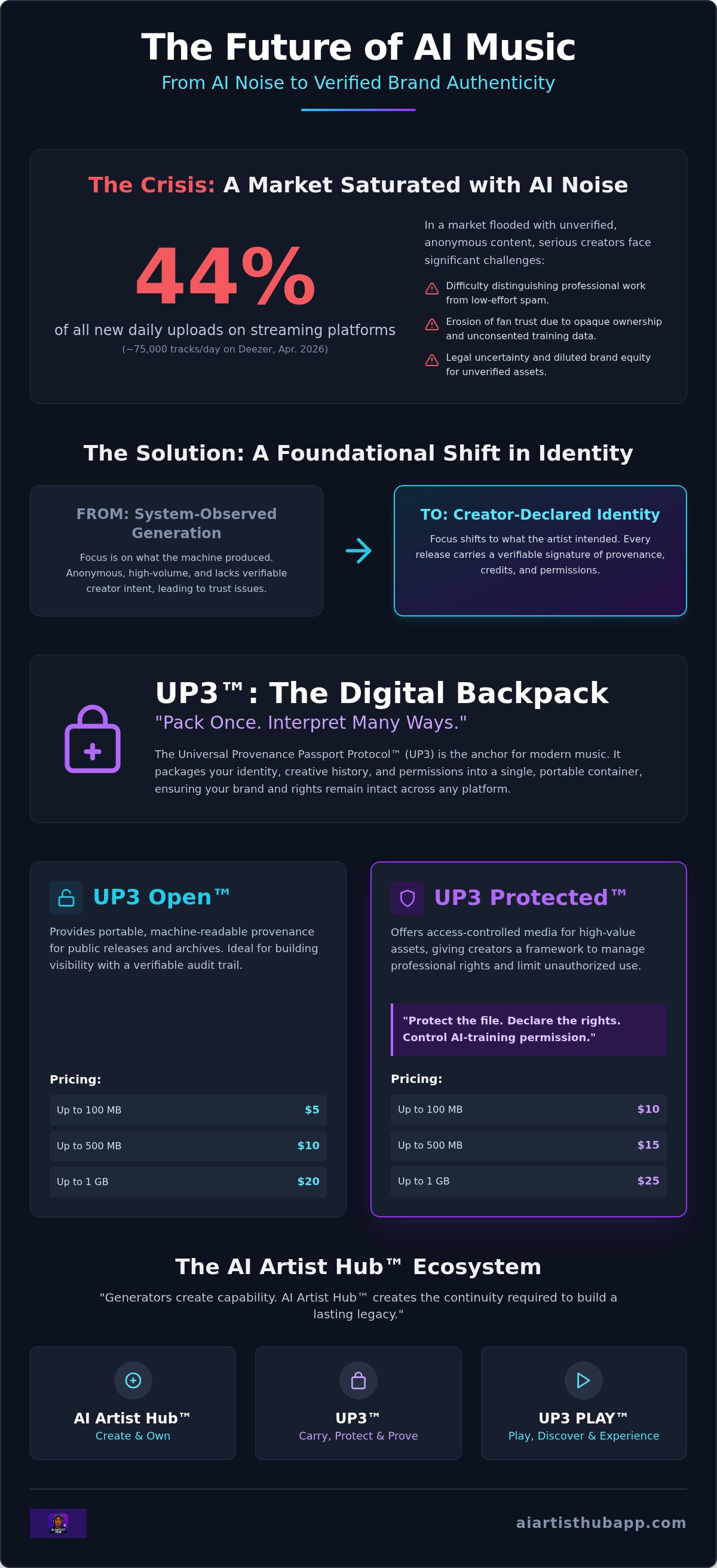
By April 2026, approximately 75,000 fully AI-generated tracks were flooding streaming platforms like Deezer every single day, accounting for nearly 44% of all new uploads. In a market saturated with synthetic output, establishing AI artist brand authenticity is no longer optional for serious creators; it's the foundation of a professional career. You've likely felt the growing disconnect from "soulless" generation or the legitimate fear of accidentally supporting unconsented training data. It's difficult to build a sustainable business when ownership is opaque and quality is inconsistent.
This analysis shows you how to bridge that gap. Discover how verified provenance and passport-native playback are transforming AI music from experimental noise into high-trust digital infrastructure. We'll examine how the UP3™ protocol functions as a digital backpack for your work, allowing you to pack once and interpret many ways. You'll learn to identify high-quality verified brands and see how provenance-aware playback through UP3 PLAY™ creates a deeper connection with your audience. Generators create capability, but AI Artist Hub™ creates the continuity required to build a lasting legacy.
Key Takeaways
- Distinguish your work from generic AI noise by shifting from system-observed generation to creator-declared identity and provenance.
- Leverage the UP3™ protocol as a "Digital Backpack" to ensure your brand's history and permissions remain portable across the ecosystem.
- Implement passport-native playback with .up3 files to deliver high-trust audio experiences that legacy MP3s can't match.
- Strengthen AI artist brand authenticity by adopting a verification framework that builds deep, reliable connections with your audience.
- Build professional continuity for your creative venture by applying the AI Music Pocket Label™ framework to your artist roster.
Beyond the Hype: Defining Verified AI Music Listening Experiences
2026 signals a definitive pivot in the digital music economy. The era of "AI noise" is ending as creators abandon anonymous, high-volume generation in favor of verified brands. Successful founders now prioritize AI artist brand authenticity to distinguish professional assets from experimental clutter. This transition replaces system-observed generation with creator-declared identity. It moves the focus from what the machine produced to what the artist intended, ensuring that every release carries a verifiable signature that fans can trust.
The Crisis of Unverified AI Content
Founders currently face a haze of legal uncertainty and ethical friction. Generic streaming platforms struggle to distinguish between legitimate AI brands and low-effort spam. This lack of clarity erodes fan trust and dilutes artist equity. The copyright status of AI-generated works remains a primary concern for those who fail to document their process. In April 2026, roughly 75,000 AI tracks were uploaded daily to Deezer, accounting for 44% of all new uploads. Without verification, your work is buried under uncredited, unconsented data.
Trust as the New Cultural Touchstone
Audiences have moved past the novelty of generative tools. They now ask a more critical question: "Who stands behind this music?" Provenance is the primary driver of value in the digital era. Establishing an authentic creator-fan relationship requires more than just a catchy melody; it requires proof of origin. Verified AI music ensures that provenance, credits, and permissions are inseparable from the media. The enforcement of the EU AI Act Article 50 on August 2, 2026, has codified this need, making machine-readable provenance a legal necessity for professional operations.
AI Artist Hub™ provides the infrastructure to establish this continuity for virtual brands. By moving away from "black box" generation and toward transparent, human-centered systems, you protect your AI artist brand authenticity. This approach respects traditional musicians and acknowledges the importance of consent and attribution. Verification restores the deep connection fans crave. It turns a simple digital file into a high-trust professional asset. Remember, generators create capability, but AI Artist Hub™ creates the continuity required for a sustainable music label.
The Digital Backpack: How UP3™ Solves the Music Identity Crisis
The Universal Provenance Passport Protocol™, or UP3™, acts as the essential anchor for modern music ventures. Think of it as a "Digital Backpack" for your creative output. You pack your identity, history, and permissions into a single portable container. This "Pack Once. Interpret Many Ways" philosophy ensures that your work remains consistent across every platform it touches. By 2026, portable provenance has become the industry standard for establishing AI artist brand authenticity. Without a machine-readable passport, your tracks are just anonymous data points in a crowded market.
UP3™ distinguishes between creator-declared metadata and system-observed provenance within a single passport. Creator-declared data captures your brand identity and artistic intent. System-observed data provides a technical log of the asset's origin and creation environment. Together, they create a high-trust environment where fans and platforms can verify the source of every sound. This structure allows you to carry your professional reputation into any interoperable space without losing control of your narrative.
UP3 Open™ vs. UP3 Protected™
Creators choose between two primary modes based on their commercial goals. UP3 Open™ provides portable provenance for public releases and archives. It costs $5 for up to 100 MB, $10 for up to 500 MB, and $20 for up to 1 GB. This mode is ideal for building visibility while maintaining a clear, verifiable audit trail of your work's origin.
UP3 Protected™ offers access-controlled media for high-value assets. It costs $10 for up to 100 MB, $15 for up to 500 MB, and $25 for up to 1 GB. Use the UP3™ protocol in Protected mode to "Protect the file. Declare the rights. Control AI-training permission." While this mode doesn't make copying universally impossible, it provides the structured framework needed to manage professional rights and limit unauthorized use. If you're ready to secure your assets, you can explore the protocol specifications to see which tier fits your current roster.
Recording DNA™: Documenting the Creative Process
Establishing ownership context requires more than just a final audio file. Recording DNA™ provides a documentation layer that captures your specific contributions as a creator. This documentation moves your work beyond the "black box" of raw AI generation by providing clear creative credits. Maintaining these records is a practical step for those following U.S. Copyright Office guidance regarding works containing AI-generated material. By documenting the human creative journey, you build the foundation for AI artist brand authenticity and long-term commercialization.
Passport-Native Playback: Why 2026 is the Year of the .up3 File
The generic MP3 is rapidly becoming a legacy format. It's an "unaware" file that carries audio but lacks a verifiable identity. In 2026, professional creators have shifted to passport-native playback using the .up3 file format. This shift is driven by the need for AI artist brand authenticity, ensuring that every play is backed by a secure provenance record. Unlike static files, a .up3 package carries its own credentials, permissions, and history. It's a smart asset that knows where it came from and who's allowed to hear it.
This technology follows the "Pack Once. Interpret Many Ways" philosophy. You create the asset once, and the passport determines how different environments handle it. For high-value releases, the protocol creates a fail-closed environment. If the playback system can't verify the passport's integrity, it won't play the file. This ensures your professional work isn't stripped of its context or used in ways you haven't authorized. Asset integrity is the new baseline for professional digital music.
UP3 PLAY™: Discovery Built on Interoperable Trust
Professional discovery requires more than a simple play button. UP3 PLAY™ serves as the software-based receiving layer for these packages. It's not a generic streaming service that hoards your data; it's a specialized environment that interprets your passport. During playback, the system distinguishes between UP3 Open™ and UP3 Protected™ assets. Open files allow for broad discovery and archival, while Protected files enforce access controls. This creates an interactive, provenance-aware listening experience that builds fan trust through transparency.
Streaming vs. Passport-Native Experiences
Traditional Digital Service Providers (DSPs) operate as closed ecosystems. They control the relationship between you and your audience, often stripping away the metadata that proves your brand's legitimacy. Passport-native files bypass these silos. They provide portable trust that moves with the file across multiple external platforms. This shift toward direct-to-fan discovery protects your creator equity. Fans no longer have to guess if a track is a legitimate release or an unverified upload. By using verified creator passports, you establish a direct, high-trust connection that legacy streaming formats simply can't provide.
Navigating the New Landscape: A Framework for Authentic AI Discovery
Discovery in 2026 requires a structured framework. Fans no longer accept anonymous, unverified uploads. They look for specific signals of AI artist brand authenticity before investing their time or money. Identifying a verified experience starts with technical validation. You check for the UP3™ Passport. This isn't a mere tag; it's the mark of professional provenance. It tells the listener that the creator has declared their identity and permissions. It confirms that the asset isn't just random noise, but a professional digital asset with a clear history. This verification process separates serious founders from hobbyists.
Evaluate brand consistency through world-building and lore. Virtual artist lore provides the emotional context that raw generation often lacks. A professional brand maintains a coherent narrative across releases, social media, and interactive experiences. This depth proves that a human architect is steering the project. Verified status is the first step toward building a legitimate enterprise. It transforms a creative project into a long-term creator business by providing a foundation of trust that persists even if external platforms change their policies.
The Artist Laboratory: Where Identity is Built
Professional identity isn't accidental. It's engineered. The Artist Laboratory workspace provides the environment to organize this identity. Here, founders manage their artist roster with discipline and strategic intent. They align lore with provenance. These are the two pillars of a virtual brand. Lore gives fans something to follow. Provenance gives them something to trust. Together, they create a brand that survives platform shifts and algorithmic changes. The laboratory environment ensures that every asset released is consistent with the broader artist brand architecture.
Direct-to-Fan Relationships in the AI Era
Owning the audience relationship is the ultimate commercial goal. The Marketplace facilitates this through direct digital product sales. You aren't just selling a track. You're delivering a verified asset that carries its own permissions and history. This is provenance-aware commerce. It allows you to sell stems, high-fidelity .up3 files, and exclusive content while maintaining asset integrity. You control the delivery and you own the customer data. This direct connection is only possible when the fan knows the source is authentic. Provenance-aware discovery ensures that the transaction is the beginning of a relationship, not just a one-off play.
Build your verified AI artist brand
Building Continuity: How AI Artist Hub™ Scales Professional Experiences
Building a sustainable creative business requires more than just high-quality output. It requires a system that ensures AI artist brand authenticity persists as your catalog grows. The AI Music Pocket Label™ provides the essential framework for this micro-enterprise scale. It's the shift from being a casual user of generative tools to becoming a strategic founder who manages a professional roster. While competitors focus on generic design or reputation management, we provide the infrastructure for business continuity. AI Artist Hub™ serves as the creator home layer, allowing you to manage multiple virtual brands with professional discipline.
Scaling a music business in 2026 demands catalog management over simple song generation. A pocket label utilizes portable provenance to ensure that every asset carries its own history and permissions across the UP3 ecosystem. By using the "Digital Backpack" approach, you ensure your identity remains intact regardless of where your music is played. This model allows founders to scale from a single experimental track to a multi-artist roster without losing control of their creative equity. Our educational frameworks provide the business training needed to professionalize this next generation of music entrepreneurs, moving beyond the hype of raw capability.
The Pocket Label Thesis
Professionalizing your output means treating every track as a long-term asset. The pocket label thesis focuses on building a cohesive brand identity that fans can recognize and trust. By anchoring your work in the UP3™ protocol, you create a verifiable chain of custody that legacy formats can't match. This discipline allows you to manage your roster's permissions, ensuring that your AI artist brand authenticity is never compromised by unverified third-party use. You're not just releasing music; you're managing a growing portfolio of high-trust digital assets.
Next Steps for 2026 AI Entrepreneurs
Transitioning into the verified economy starts with a single, professional action. You must issue your first UP3™ Passport to establish a high-trust foundation for your work. This process anchors your music in an interoperable environment where fans and platforms can verify your identity and intent. Once your first asset is secured, you can establish your Artist Laboratory to manage long-term creative growth. This workspace organizes your lore, your provenance, and your permissions into a cohesive business architecture.
Professional success in the AI era isn't about finding a better prompt. It's about building a better system. You can read more about the technical foundations in our guide: What Are Verifiable Digital Music Assets?. As you move forward, keep the core strategic distinction in mind. Generators create capability. AI Artist Hub™ creates continuity. By choosing verified systems over anonymous noise, you aren't just making music; you're building a legacy that fans can trust and follow.
Secure Your Creative Legacy in the Verified Economy
The transition from experimental noise to professional digital assets is now a commercial requirement for any serious founder. By 2026, the industry has moved past raw capability to focus on verified continuity. Adopting the Portable UP3™ Provenance Protocol allows you to move from simple track generation to disciplined catalog management. This infrastructure ensures that your brand's identity and permissions remain intact across any environment it touches.
Establishing AI artist brand authenticity through creator-owned identity management is the only way to build long-term fan trust and asset integrity. You've seen how passport-native playback and the "Digital Backpack" analogy create a stable foundation for your micro-enterprise. Our Red Dot-level professional infrastructure provides the architecture you need to scale from a single project to a multi-artist roster.
The future belongs to those who prioritize provenance over prompts. Generators create capability, but you have the tools to create a lasting legacy. Take control of your creative output and lead the next generation of music entrepreneurs.
Frequently Asked Questions
What exactly are verified AI music listening experiences?
Verified experiences are high-trust digital assets where the listener can confirm the origin, creator identity, and usage permissions of a track. This transparency distinguishes professional work from anonymous AI noise. By using machine-readable passports, these experiences provide a clear audit trail that builds AI artist brand authenticity. Fans get the certainty of supporting a legitimate creator brand rather than uncredited synthetic output.
How does the UP3™ protocol verify AI music authenticity?
The UP3™ protocol verifies authenticity by embedding a cryptographically secure "Digital Backpack" into the music file. It carries creator-declared metadata and system-observed provenance, creating a verifiable chain of custody for the asset. This portable trust moves with the .up3 package across any compatible environment. The protocol allows creators to declare rights and protect files, ensuring that the asset's identity remains consistent and verifiable regardless of where it's played.
Can I listen to .up3 files on standard streaming apps like Spotify?
No, you cannot play native .up3 packages on legacy streaming apps because they lack the necessary passport-native receiving layer. Standard apps treat music as "unaware" files that strip away provenance data. To experience the full benefits of a verified track, you must use a specialized environment like UP3 PLAY™. This software-based reader interprets the embedded passport, ensuring you experience the media exactly as the artist intended with all permissions intact.
What is the difference between UP3 Open™ and UP3 Protected™ for listeners?
The primary difference lies in how the media is accessed and secured. UP3 Open™ provides portable provenance for public releases, allowing anyone to verify the creator's identity without restrictions. UP3 Protected™ adds a layer of encryption and authorization for high-value media like stems or unreleased demos. For the listener, a Protected file requires specific entitlements to play. This fail-closed behavior ensures asset integrity, meaning the file won't play if the passport is invalid.
Does a UP3™ Passport prove I legally own the copyright to an AI song?
A UP3™ Passport does not automatically prove legal ownership or grant copyright to a song. It functions as a provenance record that documents the creator's identity and creative process. While it provides essential evidence of human authorship, it doesn't replace contracts or legal reviews. Creators should still follow government guidance for works containing AI-generated material to establish their legal standing in the evolving digital music economy.
How much does it cost for a creator to verify an AI music experience?
Verification costs depend on the file size and the chosen protection mode. UP3 Open™ packages cost $5 for up to 100 MB, $10 for up to 500 MB, and $20 for up to 1 GB. For enhanced security, UP3 Protected™ costs $10 for up to 100 MB, $15 for up to 500 MB, and $25 for up to 1 GB. These fees cover the issuance of the passport and the portable trust context rather than just commodity cloud storage.
What is an AI Music Pocket Label™ and how does it benefit fans?
An AI Music Pocket Label™ is a professional framework for creators to manage multiple virtual artists and catalogs with label-like discipline. It benefits fans by providing a consistent, high-quality roster they can trust and follow. This structure strengthens AI artist brand authenticity by ensuring every release is verified and part of a coherent world. Fans get a deeper connection through world-building and lore, supported by the technical certainty of the UP3™ protocol.
Is UP3™ a type of blockchain technology?
UP3™ is a portable provenance protocol designed for interoperable trust, but it's not a generic blockchain. It focuses on embedding machine-readable permissions and identity directly into the media package. This "Digital Backpack" approach prioritizes portability and package integrity over a distributed ledger. It provides the necessary infrastructure for creators to carry their professional reputation and permissions across the digital economy without the overhead of traditional blockchain systems.

Article by
Julius J. White (VVS Jules)
Julius J. White (VVS Jules) is the Founder & CEO of JJW AI Studios™ and builder of AI Artist Hub™, a creator-first operating platform for the emerging AI music economy. A musician, songwriter, producer, entrepreneur, and systems builder, he developed the AI Music Pocket Label™ framework around a simple idea: generation is only the beginning. His work focuses on the identity, provenance, credits, ownership context, permissions, artist development, direct-to-fan relationships, commerce, trust infrastructure, and business systems creators need to build durable AI artist brands, organized catalogs, and long-term creative ventures.
Disclaimer
This article is provided for general educational and informational purposes only and does not constitute legal, financial, tax, investment, or other professional advice. Laws, regulations, platform policies, technology, and industry practices may change over time. References to AI Artist Hub™, UP3™, UP3 PLAY™, provenance, verification, ownership assertions, permissions, creator tools, protected media, streaming or platform policies, or AI-related rules describe general information and current product capabilities where verified. They do not constitute government registration, legal adjudication, third-party rights clearance, regulatory approval, copyright ownership, guaranteed authenticity, or guaranteed permission for commercial use. Readers should independently verify current requirements, review applicable platform and rights terms, and consult qualified professionals when appropriate.
