


If you're simply hitting "generate" and uploading to a streaming service, you aren't building a career; you're providing unpaid research and development for someone else's AI model. It's a harsh reality that leaves many creators feeling like "content uploaders" rather than true artists. With platforms like Deezer processing 75,000 AI-generated tracks every day as of April 2026, the fear of being treated as digital spam is a legitimate business risk. You need a way to distinguish your work and secure your creative legacy.
You likely agree that the current distribution system wasn't built for the speed of synthetic creation. This guide shows you how to bridge that gap by transforming raw outputs into verifiable digital music assets that carry your professional identity. We'll move past the confusion of copyright and NFTs to focus on portable provenance. You'll discover a framework for building a professional AI music label and the specific tools required to carry credits and history across every marketplace. It's time to stop being a guest on someone else's platform and start owning the infrastructure of your own creative business.
Key Takeaways
- Move beyond the basic capability of AI generators by building professional continuity through a structured business identity.
- Learn to transform raw AI outputs into verifiable digital music assets that carry permanent, machine-readable records of your creative input and rights.
- Use the "backpack" analogy to ensure your metadata and credits travel with your tracks across every platform using the UP3™ Protocol.
- Implement the AI Music Pocket Label™ framework to manage portfolios of virtual artists with professional discipline and scalability.
- Establish trust with fans and marketplaces by providing transparent provenance that distinguishes your professional assets from anonymous digital noise.
The Verification Crisis: Why AI Music Needs Provenance
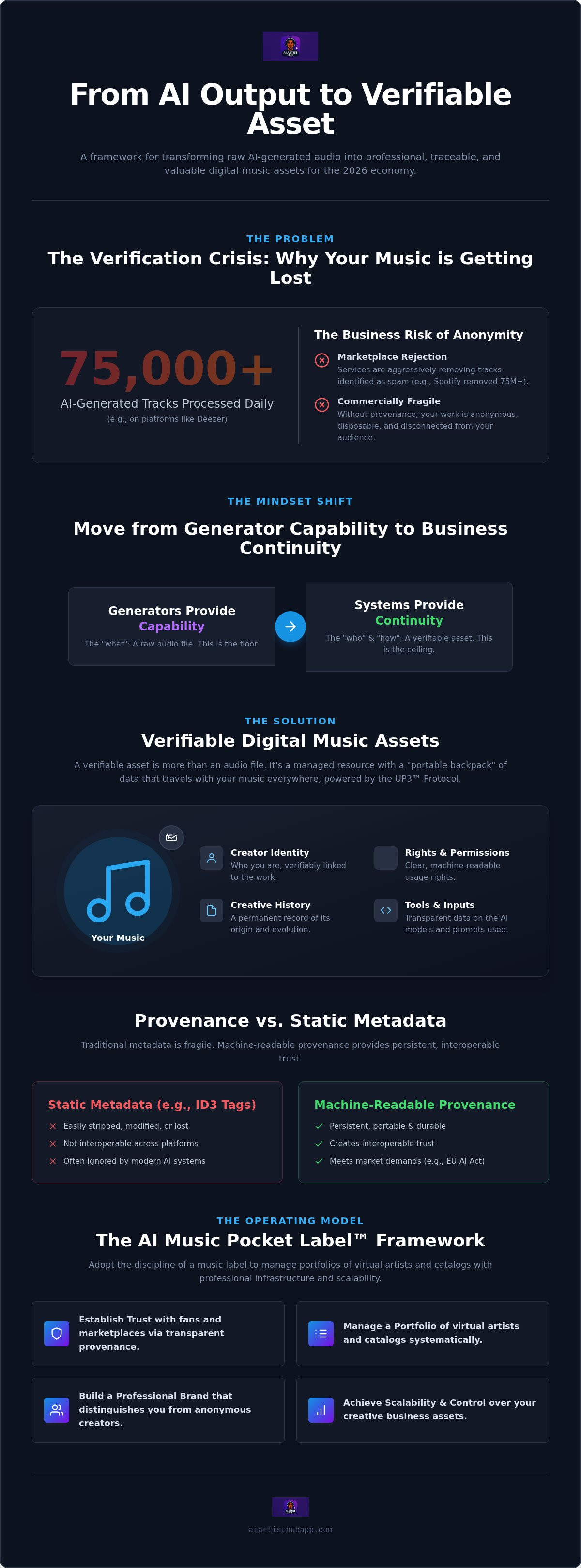
The barrier to entry for music creation has collapsed. Every day, platforms like Deezer process roughly 75,000 fully AI-generated tracks. While this represents a massive explosion in creative capability, it has simultaneously triggered a verification crisis. A simple audio file is just data; a digital asset is a managed resource with documented value and history. Without a way to prove the origin and human intent behind a track, your music remains anonymous, disposable, and commercially fragile.
Anonymous AI music carries significant business risks. Major streaming services are moving toward aggressive automated detection. Spotify removed over 75 million tracks identified as spam in the year leading up to September 2025. In 2026, the stakes are even higher. If you can't verify your work, you risk marketplace rejection and a total disconnect from your audience. Creating verifiable digital music assets is the only way to bridge the gap between raw creative output and long-term commercial viability.
Generators vs. Continuity: The Missing Link
Generators provide the capability to create audio, but they don't provide the continuity required to build a brand. Capability is the floor; continuity is the ceiling. When you use a generator, you get the "what"—the audio file. What's missing is the "who" and the "how"—the record of your creative decisions, your identity, and your rights. This documentation is what separates a hobbyist from a professional founder. You must stop thinking like a prompt engineer and start acting like a label head. A founder doesn't just produce content; they build systems that ensure their work remains traceable and valuable across the entire digital ecosystem.
The Role of Trust in the 2026 Music Economy
Trust is the primary currency in the 2026 music market. As of August 2, 2026, Article 50 of the EU AI Act requires commercial AI audio to carry machine-readable provenance data. This isn't just a regulatory hurdle; it's a market demand. Fans now prioritize artists who offer transparent creative records. They want to know the human story behind the synthetic sound. By moving away from "borrowed" audiences on social media and focusing on direct-to-fan relationships, you secure your business against platform shifts. Verifiable digital music assets give your fans the confidence to invest in your career because they can see the history and integrity of the work. Learn more about building trust in our verification guide to understand how transparency translates into revenue.
Defining Verifiable Digital Music Assets
A verifiable digital music asset is more than just a WAV or MP3 file. It's a sophisticated package that carries machine-readable records of its origin, creator, and rights permissions directly within its structure. Unlike a standard audio file that exists in isolation, verifiable digital music assets maintain a persistent link to their creative history. This ensures that no matter where the song is played, shared, or licensed, its professional context remains intact. This documentation creates a foundation for commercial activity, transforming raw audio into a managed business resource.
Think of this as a "portable backpack" for your music. When a song moves from your workspace to a marketplace or a fan's player, it carries a backpack filled with structured data about who created it, what tools were used, and what permissions are granted. This portability is essential because it allows the track to "introduce itself" to any platform it encounters. It doesn't rely on a central database to tell its story; the story travels with the sound. This backpack ensures that credits, identity records, and creative history are always available to those who need them.
Verification is an ongoing record of activity, not a static, one-time "minting" event. While Music NFTs focus on digital scarcity and ownership, provenance focuses on the lifecycle of the asset. It documents the evolution from initial generation to final release, creating a durable chain of custody that builds trust with every transaction. This continuous record provides the transparency that fans and marketplaces in 2026 demand.
Machine-Readable Provenance vs. Static Metadata
Traditional ID3 tags are insufficient for the 2026 music economy. They're easily stripped, modified, or ignored by modern AI detection systems. Machine-readable provenance provides interoperable trust across different apps and services. This allows your music to interact with the broader ecosystem, ensuring that credits and history are never lost in translation. Portable records allow a song to maintain its integrity even when moving between fragmented platforms.
The UP3™ Protocol: A Portable Identity Layer
The Universal Provenance Passport Protocol, or UP3™ (Patent Pending), serves as the infrastructure for this portable identity. It acts as a creator passport for every track, ensuring that your professional identity is baked into the asset itself. The UP3™ Protocol is a portable layer that travels beyond a single platform, allowing your music to maintain its integrity across the entire digital landscape. By providing a portable identity and rights layer, it helps creators manage their work with label-like discipline. If you're ready to start building assets instead of just files, you can explore our marketplace to see these principles in action.
Provenance vs. NFTs vs. Copyright: Clearing the Confusion
Confusion between verification, scarcity, and legal status stalls many creators before they even start. Verification, or provenance, is the technical record of who created the work and how it was made. It's the "backpack" of context that travels with the audio. NFTs are a specific technology used to manage scarcity and digital ownership, but they often lack the deep creative history needed for professional trust. Copyright is a legal status granted by government entities, which no software can automatically provide. verifiable digital music assets rely on provenance as their foundation, ensuring the track's history is documented long before legal or scarcity layers are applied.
Creators need a protocol for trust regardless of the current copyright status of AI-assisted works. While a generator provides the audio, it doesn't provide the business infrastructure needed to manage that audio as a professional asset. By focusing on provenance, you build a durable record that marketplace partners and fans can verify. This transparency is what separates a professional AI music label from a hobbyist uploader. You aren't just making songs; you're building a catalog of managed assets with a clear chain of custody.
The Legal Reality of AI Music in 2026
The legal landscape for AI music remains a moving target. Current 2026 guidance from the U.S. Copyright Office states that AI systems are not recognized as legal authors, meaning protection depends on the level of substantial human authorship involved. Additionally, Article 50 of the EU AI Act now requires commercial AI audio to carry machine-readable data. Documenting your creative process is critical for future legal clarity. Establishing a Trusted Data Infrastructure for your workflow provides the evidentiary trail needed to navigate these regulations. These verification signals don't replace legal review, but they provide the structured context required for professional commerce.
Interoperable Trust: Beyond Blockchain
True business assets must be verifiable without requiring a specific wallet or a single blockchain. Portability is the priority in a multi-platform listening environment. Your music needs to "introduce itself" to streaming services, sync agencies, and direct-to-fan marketplaces without friction. This is why we advocate for interoperable trust through the UP3™ Protocol (Patent Pending). It creates a portable creator passport that stays with the work, ensuring your identity and credits are never stripped away. Trust shouldn't be locked in a silo; it must travel with the song to ensure your verifiable digital music assets maintain their value across the entire ecosystem.
How to Build and Manage Verifiable Assets
Transforming raw AI generation into a professional catalog requires more than just a creative ear; it demands a structured operating environment. The AI Music Pocket Label™ framework provides this infrastructure. It allows creators to move beyond one-off tracks and start managing portfolios of AI artists with the discipline of a traditional label. By using software leverage, you can operate a complex roster without the overhead of a legacy music company. Building verifiable digital music assets starts with a commitment to documentation and identity management from the very first prompt.
The Artist Laboratory: Where Provenance Begins
Every professional asset needs a place of origin. Within the AI Artist Hub™ ecosystem, the Artist Laboratory serves as this central workspace. This is where you organize your brand assets, virtual identities, and release schedules. By establishing a consistent brand system in the Lab, you ensure that every track produced under a specific artist profile maintains a logical thread of continuity. This environment is where you manage the "who" behind the music, ensuring that each virtual identity has a durable history. Check out our guide to managing an AI artist roster to see how to scale this across multiple virtual brands.
Documenting provenance must happen at the point of creation. You don't add verification as an afterthought. Instead, use verification tools within the Lab to record the creative history as it unfolds. This includes documenting the human inputs, the specific tools used, and the rights permissions granted by the creator. This real-time documentation ensures the "backpack" of data is fully packed and ready for distribution before the song ever leaves your workspace.
Creating Portable .up3 Packages
Once the creative work is finished, the final step is packaging. The native .up3 file format binds your audio directly with your Universal Provenance Passport Protocol (Patent Pending) data. This isn't just a metadata tag; it's a secure package that ensures machine-readable records travel with every release. These .up3 packages enable passport-native music experiences, allowing any compatible player or marketplace to instantly recognize the creator's identity and rights. This portability is what makes your music a durable business asset rather than a temporary file on a hard drive.
Packaging your assets for direct-to-fan commerce allows you to capture value without relying on third-party streaming algorithms. By selling directly through a marketplace built on trust, you maintain control over your pricing and fan relationships. This strategic approach ensures that your creative output remains commercially viable in a competitive, tech-driven landscape.
Launch your AI Music Pocket Label™ today.
The Future of Asset Commerce: AI Artist Hub & UP3™
2026 marks a definitive shift from creative experimentation to commercial maturity. Creators are no longer just exploring capability; they're establishing durable brand ecosystems. By leveraging verifiable digital music assets, you transition from a content producer to a business owner with a portable catalog. This evolution is supported by UP3 PLAY™, which delivers playback experiences tied directly to your provenance records. It ensures that the "backpack" of data we discussed earlier remains accessible during the most critical moment: when a fan hits play.
This is the year of the "Portable Business" for AI creators. The infrastructure is finally here to support scaling from isolated song generation to a professional enterprise. By transforming your work into managed assets, you ensure that every track you release serves as a building block for a long-term brand. This shift is powered by the synergy between AI Artist Hub™ and the UP3™ Protocol (Patent Pending), providing the business layer that generators lack.
Direct-to-Fan Commerce and Marketplace Activity
Relying on "borrowed" audiences from social media platforms is a high-risk strategy. When algorithms change, your access to fans can disappear overnight. Verifiable assets solve this by enabling direct-to-fan commerce within a trusted environment. Browse the AI Artist Hub Marketplace to see how creators are already selling music and digital products without intermediaries. These assets carry their own identity and rights, which significantly increases the value of digital collectibles. Fans aren't just buying a file; they're acquiring a piece of an artist's documented history. This transparency builds the trust necessary for fans to invest in your creative journey.
Continuity and Legacy for the AI Creator
Building a lasting creative business at a micro-enterprise scale is now possible for anyone with a strategic mindset. The goal isn't just to release a hit song but to build a catalog that maintains its value for years. This continuity is the core of the AI Music Pocket Label™ thesis. Education plays a vital role here, as creators must navigate the complexities of the 2026 music economy, including the EU AI Act and evolving platform transparency tags. You need to understand how to manage your virtual roster with the same discipline as a traditional executive. It's time to take control of your creative legacy and move beyond the limitations of anonymous uploads. Start building your AI Music Pocket Label™ today and secure your place in the future of music commerce.
Own Your Creative Continuity
The shift toward verifiable digital music assets is the defining transition for creators in 2026. You've moved beyond the raw capability of AI generators to embrace a system of professional continuity. By documenting provenance at the point of creation, you ensure your work carries its own identity, credits, and rights across every platform. This portable trust is the foundation for a durable business that survives algorithm shifts and marketplace volatility.
Establishing an AI Music Pocket Label™ allows you to operate with the discipline of a global infrastructure company. You can scale virtual artist rosters within a generator-agnostic environment, ensuring your creative history remains intact. With the UP3™ Protocol (Patent Pending), your music travels with a secure digital backpack, enabling direct-to-fan commerce and native playback experiences. It's time to stop uploading content and start building a managed portfolio of professional assets.
Build your verifiable AI music business with AI Artist Hub™
Take control of your creative legacy today. The tools for growth are ready; the infrastructure is built. Step into your role as a visionary founder and lead the next era of the digital music economy.
Frequently Asked Questions
Does a verifiable digital music asset guarantee I own the copyright?
Verification tools do not automatically grant copyright or guarantee legal ownership. They provide a technical record of your creative history and identity signals. Legal status remains a matter of government regulation and the level of human authorship involved in your work. Use these tools to build a strong evidentiary trail for your verifiable digital music assets, helping you navigate the evolving legal landscape with professional transparency.
What is the difference between a UP3™ Passport and a music NFT?
A UP3™ Passport (Patent Pending) is a portable identity layer, while a music NFT is primarily a technology for scarcity and tokenized ownership. Think of the Passport as the "backpack" of data that travels with the song, containing creator credits and rights permissions. While an NFT might prove you own a token, the UP3™ Protocol ensures the audio itself carries the machine-readable provenance needed for interoperable trust across different platforms.
Can I use UP3™ provenance tools with any AI music generator?
Yes, the infrastructure is generator-agnostic and functions downstream of any creation tool. You can produce audio in your preferred environment and then use the Protocol to establish a professional record of your work. This flexibility ensures you aren't locked into a single technology. You maintain creative agency while using the AI Artist Hub™ ecosystem to build the business continuity and identity records that raw generators lack.
How does 'portable provenance' help me sell music directly to fans?
Portable provenance provides the transparency fans demand in 2026. By attaching a machine-readable record to your verifiable digital music assets, you prove the human intent and professional identity behind the track. This trust reduces friction during direct-to-fan transactions in the AI Artist Hub Marketplace. Fans aren't just purchasing audio; they're acquiring a documented piece of your creative legacy, which justifies higher prices and builds stronger brand loyalty.
Is the UP3™ Protocol a blockchain-based system?
The UP3™ Protocol is a framework for provenance and identity, not a specific blockchain implementation. It focuses on creating portable, machine-readable records that can travel beyond any single platform or ledger. This architecture ensures interoperable trust across the digital music ecosystem without requiring a specific wallet or chain. You get a portable creator/work passport that stays with your media, providing a durable record of creative history regardless of the underlying technology.
What happens if a platform doesn't support .up3 files yet?
The provenance data remains securely bound to the audio even if a platform hasn't fully integrated the protocol. While UP3 PLAY™ provides a native playback experience that surfaces this data, the machine-readable records are designed for long-term interoperability. You're building a future-proof catalog that carries its own history. As more services adopt these trust standards, your assets will already possess the necessary documentation to participate in professional commerce and licensing.
Do I need technical skills to build a verifiable music asset?
You don't need coding or advanced technical skills to use these tools. The AI Artist Hub™ platform provides Artist Laboratory workspaces and business infrastructure designed for creative entrepreneurs. The system handles the heavy lifting of binding provenance data and creating .up3 packages. You focus on developing your AI artist brands and virtual identities while the software ensures your work is organized with label-like discipline and professional scalability.
How does verification protect my AI artist brand from impersonation?
Verification links every track to your established Label Profile and Artist Laboratory. This creates a persistent record of origin that distinguishes your professional work from anonymous or fraudulent uploads. By maintaining a machine-readable chain of custody, you protect your virtual identities from spoofing and impersonation. Marketplaces and fans can verify the provenance of your releases, ensuring that your brand reputation remains secure in an increasingly crowded AI music market.

Article by
Julius J. White (VVS Jules)
Julius J. White (VVS Jules) is the Founder & CEO of JJW AI Studios™ and builder of AI Artist Hub™, a creator-first operating platform for the emerging AI music economy. A musician, songwriter, producer, entrepreneur, and systems builder, he developed the AI Music Pocket Label™ framework around a simple idea: generation is only the beginning. His work focuses on the identity, provenance, credits, ownership context, permissions, artist development, direct-to-fan relationships, commerce, trust infrastructure, and business systems creators need to build durable AI artist brands, organized catalogs, and long-term creative ventures.
Disclaimer
This article is provided for general educational and informational purposes only and does not constitute legal, financial, tax, investment, or other professional advice. Laws, regulations, platform policies, technology, and industry practices may change over time. References to AI Artist Hub™, UP3™, UP3 PLAY™, provenance, verification, ownership assertions, permissions, creator tools, protected media, streaming or platform policies, or AI-related rules describe general information and current product capabilities where verified. They do not constitute government registration, legal adjudication, third-party rights clearance, regulatory approval, copyright ownership, guaranteed authenticity, or guaranteed permission for commercial use. Readers should independently verify current requirements, review applicable platform and rights terms, and consult qualified professionals when appropriate.
