


Managing one AI artist is a creative project, but managing ten is a logistics operation. Many founders discover that the workflows used to launch their first persona quickly crumble under the weight of a growing catalog. Scaling a virtual artist roster isn't about finding better generators. It's about building a professional infrastructure that creates continuity across your entire portfolio. You've likely felt the friction of fragmented assets across different tools or the exhaustion of manually maintaining distinct lore for multiple personas. It's a common bottleneck that prevents talented creators from becoming true label owners.
This article provides the 2026 framework for transitioning from a single-creator mindset to a high-output multi-artist business. You'll learn how to implement a repeatable system for launching new artists while maintaining centralized management of your roster metadata. We'll break down the essential role of the AI Artist Hub as your operating layer and explain how the UP3 protocol provides the portable provenance needed to protect your assets. By the end of this guide, you'll have a clear roadmap for building a scalable, professional music label that delivers a measurable ROI on every digital product you release.
Key Takeaways
- Adopt the AI Music Pocket Label™ framework to transition your creative hobby into a structured, professional micro-enterprise.
- Centralize identity assets like Recording DNA™ and visual lore in the Artist Laboratory to ensure every persona remains distinct and consistent.
- Utilize the UP3™ protocol as a digital backpack for your assets, providing portable provenance and machine-readable permissions across the ecosystem.
- Execute a systematic 5-step framework for scaling a virtual artist roster using batch development and automated release workflows.
- Maximize ROI by selling high-margin digital products, such as limited-edition .up3 packages and voice model access, directly to your audience.
Scaling Beyond the Single Persona: The AI Music Pocket Label™ Thesis
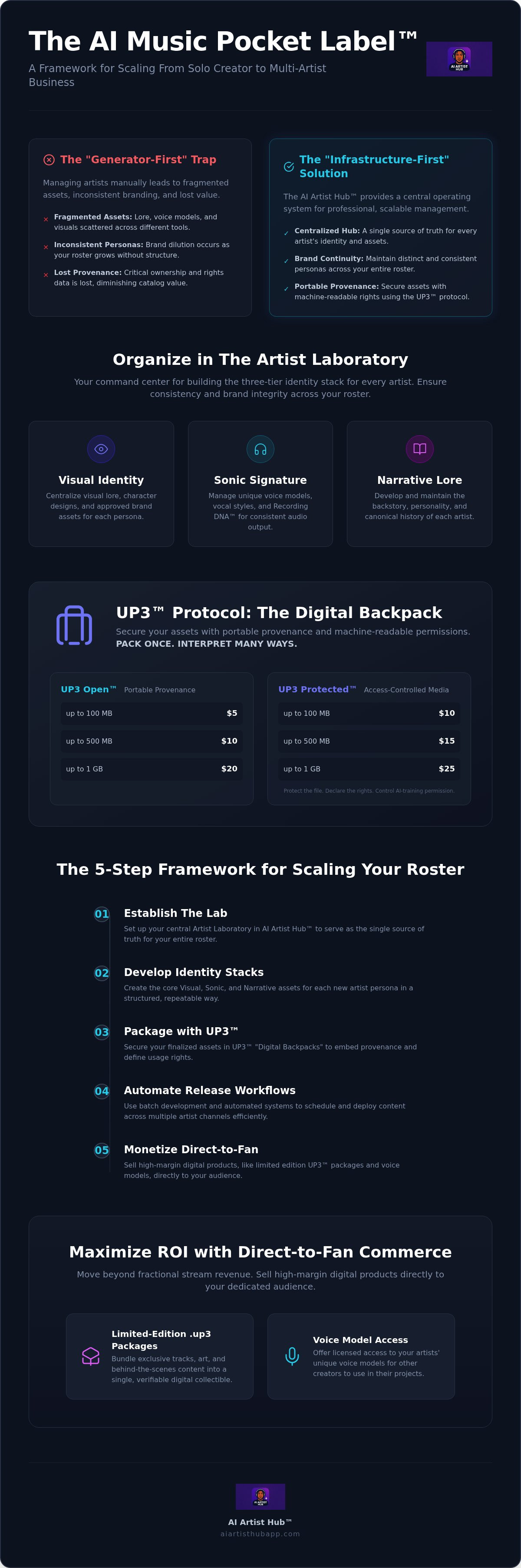
Scaling a virtual artist roster represents the critical transition from a creative hobby to a professional micro-enterprise business model. In the early stages, creators often focus on a single persona, manually managing every prompt and social post. However, true growth requires a fundamental shift in perspective. You are no longer just a prompt engineer; you are a System Architect. This means moving away from a "Generator-First" approach, where assets remain fragmented across disconnected tools, toward an "Infrastructure-First" strategy that prioritizes continuity and commercial structure. Historically, virtual bands were the exclusive domain of major labels with massive budgets. Today, the AI Music Pocket Label™ thesis democratizes this capability, providing a creator-centered framework for operating multiple worlds and high-output catalogs simultaneously. It's about building a machine that produces art, rather than just producing the art yourself.
The Limitations of Manual Roster Management
Many creators fall into the "Content Trap." They spend 90% of their time on generation and almost no time building brand equity. When you manage a roster manually, you risk losing critical artist data, such as specific voice models, visual lore, and licensing records. This lack of organization leads to inconsistent character development and massive legal headaches during the release process. Without a centralized system, provenance is lost, and the long-term value of your catalog diminishes. Generators create capability, but infrastructure creates continuity. The AI Music Pocket Label™ is the professional infrastructure layer that solves roster fragmentation by centralizing identity, provenance, and commercial rights into a single, manageable environment.
Why 2026 is the Year of the Micro-Label
The music industry is currently witnessing extreme audience fragmentation. Listeners no longer congregate solely around a few global superstars; they seek out niche, highly specific virtual identities that speak to their unique tastes. Data from 2026 indicates that while AI-generated content is flooding platforms, only creators with professional systems are capturing significant listener retention and direct-to-fan revenue. The AI Artist Hub™ enables individual founders to operate with the same discipline and strategic oversight as a traditional major label but without the massive overhead. You can manage multiple personas, maintain distinct lore, and secure your rights with professional-grade tools designed for growth. To build a solid foundation for your venture, explore our detailed guide on Scaling an AI Record Label: The 2026 Guide.
Organizing the Artist Laboratory: Infrastructure for Multi-Brand Management
Effective scaling a virtual artist roster demands a departure from the chaotic file management of the early generative era. To manage five, ten, or fifty personas simultaneously, you need a centralized operations room. We call this the Artist Laboratory (The Lab). It serves as the command center for developing and organizing every facet of an AI artist identity. Within The Lab, you maintain a high-fidelity record of each roster member's core assets: their unique voice models, visual lore, release history, and Recording DNA™. This structured approach ensures that as your label grows, your artists don't bleed into one another. Without this infrastructure, brand dilution is inevitable, particularly as AI's impact on music discovery forces creators to compete for increasingly niche audience attention.
Building the Artist Identity Stack
Every professional virtual brand relies on a three-tier identity stack: visual identity, sonic signature, and narrative lore. Visuals provide the face, the sonic signature provides the voice, and lore provides the soul. The Artist Laboratory facilitates the organization of these elements into a cohesive portfolio, allowing you to toggle between different worlds without losing creative focus. For a deep dive into crafting these foundations, see our Virtual Artist Persona: Professional Guide for 2026. By treating these components as modular assets within The Lab, you can iterate on specific traits while keeping the overarching brand intact. This discipline prevents the "generic AI" look and feel that plagues unorganized catalogs.
Managing Cross-Artist Assets and Shared Resources
Strategic management involves knowing when to share resources and when to enforce strict boundaries. You might use shared marketing templates or distribution workflows across your entire label to save time. However, you must maintain absolute separation for identity-defining assets like voice models and lore to protect brand integrity. AI Artist Hub™ tools help you track this through Recording DNA™, a system-observed record of the human creative process and tool usage. This allows you to remain generator-agnostic; you can use different AI tools for different artists while housing all management in one professional environment. This discipline separates a serious business from a casual experiment. If you are ready to professionalize your workflow, you can explore the Artist Laboratory workspace today and begin organizing your future catalog.
Provenance as a Scalable Asset: Integrating UP3™ Passports
Scaling a virtual artist roster requires more than just high creative output; it requires a foundation of verifiable trust. As your catalog expands, the administrative burden of tracking rights, origins, and attribution grows exponentially. This is the "provenance bottleneck" that often halts emerging labels before they reach their full potential. The UP3™ protocol solves this by acting as a "Digital Backpack" for every artist in your portfolio. Instead of leaving identity data locked on a centralized server, the provenance travels with the file itself. By utilizing the Creator Passport Office, you can issue verifiable credentials for your entire catalog. This ensures that every track, stem, and image maintains its history and creative integrity as it moves across the digital ecosystem.
UP3 Open™ vs. UP3 Protected™ for Roster Scaling
Selecting the correct passport mode is a strategic decision for asset management. UP3 Open™ is designed for public releases where interoperable trust and visibility are the priorities. It costs $5 for files up to 100 MB, $10 for up to 500 MB, and $20 for up to 1 GB. This mode allows any platform to see exactly who created the work and what tools were used in the process. For high-value assets such as unreleased masters, stems, or licensing previews, UP3 Protected™ provides access-controlled media. Priced at $10 for up to 100 MB, $15 for up to 500 MB, and $25 for up to 1 GB, Protected mode enables you to "Protect the file. Declare the rights. Control AI-training permission." This tier ensures your most valuable intellectual property remains secure while you scale.
Automating Rights and Permissions at Scale
Manual contract reviews and rights checks don't scale in a high-output environment. To manage a multi-artist portfolio effectively, you must implement machine-readable permissions. The UP3™ protocol operates on a simple but powerful principle: "PACK ONCE. INTERPRET MANY WAYS." You define the usage rights at the point of creation, and those permissions are automatically recognized by any UP3-compliant platform or player. This automation preserves the work's identity and history as the roster grows, preventing the licensing confusion that often plagues unorganized digital catalogs. For a deeper look at how this technology functions, read about Universal Provenance: How UP3™ Passports Preserve Identity. By embedding these standards into your daily workflow, you build a foundation of portable trust that supports long-term commercial growth.
Executing the Multi-Artist Release Strategy: A 5-Step Framework
Executing a multi-artist release strategy requires moving from inspiration to iteration. Scaling a virtual artist roster successfully relies on a repeatable rhythm that balances creative development with commercial execution. You need a system that treats each release as a data point in a larger growth strategy. This 5-step framework provides the structural discipline needed to manage high-volume output without sacrificing brand quality or legal clarity.
- Step 1: Batch Identity Development. Efficiently prep monthly roster updates within the Artist Laboratory. By grouping identity tasks, you maintain a cohesive aesthetic across the label while reducing the mental load of switching between personas.
- Step 2: Provenance Packaging. Prioritize machine-readable rights by issuing UP3™ Passports for every new work. This ensures that permissions are "baked in" before the asset ever hits the public market, protecting your long-term equity.
- Step 3: Staged Drops. Use the AI Artist Hub™ Drop Zone to facilitate direct-to-fan sales. Staggering these drops ensures your audience has time to digest each release, maximizing the commercial lifespan of every track.
- Step 4: Cross-Promotion. Treat your roster as a shared ecosystem. Successful personas can introduce their audience to newer artists, creating a self-sustaining discovery loop that lowers acquisition costs.
- Step 5: Data Integration. Review performance metrics across the entire label. Use these insights to determine which artists deserve more "Laboratory" time and which require a strategic pivot to improve ROI.
The "Release Discipline" for Pocket Labels
Consistency is the engine of growth in the digital music economy. Pocket labels must utilize the Planner and Release tools within the AI Artist Hub™ to map out content months in advance. This prevents "Release Fatigue," a common issue where a creator floods the market with too much content at once, diluting the impact of individual artists. By staggering drops across different roster members, you maintain constant brand visibility while giving each artist space to build their own unique following. For a deeper dive into these workflows, see How to Manage an AI Artist Roster and Brand Portfolio.
Scaling Audience Growth via Roster Synergy
The true power of scaling a virtual artist roster lies in synergy. When one virtual artist gains traction, they become an onboarding ramp for the rest of your label. World-building allows your personas to interact or collaborate, creating a "cinematic universe" effect that deepens fan loyalty and increases lifetime value. This cross-pollination ensures that you aren't starting from zero with every new launch. Implement these specific Virtual Artist Audience Growth Tactics: 2026 Checklist to maximize your reach and convert casual listeners into dedicated collectors.
Launch your multi-artist release campaign
Monetizing the Roster: Marketplace and Direct-to-Fan Commerce
Scaling a virtual artist roster reaches its commercial peak when you transition from a content creator to a catalog owner. In the 2026 landscape, relying on streaming royalties alone isn't a viable business model for micro-labels. You must focus on high-margin digital products that leverage the unique identity of your personas. The AI Artist Hub™ Marketplace facilitates these direct relationships, allowing you to sell stems, voice model access, and limited-edition .up3 packages without the friction of third-party gatekeepers. This environment turns your creative output into a scalable business. By offering passport-native playback through UP3 PLAY™, you provide fans with a premium experience that respects the machine-readable permissions you've embedded in every file.
Diversifying Revenue Streams Across the Roster
Successful founders diversify their income by selling more than just finished songs. You can monetize the building blocks of your virtual identities by selling "Laboratory" assets directly to other creators or dedicated fans. You can license high-value media securely through UP3 Protected™ mode, which allows you to protect the file, declare the rights, and control AI-training permission. This level of control is essential for protecting your brand's sonic and visual integrity. Pricing for these passports is fixed: UP3 Open™ costs $5 for up to 100 MB, $10 for up to 500 MB, and $20 for up to 1 GB. For assets requiring access control, UP3 Protected™ costs $10 for up to 100 MB, $15 for up to 500 MB, and $25 for up to 1 GB. This tiered structure ensures you can monetize everything from casual social clips to studio-grade masters while maintaining absolute provenance.
Building Long-Term Creative Equity
Scaling your roster is a strategic shift away from the "song-of-the-day" mentality toward building a legacy portfolio. Every artist you develop and every work you verify via the UP3™ protocol adds to your creative equity and long-term catalog valuation. Provenance and verification via the Hub build the trust necessary for high-value commerce. This turns a collection of digital files into a professional investment. As your label matures, the value resides in the verified history and distinct lore of your artists. These assets are designed to be interoperable across the digital ecosystem, ensuring your label remains relevant as new platforms emerge. You aren't just launching artists; you're architecting a new type of digital venture. Generators create capability, but the Hub creates the continuity required for lasting commercial success.
Explore the AI Artist Hub Marketplace to start scaling your roster today.
Architecting the Future of Digital Music Ventures
Transitioning from a single-persona creator to a multi-artist label owner requires a fundamental shift in operations. Scaling a virtual artist roster is no longer a manual task; it's a systematic process of brand management. By centralizing your identity assets in the Artist Laboratory and securing your works with the UP3™ protocol, you build a foundation of portable trust and commercial continuity. This infrastructure-first approach ensures that every release contributes to the long-term equity of your catalog rather than just creating temporary noise.
The AI Artist Hub™ provides the essential tools for this evolution. Its generator-agnostic environment and direct-to-fan commerce tools allow you to manage growth with the discipline of a major label. You now have the framework and the systems to turn creative capability into a sustainable micro-enterprise. Generators create capability, but the Hub creates the continuity required for lasting success.
Start your AI Music Pocket Label™ on AI Artist Hub today
Take control of your creative output and build a legacy that lasts.
Frequently Asked Questions
How many virtual artists can I realistically manage with AI Artist Hub™?
The platform is architected to support high-output portfolios, allowing you to manage as many virtual artists as your business strategy requires. Through the AI Music Pocket Label™ framework, you organize multiple catalogs and worlds within centralized Artist Laboratory workspaces. The infrastructure helps you transition from a single project to a professional micro-enterprise model. Success in scaling a virtual artist roster depends on using these systematic tools to maintain distinct brand identities across your entire label.
Does scaling a virtual artist roster require a team, or can I do it solo?
You can manage an entire roster as a solo founder by leveraging the professional infrastructure provided by the Hub. Tools like the Planner and Release suite automate the administrative heavy lifting that usually requires a traditional label team. By using a System Architect approach, you focus on high-level brand strategy while the platform handles the logistics of identity and provenance. This allows individual creators to operate with the discipline and output of a much larger organization.
What is the cost of issuing UP3™ Passports for a large roster of artists?
Issuing UP3™ Passports follows a fixed, self-serve pricing model based on file size and protection mode. For UP3 Open™, prices are $5 for up to 100 MB, $10 for up to 500 MB, and $20 for up to 1 GB. If you require UP3 Protected™ for high-value assets, the costs are $10 for up to 100 MB, $15 for up to 500 MB, and $25 for up to 1 GB. These costs are per-issuance, providing portable trust and machine-readable permissions for your growing catalog.
Can I use different AI generators for different artists in my roster?
Yes, the AI Artist Hub™ is entirely generator-agnostic, meaning you can use any AI music or image tool to create your content. The Hub functions as the operating layer where you organize those assets, establish provenance, and manage commercial rights. This flexibility allows you to choose the best generation tools for each specific persona while maintaining a centralized management system for scaling a virtual artist roster. It ensures you aren't locked into a single technology provider.
How do I protect the intellectual property of my virtual artists as I scale?
You protect your virtual artists' intellectual property by embedding portable provenance and machine-readable permissions directly into your files using the UP3™ protocol. Recording DNA™ tracks your creative process and tool usage, providing a documentation layer for your work. For sensitive assets, UP3 Protected™ enables you to control AI-training permissions and declare rights through encryption. This ensures your brand integrity remains intact as your portfolio expands across different platforms and discovery layers.
What is the difference between UP3 Open™ and UP3 Protected™ for my releases?
The primary difference lies in how the media payload is handled and enforced. UP3 Open™ provides portable provenance and machine-readable permissions without protected-payload enforcement, making it ideal for public releases and building interoperable trust. UP3 Protected™ adds a layer of encryption and controlled decryption, allowing you to protect the file, declare the rights, and control AI-training permission. This mode is best suited for unreleased masters, stems, and high-value licensing previews where access control is critical.
Is the 1 TB Vault Backpack™ tier available for large rosters yet?
The 1 TB Vault Backpack™ tier is currently demand-gated and is not yet live for general use. While target pricing has been set at $40 for Open mode and $50 for Protected mode, large-scale roster owners should monitor official updates for its release. Until then, creators can utilize the Studio-tier passports for their high-fidelity assets. This ensures every major release in your catalog still benefits from professional provenance and portable trust without waiting for the larger storage tier.
How does UP3 PLAY™ handle music from multiple artists in one roster?
UP3 PLAY™ functions as a Passport-native experience layer that interprets the specific permissions and identity data embedded in each .up3 package. It distinguishes between different artists in your roster by reading the unique provenance data issued through the Hub. The player ensures that playback behavior matches the rights you've declared, whether the file is in Open or Protected mode. This provides a consistent, high-quality experience for fans discovering your multi-artist catalog through the UP3 ecosystem.

Article by
Julius J. White (VVS Jules)
Julius J. White (VVS Jules) is the Founder & CEO of JJW AI Studios™ and builder of AI Artist Hub™, a creator-first operating platform for the emerging AI music economy. A musician, songwriter, producer, entrepreneur, and systems builder, he developed the AI Music Pocket Label™ framework around a simple idea: generation is only the beginning. His work focuses on the identity, provenance, credits, ownership context, permissions, artist development, direct-to-fan relationships, commerce, trust infrastructure, and business systems creators need to build durable AI artist brands, organized catalogs, and long-term creative ventures.
Disclaimer
This article is provided for general educational and informational purposes only and does not constitute legal, financial, tax, investment, or other professional advice. Laws, regulations, platform policies, technology, and industry practices may change over time. References to AI Artist Hub™, UP3™, UP3 PLAY™, provenance, verification, ownership assertions, permissions, creator tools, protected media, streaming or platform policies, or AI-related rules describe general information and current product capabilities where verified. They do not constitute government registration, legal adjudication, third-party rights clearance, regulatory approval, copyright ownership, guaranteed authenticity, or guaranteed permission for commercial use. Readers should independently verify current requirements, review applicable platform and rights terms, and consult qualified professionals when appropriate.
