


Can you protect a digital brand when the source of its creative output remains invisible? As AI-generated content floods the market, traditional methods of tracking ownership and attribution are hitting a breaking point. You're likely facing the frustration of opaque royalty distributions and the technical hurdle of proving the origin of your tracks across fragmented platforms. It's a systemic gap that threatens the scalability of any serious music venture.
Building a sustainable business in this era requires a shift toward portable, machine-readable trust systems. We'll explore how the intersection of music provenance and blockchain principles provides the infrastructure your AI Music Pocket Label™ needs to thrive. You'll discover how the UP3™ protocol functions as a portable backpack for your audio, ensuring that structured context regarding creator identity and rights permissions travels with the file itself. This article delivers a clear framework for managing artist identity and establishing the commercial continuity necessary to lead in the new music economy.
Key Takeaways
- Understand why traditional metadata is failing and how AI-driven transparency ensures commercial continuity for modern creators.
- Master the distinction between centralized ledgers and portable frameworks to implement music provenance and blockchain principles that travel with your audio files.
- Apply the AI Music Pocket Label™ thesis to build long-term brand equity through verifiable artist identity and structured roster management.
- Establish a provenance-first workflow in your Laboratory workspace to document creative history from the initial prompt to the final master.
- Discover how the UP3™ Protocol acts as a "portable backpack" for your music, providing a scalable identity layer across the global digital ecosystem.
Beyond the Ledger: Why Music Provenance and Blockchain Matter in 2026
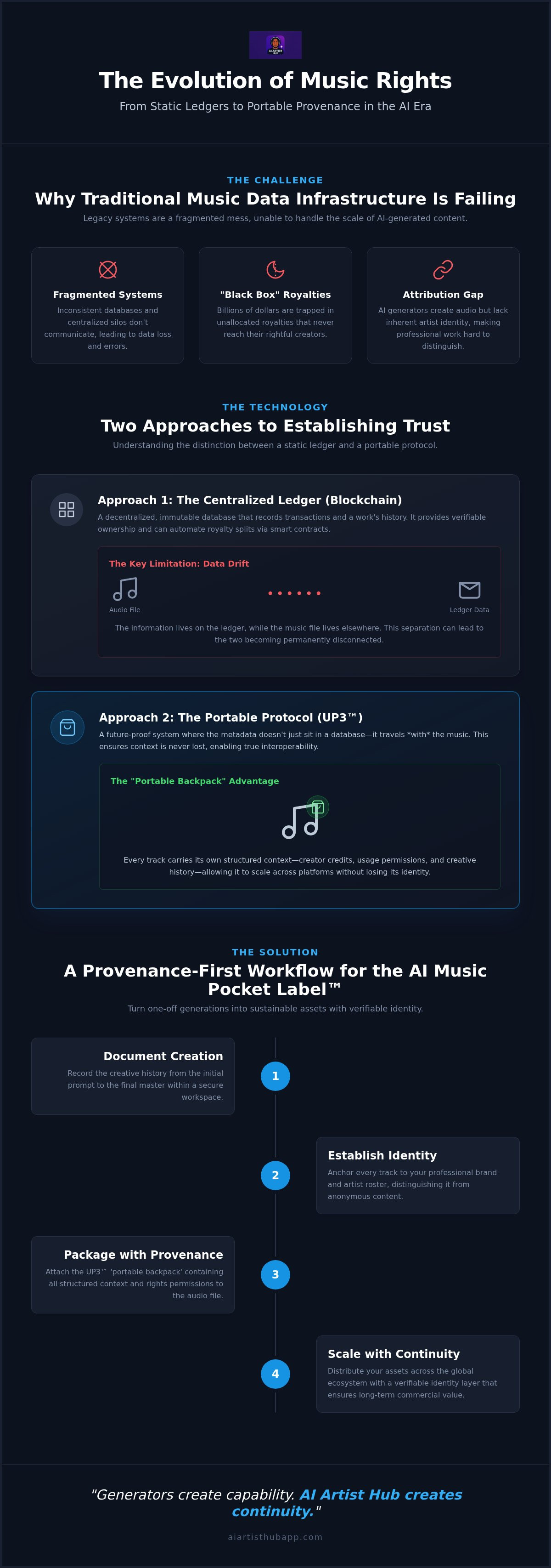
The music industry's data infrastructure is currently a fragmented mess. Inconsistent databases and manual entry errors result in billions of dollars trapped in "black box" royalties that never reach the rightful creators. By 2026, the sheer volume of content has made these legacy systems obsolete. If you're operating at scale, you can't rely on centralized silos that don't talk to each other. This is why music provenance and blockchain concepts are shifting from experimental tech to foundational business requirements.
Generators create capability, but they don't provide identity. Without a structured way to track the origin of a work, creators face the risk of unverified content and "ghost" tracks that lack commercial value. Provenance serves as the continuity layer, ensuring that every piece of music you release is anchored to your professional brand and long-term strategy. It's about turning a one-off generation into a sustainable asset. While generators provide the raw materials, the AI Artist Hub™ provides the infrastructure to turn those materials into a professional enterprise.
The Identity Crisis in Generative Music
AI tools can produce professional audio in seconds, but they lack an inherent sense of artist identity. This creates a massive attribution gap. If anyone can prompt a model, how do you prove which tracks belong to your AI Music Pocket Label™? You need human-centered attribution to distinguish your professional output from the noise. Establishing clear provenance during the creation phase prevents your work from being lost in a sea of anonymous, unmonetizable audio. It's the difference between a random file and a branded product. In the same way that enthusiasts discover We LOVE Arabian Horses to connect with a documented lineage, your digital assets need a verifiable history to maintain their value.
Decentralized ledgers provide an immutable record of a track's history, from its initial creation to its latest licensing deal. This tech offers a level of verifiable ownership that protects creators in a high-speed market. By merging music provenance and blockchain principles, smart contracts can automate complex royalty splits, ensuring everyone gets paid without waiting for manual audits. It's vital to distinguish between a cold, public ledger and a creator-controlled record. You want a system that gives you authority over your data while using the transparency of the ledger to prove its validity to the world. For a deeper look at how these records function, explore our UP3™ Protocol documentation.
Decoding the Technology: Blockchain vs. Portable Provenance Protocols
Define your objective before choosing a technical solution. Music provenance is the documented history of a work’s creation, identity, and rights. It serves as the definitive record of a digital asset. While industry discussions often group music provenance and blockchain together, you must distinguish between the ledger and the protocol. Blockchain functions as a decentralized database that records immutable transactions. However, a database entry is often static; it lives on the ledger while the music file lives elsewhere. This separation can lead to data drift where the music and its rights information become disconnected.
Future-proof systems require portability. Portable provenance protocols ensure that metadata doesn't just sit in a database. It travels with the music. Think of this as a "portable backpack." Every track carries its own structured context, including creator credits and usage permissions. This shift from centralized lookups to portable assets allows an AI Music Pocket Label™ to scale across different platforms without losing its identity or rights data. Interoperability is the key to future music playback because it allows different systems to read and respect the same set of instructions natively.
Smart Contracts and Rights Management
Blockchain technology enables smart contracts that execute fractional payments automatically. These are machine-readable permissions that trigger when a specific event occurs, such as a stream or a digital sale. They provide the logic for complex royalty splits across a roster of artists. It's important to remember that these tools support your business operations but don't replace legal contracts or government registrations. They act as the high-speed execution layer for the commercial agreements you've already established. You can explore how we integrate these systems by visiting our protocol infrastructure page.
The Shift to Portable Creator Passports
The UP3™ Protocol introduces the concept of a "work passport." This functions as the portable backpack for your audio, containing structured context about the creator, credits, and rights permissions. This approach focuses on the portability of information rather than acting as a legal claim of ownership. When a track is passport-native, it carries its identity to any compatible player or platform. This provides fans with a richer experience through verified credits while platforms receive clean, structured data without manual verification. This portable identity layer ensures your AI artists remain recognizable and protected regardless of where the music is played. Building on a portable foundation ensures your creative output remains a professional, traceable asset in a crowded market.
Strategic Advantage: How AI Music Pocket Labels™ Leverage Trust
Operating a successful digital music venture requires a shift from being a casual prompt engineer to becoming a strategic founder. The AI Music Pocket Label™ thesis provides the business framework necessary to manage portfolios of virtual artists with professional discipline. By integrating music provenance and blockchain principles into your daily workflow, you transform creative capability into long-term brand equity. This isn't just about tracking files; it's about building a scalable system where every track reinforces the value of your entire catalog.
Central to this strategy are Artist Laboratory Workspaces. These environments allow you to organize virtual rosters with the same rigor as a traditional label, but with the efficiency of software leverage. Within these labs, provenance acts as the connective tissue between your creative prompts and your commercial releases. It provides the "continuity" layer that generators lack, ensuring that your audience and business partners can verify the origin and history of every asset you produce.
Building Durable Virtual Artist Brands
Consistency is the foundation of any successful brand. For virtual artists, provenance serves as the "DNA" that links disparate releases into a cohesive identity. When you document the creative history of a character or project, you establish a track record that fans can follow. This transparency builds a sense of authenticity that is often missing in anonymous AI content. To scale effectively, you must master AI artist roster management. By maintaining structured provenance, you ensure that your virtual brands remain durable and recognizable across multiple platforms and release cycles.
Monetizing Trust in the Marketplace
Trust is the ultimate currency in direct-to-fan commerce. Verifiable provenance records facilitate secure sales by providing buyers with the context they need to invest in your work. In the AI Artist Hub Marketplace, verification signals act as trust markers for potential collectors. This integration of music provenance and blockchain logic ensures your digital products are attractive to commercial partners who require certainty before licensing or distributing new content. By reducing friction during the transaction, you create a more efficient path to monetization for your entire portfolio of AI artists.
Implementing a Provenance-First Workflow for AI Creators
Transition your creative process from a series of random generations into a professional production line. A provenance-first workflow ensures that every track you produce is a verifiable asset rather than a temporary file. While music provenance and blockchain principles provide the technical foundation, the actual value comes from your discipline during the Laboratory phase. You aren't just making music; you're building a structured record of human-led innovation. This approach protects your creative identity and clarifies rights before your music ever reaches a streaming platform.
Transparency is a commercial requirement in the modern industry. Disclosing the use of AI tools and documenting your creative trail builds trust with fans and distributors alike. It isn't about diminishing your creativity; it's about providing the structured context that professional partners demand. This level of transparency protects your brand from attribution risks and ensures your work meets the high standards of the new music economy.
Phase 1: Capturing the Creative Trail
Documenting the creative trail begins with the first prompt. Record the specific generator inputs, model versions, and seed parameters used during your session. This data establishes the technical origin of the work. You must also highlight your human-in-the-loop contributions, such as lyrical adjustments, arrangement choices, or post-production mixing. Capturing these details creates a "paper trail" for rights and permissions, ensuring your capability translates into long-term continuity.
Phase 2: Verifying Identity and Credits
Organize your data within your AI Music Pocket Label™ profile to prepare for release. This is where you assign definitive credits to your virtual artists and any human collaborators involved in the project. Use our verification infrastructure to secure these records. By anchoring your credits early, you prevent identity fragmentation and ensure that your portfolio remains manageable as it grows. This structured approach allows you to package your audio for a passport-native release with confidence.
Use this checklist to prepare your work for the global market:
- Log all generator model versions and specific prompt history.
- Document all human creative interventions and arrangement edits.
- Assign role-based credits to virtual artist personas and human team members.
- Verify the internal asset record through the UP3™ Protocol layer.
- Package the final audio with its "portable backpack" of structured metadata.
Build your professional portfolio in the Hub
The Future of Interoperable Trust: UP3™ and AI Artist Hub™
The evolution of digital music demands a move toward interoperable trust. While the intersection of music provenance and blockchain provides the security layer, the industry needs a standard for how that data moves between platforms. The vision is simple: your music should carry its credentials wherever it goes. This ensures that your virtual artist brands are recognized by every player, store, and marketplace in the global ecosystem. By adopting a system that prioritizes portability, you move beyond the limitations of centralized databases and manual entry. You gain the power to broadcast your identity to the world with machine-readable precision.
UP3™: Making Provenance Portable
The Universal Provenance Passport Protocol (UP3™) serves as the portable identity layer for your creative work. Think of it as a portable backpack. A song travels with this backpack, containing structured context about the creator, credits, and rights permissions. This isn't just metadata; it's a patent-pending system designed for portability. The .up3 package binds the audio file with its passport data, ensuring the two never become separated. For technical readers looking to integrate this standard, the UP3 website provides the necessary protocol specifications. This approach ensures that information remains accessible even when the music leaves your local environment.
Continuity Through AI Artist Hub™
Generators create capability, but the AI Artist Hub™ creates continuity. It serves as your creator operating environment, providing the business infrastructure to manage your AI Music Pocket Label™ with professional rigor. The platform supports you after the generation phase, offering tools for verification and brand development. By using UP3 PLAY™, you can deliver provenance-aware playback experiences that respect the structured data within each track. This native playback experience allows fans to see verified credits and artist identity directly within the player, fostering a deeper connection to your work.
Setting up your first Artist Laboratory is the next logical step for any serious founder. This workspace allows you to organize your roster and document your creative history in real-time. You are no longer just producing audio files; you are building a legacy. This shift from "generating capability" to "building legacy" is what defines the leaders in the AI era. You can explore our pricing and platform options to find the infrastructure that fits your scale. Focus on establishing a solid foundation today so your virtual brands remain relevant for years to come. Your success depends on the systems you build, not just the sounds you generate.
Scaling Your Vision with Verifiable Trust
Establishing a professional foundation in the AI music market requires more than just high-quality audio. It demands a commitment to transparency and structured identity. By integrating the principles of music provenance and blockchain, you transform random creative outputs into a scalable portfolio of assets. You've learned how the UP3™ Protocol acts as a portable backpack, ensuring your credits and rights permissions travel with your music across every platform. This shift from simple capability to structured continuity is what separates casual creators from serious industry founders.
Our patent-pending provenance infrastructure and generator-agnostic operating environment provide the tools you need to build a durable legacy. Using human-centered creator tools ensures that your virtual artists maintain their identity while you scale your operations. Take control of your creative output today and build the business infrastructure your vision deserves. The tools for interoperable trust are ready to support your entrepreneurial journey.
Secure your creator identity with the UP3™ Protocol
Frequently Asked Questions
What is the difference between music provenance and copyright?
Provenance is the documented history of creation, while copyright is a legal right granted by a government. Music provenance provides the structured context and creative trail of a work. It acts as a factual record of who did what and when. Copyright represents the legal ownership and control over that work. While provenance can support your claims during a legal review, it doesn't replace official government registration or legal contracts.
Does using blockchain for music provenance guarantee legal ownership?
No, using music provenance and blockchain records doesn't automatically grant or guarantee legal ownership. These technologies provide an immutable ledger of transactions and creative history, which serves as strong evidence of a work’s origin. However, legal ownership is determined by national laws, contracts, and government registrations. You should treat these digital records as high-fidelity documentation that supports your business operations rather than a substitute for legal advice or official filings.
How does the UP3™ Protocol help AI music creators?
The UP3™ Protocol helps creators by providing a "portable backpack" for their audio files. This patent-pending protocol ensures that structured context about the creator, credits, and rights permissions travels with the song across different platforms. It solves the problem of metadata stripping and fragmented identity. By making your provenance portable, you ensure that your work remains recognizable and professional regardless of where it's played or distributed in the digital ecosystem.
What is an AI Music Pocket Label™?
An AI Music Pocket Label™ is a business framework that allows individual creators to operate portfolios of AI artists with professional discipline. It uses software leverage to manage rosters, catalogs, and branding at scale. This model treats AI generation as a capability while using the AI Artist Hub™ infrastructure to create commercial continuity. It empowers micro-entrepreneurs to run a sophisticated music venture without the overhead of a traditional record label.
Can I use provenance tools for music generated by any AI model?
Yes, the AI Artist Hub™ is generator-agnostic, meaning you can document provenance for music created with any AI tool. The focus is on capturing your human-in-the-loop contributions and the technical trail of the generation process. Whether you use popular foundation models or custom tools, you can use our infrastructure to anchor those outputs to your professional brand. This ensures your creative continuity remains intact regardless of which generation software you choose.
How does portable provenance improve the fan experience?
Portable provenance allows fans to access verified credits and artist identity directly through passport-native playback experiences like UP3 PLAY™. Instead of seeing anonymous files, fans get a rich, transparent look at the creative history and human involvement behind the music. This builds trust and a deeper connection between the audience and your virtual brands. It transforms a simple audio file into an interactive asset that rewards fan curiosity with structured, reliable information.
Is blockchain the only way to track music provenance in 2026?
Blockchain is a powerful tool for recording immutable history, but it isn't the only component of a modern provenance system. While music provenance and blockchain are often linked, portable protocols like UP3™ are essential for ensuring data travels with the audio file itself. A ledger record is often static and separate from the music. True interoperability requires a combination of secure records and portable data packages that work across various platforms and playback environments.
How do I start building a virtual artist brand with verified provenance?
Start by setting up an Artist Laboratory Workspace within the AI Artist Hub™ to organize your creative process. Document every step of your workflow, from the initial generator inputs to your human-led arrangement choices. Once your track is complete, package it using the UP3™ Protocol to ensure its identity is locked to the file. This provenance-first approach ensures that your virtual artist brand has a professional foundation and a verifiable history from day one.

Article by
Julius J. White (VVS Jules)
Julius J. White (VVS Jules) is the Founder & CEO of JJW AI Studios™ and builder of AI Artist Hub™, a creator-first operating platform for the emerging AI music economy. A musician, songwriter, producer, entrepreneur, and systems builder, he developed the AI Music Pocket Label™ framework around a simple idea: generation is only the beginning. His work focuses on the identity, provenance, credits, ownership context, permissions, artist development, direct-to-fan relationships, commerce, trust infrastructure, and business systems creators need to build durable AI artist brands, organized catalogs, and long-term creative ventures.
Disclaimer
This article is provided for general educational and informational purposes only and does not constitute legal, financial, tax, investment, or other professional advice. Laws, regulations, platform policies, technology, and industry practices may change over time. References to AI Artist Hub™, UP3™, UP3 PLAY™, provenance, verification, ownership assertions, permissions, creator tools, protected media, streaming or platform policies, or AI-related rules describe general information and current product capabilities where verified. They do not constitute government registration, legal adjudication, third-party rights clearance, regulatory approval, copyright ownership, guaranteed authenticity, or guaranteed permission for commercial use. Readers should independently verify current requirements, review applicable platform and rights terms, and consult qualified professionals when appropriate.
