


The most valuable asset in the modern music industry isn't a human performer; it's a perfectly architected digital identity. Your virtual artist is a high-yield business asset, not a digital experiment. You likely recognize that a compelling persona requires more than just a generated image and a catchy hook. Mastering virtual artist profile management is the only way to transform a collection of AI assets into a verified, monetizable roster that fans actually trust. Between the complexities of U.S. Copyright Office regulations regarding human authorship and the technical friction of claiming artist identifiers on Spotify or Apple Music, it's easy to lose momentum.
This article provides the professional systems you need to build, verify, and scale your virtual personas with confidence. You'll gain a clear roadmap for setting up profiles that meet industry standards while securing the provenance of your AI-generated content. We will break down the essential 2026 checklist, covering everything from establishing legal ownership of your assets to implementing a scalable management system for multiple artists. Stop guessing and start building the infrastructure for your digital label today.
Key Takeaways
- Establish a solid foundation for virtual artist profile management by using provenance tools to verify human-led ownership of AI assets.
- Secure unique artist identifiers and URIs across all major DSPs to prevent technical friction and ensure a professional platform presence.
- Develop a cohesive brand architecture that links compelling origin stories with consistent visual assets for maximum audience engagement.
- Maximize revenue by prioritizing direct-to-fan sales of exclusive digital products over traditional, low-margin streaming royalties.
- Scale your operations by transitioning from a single profile to a multi-artist roster using automated management systems and professional infrastructure.
What is Virtual Artist Profile Management in 2026?
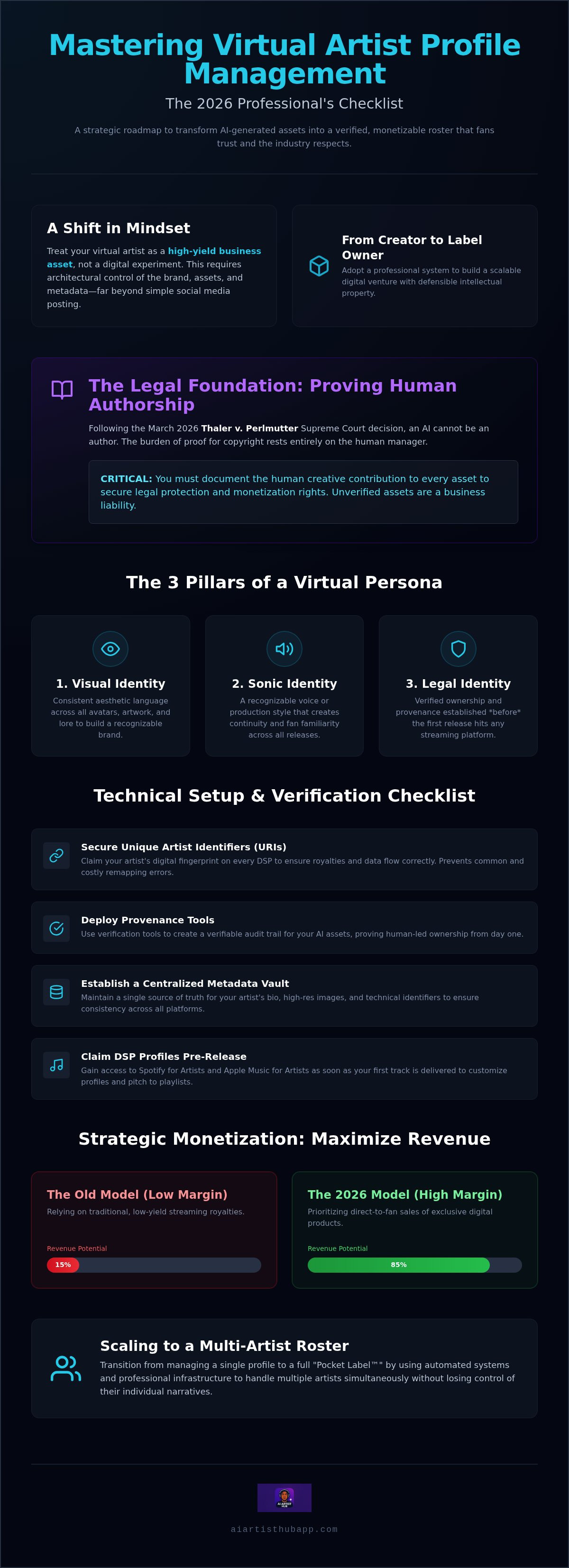
Virtual artist profile management is the architectural control of a digital persona's brand, assets, and metadata. It's a professional system designed for creators who've moved past simple content generation to building scalable digital ventures. In 2026, managing a virtual artist is fundamentally different from traditional social media management. You aren't just posting updates; you're maintaining a complex legal and technical infrastructure that ensures every asset is verified and monetizable. This process requires a shift in mindset from being an anonymous creator to becoming a professional virtual label owner who treats digital personas as high-value intellectual property.
Virtual artists require more rigorous management than human performers because of the unique provenance needs of AI-generated content. Following the March 2026 Supreme Court decision in Thaler v. Perlmutter, which upheld that an AI cannot be considered an author under the Copyright Act, the burden of proof rests entirely on the manager. You must document the human creative contribution to every asset to secure legal protection. Without this level of virtual artist profile management, your assets remain in a legal gray area, making them nearly impossible to defend or monetize effectively.
The history of virtual performers shows the risks of poor brand architecture. The case of FN Meka serves as a reminder that without a strong, human-led management system and clear ethical guidelines, a virtual persona can quickly become a business liability. Professional infrastructure ensures that the persona remains consistent, relatable, and, most importantly, under your total control.
The Core Components of a Virtual Persona
Successful management relies on three distinct pillars. First, you need a visual identity that uses consistent aesthetic language across all avatars and lore. Second, you must establish a sonic identity. This involves maintaining a recognizable voice or production style so the audience feels a sense of continuity across releases. Third, you must secure a legal identity. This means establishing verified ownership and provenance through specialized tools before the first track ever hits a streaming platform. These components form the foundation of a professional digital brand.
Why Infrastructure Matters More Than Content
Content is now infinite, but a well-managed brand is a scarce and valuable asset. Professional virtual artist profile management focuses on building a central hub that prevents platform dependency. By using an "Artist Laboratory" for roster development, you can test personas and refine metadata in a controlled environment before a public launch. This systematic approach ensures your roster remains organized and scalable. It allows you to manage multiple artists simultaneously without losing control of the individual narratives or technical identifiers that drive growth.
Technical Setup and Verification Checklist
Secure your technical foundation before uploading a single track. Effective virtual artist profile management starts with securing unique artist identifiers (URIs) across every major digital service provider (DSP). These identifiers act as the digital fingerprint for your persona; they ensure that royalties and fan engagement data flow to the correct account. Without these, your releases risk being remapped to human artists with similar names. This common technical hurdle can take weeks to resolve through support tickets, stalling your momentum before you even launch.
Deploy professional AI artist verification and provenance tools to prove human-led label ownership from day one. In a landscape where AI authorship is scrutinized, having a verifiable audit trail for your training data and generated assets is your best defense. Establish a centralized metadata vault to maintain consistency across platforms. This vault should store every iteration of your artist's bio, high-resolution imagery, and technical identifiers, serving as the single source of truth for your entire roster.
Claiming Your Digital Territory
Claim your Spotify for Artists and Apple Music for Artists profiles as soon as your first release is delivered to the DSPs. Don't wait for the release date. Use your distributor's portal to request access to these profiles using the specific URIs assigned to your artist. This early access allows you to customize your profile, upload "Canvas" videos, and pitch to editorial playlists. If your artist's content accidentally appears on a human artist's page, use the "report a mapping error" tools immediately. To strengthen your claim, create a source-of-truth profile on your own domain. A dedicated website or landing page serves as an external validator that DSPs use to confirm your identity during the verification process.
AI Artist Verification and Ownership
Utilize digital watermarking or blockchain-based timestamping to establish asset provenance. These tools create a permanent record of when and how an asset was created. Document your human-in-the-loop process meticulously. This documentation should include prompt logs, selection criteria, and manual editing steps. Proving that a human made the creative decisions is essential for meeting the current standards set by the U.S. Copyright Office. Finally, register your AI Music Pocket Label™ as the legal entity behind the artist. This formalizes your role as the owner and manager, providing a clear legal structure for contracts, licensing deals, and direct-to-fan sales. This systematic approach transforms a digital persona into a protected commercial asset.
Building a Cohesive Virtual Artist Brand Identity
Crafting a cohesive identity is the bridge between a technical setup and a loyal fanbase. Effective virtual artist profile management requires a shift from sporadic posting to strategic brand architecture. You must build a persona that feels intentional, even if the creative tools are automated. Start by defining an origin story that resonates with your specific target demographic. This narrative provides the "why" behind the music, giving fans a reason to invest emotionally in a digital entity. A well-defined story turns a collection of tracks into a professional brand with long-term growth potential.
Maintain strict visual consistency across every digital touchpoint. Your social avatars, cover art, and marketing assets must share a unified aesthetic language. If your artist appears as a hyper-realistic cyborg on Spotify but a 2D anime character on TikTok, the brand identity collapses. Develop a distinct communication style or voice for the virtual artist. This voice should remain consistent across all social channels, whether the persona is mysterious and aloof or high-energy and interactive. Implement a content calendar that balances music releases with lore-building posts. This ensures the audience stays engaged between drops by learning more about the artist's world.
Narrative and Lore Development
Create a world-building document to serve as the artist's internal constitution. This document guides the artist's evolution, detailing their history, motivations, and future goals. Use interactive storytelling, such as fan polls or cryptic social clues, to invite the audience into the journey. When writing the professional bio, acknowledge the AI nature of the project while highlighting your creative vision as the manager. This transparency builds trust and positions you as a pioneer in the industry rather than someone hiding behind an algorithm. A compelling lore document ensures that every piece of content serves the larger brand narrative.
Visual Asset Management
Organize high-resolution electronic press kits (EPKs) for every persona in your roster. These kits should include approved imagery, logos, and narrative summaries for media outlets. Ensure your visual AI tools maintain consistent character traits through seed management and specific prompt engineering. This technical discipline prevents character drift, where the artist's appearance changes subtly over time. Maintaining this level of visual detail is a core part of professional virtual artist profile management. For a deeper dive into launching these personas effectively, consult the AI Music Pocket Label™ Guide. This resource provides the strategic framework needed to move from a single concept to a market-ready brand.
Direct-to-Fan Distribution and Profile Monetization
Break the cycle of relying on fractional streaming royalties. In 2026, professional virtual artist profile management focuses on capturing maximum value through direct-to-fan (D2C) channels. While platforms like Spotify are essential for discovery, they shouldn't be your primary revenue source. Use your artist profiles as high-conversion landing pages that drive traffic to your own ecosystem. Offer exclusive digital products that fans can't find elsewhere. This includes multi-track stems for remixing, high-resolution conceptual art for digital displays, or limited-edition tracks. This strategy transforms a passive listener into a direct customer who supports your label's growth directly.
Position your profile as a gateway to a dedicated AI Artist Marketplace. Instead of hoping for a viral hit to generate pennies, build a business model that scales with your audience's depth of engagement. By offering high-value digital assets, you create multiple revenue streams from a single persona. This shift from passive consumption to active ownership is the hallmark of a successful virtual artist venture.
The "Hub and Spoke" Distribution Model
Implement a "Hub and Spoke" model where your artist profiles serve as the spokes and your label acts as the central hub. Every social media account and streaming profile must lead back to a central, controlled environment. This architecture allows you to capture fan data and maintain a direct line of communication. Integrate a dedicated AI Artist Marketplace to facilitate the sale of digital collectibles and assets. Use social proof, such as verified fan counts and platform verification badges, to build commercial trust. When fans see a professional, verified presence linked to a secure marketplace, they're more likely to invest in your digital offerings.
Monetizing the Creative Process
Stop treating the generation process as a secret. Monetize it by offering "Superfans" subscription access to your Artist Laboratory. This behind-the-scenes look at the AI generation and curation process builds deeper engagement and provides a steady recurring revenue stream. You can also offer virtual artist licensing to social media creators, allowing them to use your artist's persona or music in their own content for a fee. Ensure you have frictionless payment gateways integrated for direct music sales. This setup ensures that every interaction with your virtual artist has a clear path to monetization. By controlling the distribution chain, you bypass the gatekeepers and keep a larger share of the revenue. Effective virtual artist profile management ensures that your brand remains the primary beneficiary of every fan interaction.
Managing an AI Artist Roster with a Pocket Label™
Transition your operation from managing a single profile to overseeing a multi-artist roster. Scaling a digital venture requires a systematic approach to virtual artist profile management that prioritizes efficiency and asset protection. As your label expands, you must move away from manual updates and toward automated release management. Use professional business suites to synchronize marketing efforts across multiple personas simultaneously. This ensures that every artist in your roster receives consistent visibility without increasing your personal workload exponentially. Standardizing these workflows allows you to focus on high-level strategy rather than technical friction.
Monitor cross-artist analytics to identify which virtual brands resonate most with your audience. High-performing personas deserve more resources, while underperforming ones may require a pivot or a brand reboot. By analyzing data across your entire label, you can make strategic decisions about where to invest your creative energy. This data-driven approach is what separates a casual hobbyist from a professional label manager. Scaling your operations with a dedicated AI music business suite provides the infrastructure needed to handle the complexities of a growing digital roster.
Roster Organization and Workflow
Group your artists by genre, mood, or target demographic to streamline your marketing efforts. This organization allows you to cross-promote artists within the same "world" and share audience insights across similar profiles. Standardize your profile update process to save time as the roster grows. Create templates for metadata, bios, and visual assets that can be quickly adapted for new releases. Leverage AI Artist Hub™ tools for bulk management and verification. These tools allow you to handle the technical requirements for multiple artists from a single dashboard, ensuring that every persona remains verified and secure. Efficient virtual artist profile management at scale requires this level of modularity.
Long-Term Equity and Asset Management
Treat every virtual profile as a long-term intellectual property asset. Unlike human artists, virtual personas don't age or burn out, but they do require strategic planning to remain relevant. Plan for "Artist Retirements" or reboots within your label to keep the roster fresh and the audience engaged. If a persona's narrative arc concludes, use that equity to launch a legacy collection or a successor artist. This long-term view ensures that the value of your assets grows over time, regardless of individual release cycles. Build the foundation for a sustainable digital empire by focusing on long-term equity and professional systems. Start building your AI Music Pocket Label™ today.
Secure Your Future in the Virtual Music Economy
You now have the blueprint to transform digital personas into high-yield intellectual property. Success in 2026 requires moving beyond simple content creation. You must treat every artist as a verified, managed brand with a clear provenance trail. By prioritizing direct-to-fan monetization and building a cohesive narrative, you create a business that isn't dependent on shifting platform algorithms. Professional virtual artist profile management ensures that your creative output remains a protected, scalable asset rather than a temporary digital experiment.
The infrastructure you build today determines the growth of your roster tomorrow. Don't let technical friction or ownership gaps stall your professional progress. It's time to deploy the systems that allow your digital label to thrive in a competitive landscape. Launch Your AI Music Pocket Label™ Infrastructure to access secure AI artist verification tools, direct-to-fan marketplace integration, and centralized roster management. Take control of your creative legacy and start building a scalable digital empire with confidence. The future of the music industry is yours to architect.
Frequently Asked Questions
How do I get a verified badge for an AI music artist profile?
Claim your profile through Spotify for Artists or Apple Music for Artists using the unique URI provided by your distributor. You don't need a human face to receive a verification badge. Submit high-resolution visual assets and link your official domain to prove the profile is an authorized representation of your brand. This process establishes trust with both the platform and your audience.
Can I manage multiple virtual artists from a single dashboard?
Yes, you can manage an entire roster using a professional AI Music Pocket Label™ platform. This centralized infrastructure allows you to oversee metadata, release schedules, and verification status for multiple personas without constantly switching accounts. This system is essential for scaling your digital label while maintaining total control over every artist's brand and output.
What is the difference between a virtual artist and a standard music profile?
Virtual artists are digital personas where the narrative and lore take precedence over a human performer. Unlike standard profiles, these identities require specialized virtual artist profile management to handle unique provenance and verification needs. You are managing a collection of intellectual property assets and AI-generated content rather than a traditional human career path.
Do I need a legal label to manage virtual artist profiles professionally?
You don't need a traditional record contract, but you should establish a legal entity like an AI Music Pocket Label™ to hold your assets. This structure provides the framework necessary for signing distribution agreements and claiming ownership of your AI-generated personas. It ensures your business remains professional and protected as you grow your digital roster.
How do I handle artist remapping issues on Spotify or Apple Music?
Use the "report a mapping error" tools within your artist portal immediately if your music appears on a human artist's profile. Provide your unique Artist URI to ensure the DSPs can distinguish your virtual persona from others with similar names. Consistent metadata is your most effective defense against these common technical hurdles in the digital music ecosystem.
Is it possible to sell music directly from a virtual artist profile?
Yes, you should use your profiles as gateways to a dedicated direct-to-fan marketplace. While streaming platforms are useful for discovery, selling high-resolution tracks and exclusive digital products directly to fans ensures significantly higher profit margins. This strategy bypasses traditional gatekeepers and builds a sustainable revenue model for your digital artist ventures.
How do I prove I own the rights to an AI-generated artist persona?
Maintain a detailed provenance trail using specialized AI artist verification and ownership tools. Document every step of the human creative process, including prompt logs and manual curation, to meet legal copyright standards. Secure digital watermarking or blockchain timestamps provide an immutable record of your label's ownership of the persona and its associated assets.
What are the best tools for virtual artist audience growth in 2026?
Focus on creator marketing and release tools that leverage interactive storytelling and lore-building. Use automated systems to maintain a consistent presence across social channels while monitoring cross-artist analytics to identify high-performing trends. Effective virtual artist profile management relies on these specialized business suites to build a loyal fanbase and scale your digital roster efficiently.

Article by
Julius J. White (VVS Jules)
Julius J. White (VVS Jules) is the Founder & CEO of JJW AI Studios™ and builder of AI Artist Hub™, a creator-first operating platform for the emerging AI music economy. A musician, songwriter, producer, entrepreneur, and systems builder, he developed the AI Music Pocket Label™ framework around a simple idea: generation is only the beginning. His work focuses on the identity, provenance, credits, ownership context, permissions, artist development, direct-to-fan relationships, commerce, trust infrastructure, and business systems creators need to build durable AI artist brands, organized catalogs, and long-term creative ventures.
Disclaimer
This article is provided for general educational and informational purposes only and does not constitute legal, financial, tax, investment, or other professional advice. Laws, regulations, platform policies, technology, and industry practices may change over time. References to AI Artist Hub™, UP3™, UP3 PLAY™, provenance, verification, ownership assertions, permissions, creator tools, protected media, streaming or platform policies, or AI-related rules describe general information and current product capabilities where verified. They do not constitute government registration, legal adjudication, third-party rights clearance, regulatory approval, copyright ownership, guaranteed authenticity, or guaranteed permission for commercial use. Readers should independently verify current requirements, review applicable platform and rights terms, and consult qualified professionals when appropriate.
