


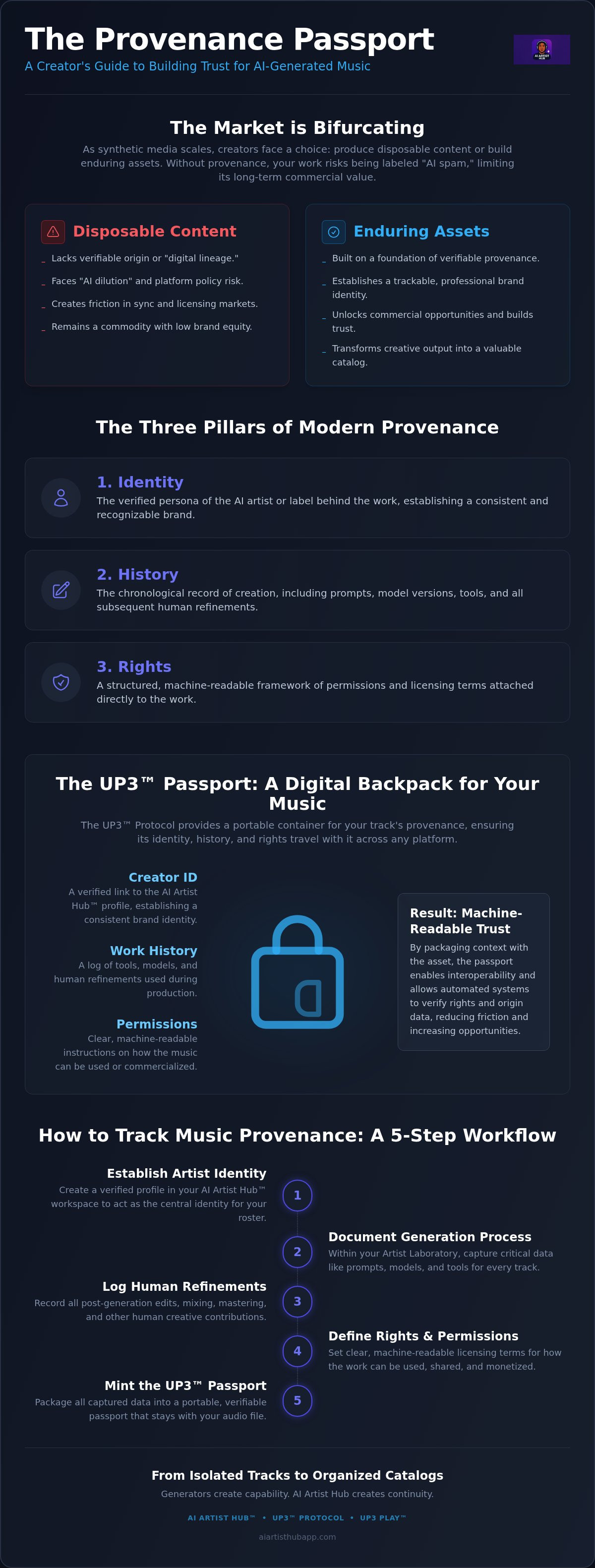
A generic AI generation is just digital noise until you wrap it in a layer of verifiable trust. As the volume of synthetic media scales, the market is quickly bifurcating into two distinct groups: those who create disposable content and those who build enduring assets. You likely recognize the growing fear of being labeled as "AI spam" or the anxiety that comes with shifting platform policies. These concerns are valid because without a clear record of origin, your digital products lack the foundation required for long term commercial growth. Learning how to track music provenance is no longer a technical niche; it's the core requirement for any serious creator operating an AI Music Pocket Label™.
Discover how to establish trust and continuity for your artist roster by mastering the tools of portable provenance. This guide shows you how to use the UP3™ Protocol to give every track a "portable backpack" that carries its identity, credits, and permissions across the ecosystem. We'll provide a strategic roadmap to transform your creative output into a verifiable brand identity that increases the commercial value of your catalog. You'll learn to move beyond simple generation and start building a high utility business that commands respect from fans and platforms alike.
Key Takeaways
- Learn why traditional industry identifiers fail generative workflows and how modern provenance establishes a verifiable history for your digital assets.
- Understand the "digital backpack" framework of the UP3™ Passport to ensure your metadata and credits travel seamlessly with every audio file.
- Master a professional five step workflow for how to track music provenance by capturing critical generation data within your Artist Laboratory workspace.
- Establish long term brand equity for your AI Music Pocket Label™ by using structured records to scale direct to fan commercial opportunities.
- Leverage the UP3™ Protocol and UP3 PLAY™ to deliver a passport native listening experience that builds authentic trust with your audience.
Understanding Music Provenance in the AI Era
Music provenance is the verifiable history of a work’s creation, identity, and ownership. In the context of generative media, this goes beyond a simple credit line; it serves as the documented lineage of every prompt, model version, and human edit. Understanding Data Provenance is critical for creators because it transforms a digital file from a mystery into a trackable asset. Traditional systems like the International Standard Recording Code (ISRC) were built for a world of physical masters and human performers. They identify the "what" but completely ignore the "how." For creators learning how to track music provenance, the focus shifts from a binary "who made this" to a rich, multi-layered creative history.
Modern provenance rests on three essential pillars that ensure your work stands up to professional scrutiny:
- Identity: The verified persona of the AI artist or label behind the work.
- History: The chronological record of generation, refinement, and human intervention.
- Rights: The structured permissions and licensing framework attached to the specific work.
The Problem of Anonymous AI Content
Uploading generic AI music without these pillars is a recipe for commercial failure. Anonymous content faces "AI dilution," where platforms and listeners struggle to distinguish between thoughtful artistry and low effort spam. This lack of record creates immense friction in the sync and licensing markets. If a music supervisor can't verify the origin of a track, they won't touch it. Without provenance, your music remains a disposable commodity rather than a valuable brand asset. You don't just need a song; you need a record of that song's journey.
From Isolated Tracks to Organized Catalogs
Generators create capability, but only professional infrastructure creates continuity. There is a massive gap between a single generator output and a professional label release. Bridging this gap requires moving away from isolated tracks toward organized catalogs. The AI Music Pocket Label™ framework provides this bridge. It allows you to operate with the discipline of a traditional label while leveraging the speed of AI. By prioritizing continuity, you ensure that your audience knows exactly what to expect from your brand. Mastering how to track music provenance is the first step in building this professional foundation, turning a hobby into a scalable digital venture.
The Anatomy of a Music Provenance Passport
Establishing a verifiable identity requires more than a simple file name or a static metadata tag. You need a structured container that moves with your media across every platform and distribution channel. The UP3™ Passport acts as this container, serving as a digital backpack for every song in your catalog. By mastering how to track music provenance through this framework, you transform a generic audio file into a transparent, machine-readable asset. This isn't about making absolute legal claims; it's about providing the structured context that platforms and fans now demand.
The Digital Backpack Analogy
Visualize your song as a traveler. In the old music economy, that traveler arrived at a streaming platform with no identification, relying on the platform to "guess" its origin. With the UP3™ Passport, the song carries its own context in a portable backpack. Inside this backpack, you store essential verification signals, detailed credits, and creation history. While the TrackOrigin Standard helps verify human involvement in the creative process, the UP3™ Passport ensures that this data remains accessible regardless of where the file is played or sold. It’s a persistent record that stays attached to the work, reducing the risk of your artistry being lost in the noise of anonymous uploads.
Every professional passport contains three critical components that define the work’s integrity:
- Creator ID: A verified link to the AI Artist Hub™ profile, establishing a consistent brand identity.
- Work History: A chronological record of the tools, models, and human refinements used during production.
- Permissions: A clear set of machine-readable instructions regarding how the music can be used, shared, or commercialized.
Machine-Readable Trust and Interoperability
Provenance must be readable by both humans and algorithms to be effective in a high-speed digital market. Modern streaming services and marketplaces use automated systems to scan for rights and origin data. If your music doesn't speak their language, it gets flagged or buried. The UP3™ Protocol creates a universal standard for this communication, ensuring your portable identity works everywhere. This interoperability reduces your reliance on platform-specific verification tools and gives you more control over your release cycle. You're no longer just uploading a track; you're deploying a smart asset. To begin securing your catalog with this level of detail, explore the UP3™ Protocol and start building your first passport-native release.
Why Creators Must Track Music Provenance
Establishing brand equity for a virtual artist roster requires more than high quality audio. It demands a verifiable foundation. As the digital music market saturates with anonymous outputs, mastering how to track music provenance becomes your primary competitive advantage. You're not just releasing songs; you're building a durable legacy that survives shifts in generative technology and platform algorithms. A professional label doesn't leave its history to chance. It captures the data necessary to prove its identity at every stage of the commercial lifecycle.
Future proofing your business means preparing for the inevitable wave of regulatory requirements and platform disclosures. Current trends suggest that major streaming services will soon require detailed metadata for all synthetic media to maintain platform integrity. Understanding how to track music provenance ensures that your business remains compliant and commercially viable in a rapidly evolving legal landscape. Don't wait for platforms to force your hand; this proactive stance separates professional founders from casual hobbyists who will be left scrambling when the rules change.
Commercial Value and Marketplace Readiness
Verifiable records act as a powerful "buy-signal" for digital products. When a collector or fan evaluates a work, they prioritize items with a clear, documented history. Transparency reduces the friction inherent in direct to fan commerce by removing the "black box" mystery of how the work was created. On the AI Artist Hub Marketplace, provenance data provides the structural proof that transforms a simple file into a premium tradable asset. Collectors want to know the work is authentic to your specific AI Music Pocket Label™, and a portable passport provides that peace of mind instantly.
Audience Trust and Ethical Disclosure
Building trust with a fan base in the age of AI requires radical transparency. Modern audiences are increasingly concerned with consent, training data, and proper attribution. Starling Lab's research emphasizes that data integrity is the cornerstone of authenticity in digital media. By owning your process rather than hiding the AI, you foster a stronger direct to fan relationship. This approach respects human creativity by clearly defining where the machine ends and the artist's direction begins. Moving from "hiding the AI" to "owning the process" allows you to position yourself as a visionary architect of a new digital culture.
How to Track Music Provenance: A 5-Step Workflow
Implementing a professional system for your AI artist roster requires a shift from chaotic generation to structured management. You don't just want to create; you want to build a catalog with lasting value. Mastering how to track music provenance involves a disciplined five step workflow that begins the moment you enter the creative environment. By following these steps, you ensure that every track you release carries the necessary context to be recognized as a premium asset rather than anonymous digital noise. This process transforms capability into continuity.
- Capture: Document generation data immediately after creation.
- Organize: Centralize assets within a professional Artist Laboratory.
- Identify: Assign the work to a specific virtual artist profile.
- Issue: Generate a portable provenance passport via the UP3™ Protocol.
- Distribute: Release through provenance aware playback surfaces.
Assigning a work to a specific virtual persona is where your brand identity takes root. It is the difference between a random audio file and a professional artist release. Once the identity is established, you must look toward distribution. Releasing your music through passport native environments ensures that your provenance data remains visible and functional for the end listener. This holistic approach protects your work from being stripped of its context as it moves through the digital ecosystem.
Capturing the Creative Trail
The most critical data is often the most ephemeral. You must save prompt history, model versions, and seed data as you work. This isn't just about technical documentation; it's about proving the specific human led interventions that define your unique sound. If you wait until a track is finished to gather this information, you've already lost the thread. Use The Lab to organize these assets securely. Centralizing your prompts and early iterations within a dedicated workspace allows you to maintain a clean record of your creative lineage from day one. It's the foundation of a professional AI Music Pocket Label™.
Issuing and Managing Passports
Once your assets are organized, you need to package them into a portable format. Generating a UP3™ Passport for a single track or an entire catalog provides the "backpack" that carries your credits and permissions. This process involves embedding machine readable records directly into the metadata structure. As your work evolves through remixes or updates, your provenance records should reflect those changes. This dynamic management ensures that your work remains interoperable across the global music landscape. Learning how to track music provenance through these structured passports allows you to manage your roster with the same precision as a major label executive.
Access The Lab to start organizing your provenance data today.
Building Continuity with the UP3™ Protocol
The UP3™ Protocol serves as the connective tissue between your creative output and your audience. While previous sections detailed the technical how to track music provenance, this final layer focuses on the commercial application of that data. By integrating provenance into every release, you establish a direct line of trust with fans who value transparency. The AI Artist Hub™ provides the essential business infrastructure to manage these records, allowing you to operate with the discipline of a global music company. This isn't just about metadata; it's about building a scalable ecosystem where your artist identity remains intact regardless of where the music travels.
Playback is the ultimate destination for provenance. UP3 PLAY™ offers a dedicated experience for passport native music, ensuring that the "digital backpack" of context is always accessible to the listener. This downstream solution solves the attribution gap left by traditional streaming services. When you release music within this ecosystem, you aren't just uploading a file. You are deploying a verifiable brand asset that carries its own history, credits, and permissions into the ears of your audience.
Interoperable Trust Beyond the Platform
Provenance should never be locked into a single "walled garden." If your records only exist within one generator or one social platform, your business is vulnerable to policy shifts and platform decay. The UP3™ Protocol ensures portability, allowing your work to maintain its integrity across the entire digital economy. This interoperability is the foundation of a human centered AI music economy, where creators retain control over their work’s identity. By prioritizing portable trust, you ensure that your catalog remains valuable even as the underlying generative tools continue to evolve.
Next Steps for AI Music Entrepreneurs
Transitioning from a casual hobbyist to a professional owner of an AI Music Pocket Label™ requires a commitment to systems and strategy. Start by setting up your first Artist Laboratory to centralize your provenance management. This workspace acts as the command center for your roster, ensuring that every track is born with a verifiable record of its creation. Learning how to track music provenance through structured systems ensures that your business stays ahead of regulatory shifts and platform requirements. For those ready to scale, the Academy provides the business training necessary to navigate this new landscape with confidence. You can also explore the Marketplace to see how other creators are using these tools to build verifiable brand identities.
Securing the Future of Your AI Artist Roster
Establishing a professional identity in the generative music era requires more than just high quality outputs. It demands a commitment to transparency and structured record keeping. By mastering how to track music provenance, you transition from a casual creator to a serious owner of an AI Music Pocket Label™. The patent pending UP3™ Protocol infrastructure provides the essential portable backpack for your songs, ensuring that credits and identity remain intact across every platform and playback surface. This foundation allows you to build a catalog with lasting commercial value while fostering deep trust with your fan base.
Our generator agnostic workflow and human centered creator tools are designed to give you complete control over your creative lineage. You have the infrastructure to architect a sustainable digital venture that thrives on continuity rather than temporary hype. By prioritizing verifiable artistry, you separate your brand from the noise of anonymous content and position yourself as a leader in the new music economy. The framework is ready; the next move is yours to take.
Start building your AI Music Pocket Label™ and track your provenance today.
Your journey toward building a verifiable brand starts with a single record. Take control of your artistry and define the future of the industry on your own terms.
Frequently Asked Questions
Does tracking provenance automatically grant me copyright?
Tracking provenance does not automatically grant legal copyright. As of August 2026, U.S. copyright law requires significant human authorship for a work to be eligible for protection. While your records document your creative history and human led interventions, they serve as transparency signals rather than a government registration. These tools help you organize the evidence needed for legal reviews or platform disputes, but they don't replace formal legal advice or statutory registration.
How is a UP3™ Passport different from an ISRC code?
An ISRC code identifies a specific sound recording within traditional industry databases. In contrast, a UP3™ Passport acts as a portable backpack that travels with the audio file itself. It contains machine readable context about the creator’s identity, work history, and specific permissions. While ISRC is a static identifier, the passport is a dynamic record that ensures your provenance data remains accessible across different platforms, regardless of where the music is played.
Do I need to be a developer to use music provenance tools?
You don't need technical expertise or developer skills to manage your creative records. The AI Artist Hub™ provides a streamlined operating environment designed specifically for founders and creators. By using a professional Artist Laboratory, you can easily implement systems for how to track music provenance without writing a single line of code. The focus is on business management and brand continuity, allowing you to leverage powerful software tools through an intuitive, user friendly dashboard. For tech professionals and students who are exploring this space, QuickApply offers a way to automate the job application process, allowing them to focus more on their creative and technical projects.
While these software tools remove the need for coding, those interested in the physical components of innovation can explore MC4.0 Controller to see how modular hardware is used to teach complex STEM concepts.
Yes, the protocol is entirely generator agnostic. You can capture and organize data from any major AI music platform currently available on the market. The process involves saving your prompt history and seed data immediately after generation and importing those details into your Artist Laboratory. This flexibility allows you to maintain a unified catalog even if you use multiple different tools to build your AI Music Pocket Label™ roster and assets.
What happens to the provenance if I sell my AI artist brand?
Provenance records significantly increase the commercial value of your brand during a sale. When you transfer ownership of an AI artist, the buyer receives the complete creative history and identity records stored within the UP3™ Passport. This transparency reduces buyer risk by providing a clear lineage of the assets. Because the records are portable, the brand’s identity remains intact, ensuring that the new owner can maintain continuity and trust with the existing fan base.
Is music provenance the same thing as a blockchain record?
No, music provenance is a distinct framework for identity and creative history. While some systems use distributed ledgers, the UP3™ Protocol is a portable identity and rights layer focused on interoperability. It's designed to be a "digital backpack" that carries structured context across platforms. Understanding how to track music provenance is about establishing a verifiable brand identity and creative trail rather than relying on a specific database technology or blockchain architecture to prove ownership.
How do fans see the provenance data for my songs?
Fans access your provenance data through passport native playback experiences like UP3 PLAY™. When a listener interacts with your music on a supported platform, they can view the credits, artist identity, and creative history attached to the track. This transparency transforms the listening experience from passive consumption into an active engagement with your brand. It allows you to share the "digital backpack" of context directly with your audience, building authentic, long term trust.
Why is provenance important for virtual artist "lore" and branding?
Lore is the foundation of any successful virtual artist, and provenance provides the verifiable evidence for that story. By documenting the chronological history of your artist’s releases and creative evolution, you anchor their persona in reality. This "proof of life" makes the virtual character feel more tangible to fans. Provenance ensures that the artist’s identity remains consistent across different platforms, allowing you to scale their brand and lore with professional, label like discipline.

Article by
Julius J. White (VVS Jules)
Julius J. White (VVS Jules) is the Founder & CEO of JJW AI Studios™ and builder of AI Artist Hub™, a creator-first operating platform for the emerging AI music economy. A musician, songwriter, producer, entrepreneur, and systems builder, he developed the AI Music Pocket Label™ framework around a simple idea: generation is only the beginning. His work focuses on the identity, provenance, credits, ownership context, permissions, artist development, direct-to-fan relationships, commerce, trust infrastructure, and business systems creators need to build durable AI artist brands, organized catalogs, and long-term creative ventures.
Disclaimer
This article is provided for general educational and informational purposes only and does not constitute legal, financial, tax, investment, or other professional advice. Laws, regulations, platform policies, technology, and industry practices may change over time. References to AI Artist Hub™, UP3™, UP3 PLAY™, provenance, verification, ownership assertions, permissions, creator tools, protected media, streaming or platform policies, or AI-related rules describe general information and current product capabilities where verified. They do not constitute government registration, legal adjudication, third-party rights clearance, regulatory approval, copyright ownership, guaranteed authenticity, or guaranteed permission for commercial use. Readers should independently verify current requirements, review applicable platform and rights terms, and consult qualified professionals when appropriate.
