


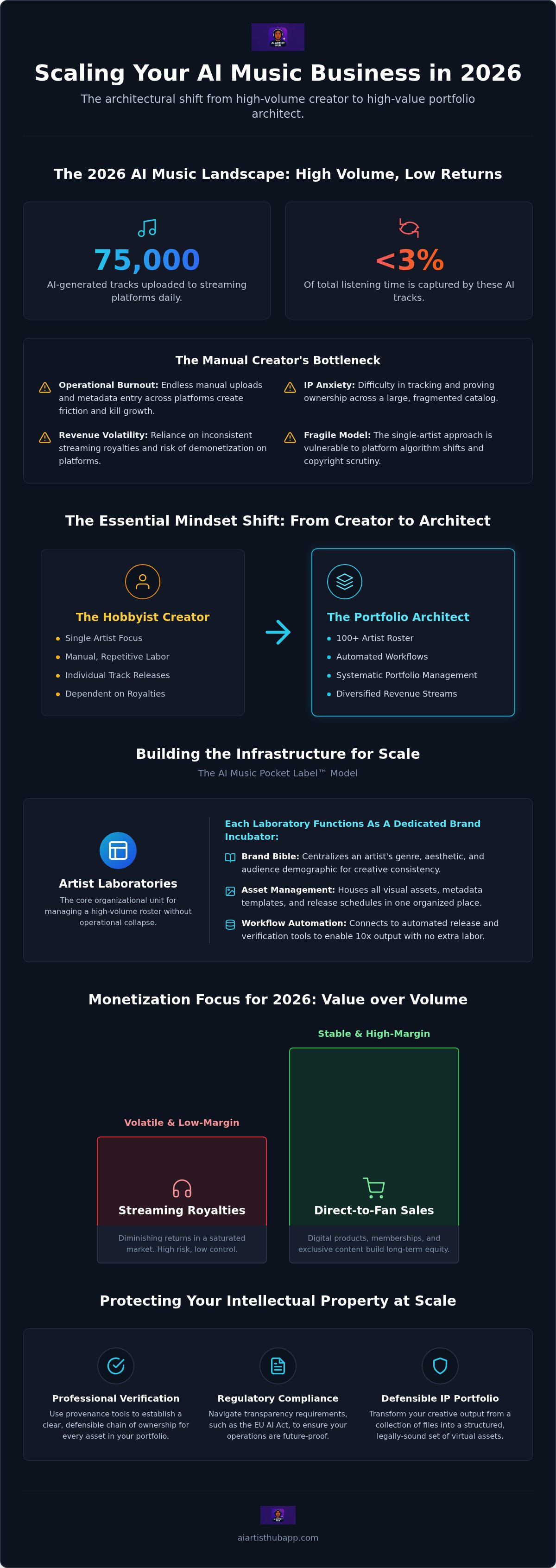
As of April 2026, 75,000 AI-generated tracks flood streaming platforms every day, yet these uploads account for less than 3% of total listening time. If you're stuck in a cycle of manual uploads and diminishing returns, you already know that scaling an AI music business requires more than just high-volume output. You've likely felt the burnout of manual asset management and the mounting anxiety of tracking ownership across a growing catalog while platforms like Tidal begin demonetizing fully synthetic content.
It's time to stop acting like a content creator and start thinking like a portfolio architect. This guide promises to show you the exact architectural shift needed to move from manual creation to automated management, allowing you to scale your roster to 100+ artists with professional precision. We'll explore how to build a legally defensible portfolio of virtual IP, navigate the transparency requirements of the EU AI Act, and diversify your revenue streams to ensure your label remains profitable in a high-volume market. Learn how to transform your creative output into a structured, scalable enterprise.
Key Takeaways
- Transition from a content creator to a portfolio architect by adopting a systematic approach to virtual brand management.
- Master the technical infrastructure required for scaling an AI music business from a single artist to a roster of 100+ profiles.
- Prioritize high-margin revenue streams like direct-to-fan digital product sales over increasingly volatile streaming royalties.
- Establish a legally defensible IP portfolio using professional verification and provenance tools to secure long-term ownership.
- Deploy specialized Artist Laboratories to maintain organizational clarity and creative consistency across high-volume asset libraries.
From Hobbyist to Architect: The 2026 Shift in Scaling an AI Music Business
The music industry has reached a critical tipping point. In 2026, AI music generation is no longer a novelty; it's a commodity. While the history of AI in music shows a slow evolution from rule-based algorithms to advanced neural networks, today's reality is an explosion of content. Thousands of tracks are generated every minute. This abundance has shifted the value from the creation itself to the architecture behind the brand.
Success in this environment requires a transition from hobbyist to architect. You aren't just a producer anymore. You're building a system. This involves Portfolio Architecture, where you treat your AI artists as a diversified set of assets rather than individual experiments. Scaling an AI music business means moving beyond the Single Artist model, which relies on a single brand to carry your entire revenue stream. That approach is too fragile for the current market.
Traditional distribution models fail high-volume creators. They weren't built for labels that drop 50 tracks a week across 20 different virtual personas. Manual metadata entry, individual artist verification, and fragmented royalty tracking create a massive bottleneck. This friction kills growth. To scale, you must replace manual labor with automated workflows that manage the complexity of a multi-artist roster.
The Death of the 'One-Hit' AI Creator
Relying on a single viral track is a gamble with diminishing returns. In 2026, algorithmic platforms prioritize consistency and brand depth over isolated spikes. If your only asset is one virtual artist, you're vulnerable to platform shifts and copyright scrutiny. Building long-term virtual artist equity involves creating a cohesive identity that fans can follow across multiple platforms. To get the foundation right, consult our How to Start an AI Music Label: Complete 2026 Guide.
Defining the AI Music Pocket Label™ Model
The AI Music Pocket Label™ model represents a shift toward decentralized, creator-owned infrastructure. It's a system designed to handle the complexity of managing a multi-artist roster without the overhead of a traditional record company. By using automated release management and integrated verification tools, you can achieve 10x growth in output without 10x the labor. This model empowers you to maintain total control over your intellectual property while scaling your reach across global markets. It transforms a creative hobby into a professional, scalable enterprise.
Building the Infrastructure: Roster Management and Artist Laboratories
Build infrastructure that supports exponential growth from the first day. When scaling an AI music business, your primary challenge shifts from creative production to administrative management. Handling metadata, artwork, and distribution for 20 or 50 virtual artists manually is impossible. You need a centralized system that treats each virtual artist as a distinct business unit. This is why Artist Laboratories are the foundation of a professional roster. They provide the structural framework needed to move from a single artist to a managed portfolio without operational collapse.
Adopt an "Incubator" approach to roster development. Instead of pouring all your resources into one profile, launch multiple artist concepts simultaneously in small batches. Monitor engagement data to identify which personas resonate with specific demographics. This strategy allows you to fail fast and double down on winners. In 2026, brand identity carries more weight than individual song quality. A recognizable virtual brand creates long-term equity, while a single track is a fleeting asset in a saturated market.
Implementing Artist Laboratories for Roster Control
Deploy Artist Laboratories to sandbox and organize your roster by genre, aesthetic, and audience demographic. Each laboratory functions as a dedicated environment for a specific brand, housing its "brand bible" and visual assets. This structure ensures creative consistency across hundreds of tracks. Professional management also requires rigorous attention to governance and provenance, ensuring every asset within your lab is verified and legally defensible. Centralize your metadata in a professional business suite to prevent the tracking errors that plague high-volume creators.
Workflow Automation for High-Volume Releases
Move away from platform-specific manual uploads and adopt a centralized dashboard. Schedule releases across streaming services and direct-to-fan marketplaces simultaneously to maximize reach. Optimize your "upload-verify-release" pipeline to reduce human intervention and eliminate the manual friction that slows down growth. Release automation serves as the primary engine for scaling an AI music business into a high-output enterprise. Establish your foundation on a system designed for this scale. You can begin organizing your portfolio today by using the AI Artist Hub platform to manage your first laboratory.
Monetization Trends: Streaming vs. Direct-to-Fan Scaling in 2026
Profitability in the current market requires a cold analysis of the numbers. Relying solely on streaming platforms for scaling an AI music business often leads to a revenue trap. With Spotify paying between $0.003 and $0.005 per stream, reaching a living wage requires millions of plays. Compare this to a direct-to-fan model. One thousand dedicated subscribers paying five dollars a month generate $60,000 in annual recurring revenue. This shift in focus from mass-market streaming to high-value fan relationships changes the fundamental economics of your label.
Streaming platforms are increasingly hostile toward high-volume AI creators. Tidal has already begun demonetizing fully synthetic tracks, and Deezer reports flagging 85% of AI-generated streams as fraudulent. These policy shifts create a high-risk environment for businesses built on third-party foundations. A centralized marketplace model supports a high-volume roster better than Spotify because it allows you to set your own prices, keep a higher percentage of the sale, and bypass the 1,000-stream royalty threshold required by major platforms.
Integrate audience-growth tools to drive traffic directly to your owned assets. These tools enable you to capture email addresses and social data, ensuring you aren't at the mercy of an algorithm to reach your listeners. By controlling the transaction environment, you move from being a passive recipient of royalties to an active manager of a commercial ecosystem.
The Direct-to-Fan Marketplace Advantage
Own your fan data to secure the future of your roster. When you sell music or merchandise through your own marketplace, you retain 100% of the customer information. This data is gold for cross-promotion. If a fan buys a track from your AI lo-fi artist, you can directly market your new AI ambient project to them without paying for additional ads. Use subscription tiers to provide exclusive access to new releases, creating a stable, predictable income stream that scales as you add more artists to your portfolio.
Scaling Revenue Through Digital Products
Diversify your income by selling more than just finished tracks. Package your AI artist stems, MIDI files, and synth presets as digital products for other creators to use. This secondary revenue stream capitalizes on the "producer-to-producer" market, which often yields higher margins than consumer streaming. Create fan-only digital collectibles that offer social proof of early support. These products protect your business from streaming platform policy changes and ensure that scaling an AI music business remains profitable even if royalty rates continue to decline.
Governance and Provenance: Protecting Intellectual Property at Scale
Proving ownership of 100+ virtual artists is the single biggest barrier to high-value licensing deals. As your roster grows, the question of "who owns this?" becomes a constant operational challenge rather than a one-time legal hurdle. Effective scaling an AI music business depends on your ability to produce an immutable record of creation for every asset in your portfolio. Without a transparent ownership log, your catalog remains a collection of files rather than a legally defensible IP portfolio.
Provenance tracking is now a mandatory requirement for professional label operations. With Article 50 of the EU AI Act becoming fully enforceable on August 2, 2026, creators must provide machine-readable watermarks and clear disclosures for AI-generated content. Major streaming platforms like Apple Music and Spotify have already implemented transparency tags and AI-use disclosure requirements. Adopting these standards early protects your business from mass demonetization and positions your roster as a reliable partner for sync licensing agencies and global distributors.
Mitigate "AI fraud" claims by maintaining a centralized repository of creation data. This digital paper trail serves as your primary defense against platform takedowns and ownership disputes. It transforms your operation from a high-volume uploader into a verified IP house. You can secure your entire catalog today by using AI Artist Hub verification and provenance tools to establish a professional ownership record.
Establishing AI Music Ownership Verification
Create a digital paper trail for every release to secure your intellectual property. Use verification tools to log the specific parameters, timestamps, and human-in-the-loop interventions that define your unique virtual IP. This documentation is essential for securing sync licensing opportunities, as music supervisors require absolute certainty regarding rights clearance. Protect your virtual artist profiles by claiming them across all social and streaming web properties, ensuring that your brand identity remains exclusive to your label.
Fraud Detection and Brand Protection
Monitor the digital landscape for unauthorized clones of your virtual artists. As a brand gains traction, third parties may attempt to capitalize on your aesthetic or name by releasing "synthetic soundalikes." Implement automated takedown strategies to protect your roster at scale. Building social proof through verified artist laboratories reinforces your authority in the market. This proactive approach to brand protection ensures that scaling an AI music business leads to long-term equity rather than a fragmented, unprotected catalog. Consistent enforcement of your IP rights signals to the industry that your virtual artists are professional, managed assets.
Executing the Growth Roadmap: From 1 to 100 Artists
Move from theory to execution by following a systematic growth roadmap. Scaling an AI music business isn't about working harder; it's about deploying a repeatable system that handles volume without increasing headcount. By moving through these five distinct phases, you transform a single creative project into a global digital asset portfolio.
- Phase 1: Foundation. Set up your AI Music Pocket Label™ platform to centralize your operations from day one.
- Phase 2: Validation. Launch your first 5 "Seed" artists to gather market data and identify which aesthetics resonate with listeners.
- Phase 3: Expansion. Utilize Artist Laboratories to organize and scale to 20+ brands, ensuring each has a distinct market position.
- Phase 4: Optimization. Automate your marketing funnels and direct-to-fan sales workflows to maximize your profit margins.
- Phase 5: Dominance. Manage a 100+ artist roster with a lean team by relying on automated provenance and release management.
This progression ensures you don't overextend your resources before validating your artist concepts. It allows you to build a sturdy infrastructure that supports hundreds of assets while maintaining the brand integrity required for long-term equity. Scaling an AI music business successfully means your operational capacity always stays one step ahead of your creative output.
The 90-Day Scaling Sprint
Execute your growth in structured sprints to maintain momentum. During weeks 1 through 4, focus entirely on infrastructure setup and brand identity development for your initial roster. Move into high-volume content production and verification in weeks 5 through 8, ensuring every track meets the transparency standards discussed in previous sections. Finally, use weeks 9 through 12 to launch your direct-to-fan marketplace and scale targeted ads. This 90-day window transforms your label from a conceptual framework into a revenue-generating enterprise.
Leveraging the AI Artist Hub™ for Professional Scaling
The AI Artist Hub™ platform handles the heavy lifting of roster management, allowing you to focus on high-level strategy rather than manual data entry. By providing the essential infrastructure for verification, release automation, and direct sales, the tools empower you to manage a massive portfolio with professional precision. Don't let administrative friction cap your growth potential. Focus on your role as a portfolio architect while the system handles the complexities of management. Scale your label today with the AI Artist Hub™ Platform and take control of your digital future.
Architect Your Future in the Virtual Music Economy
The 2026 landscape demands a permanent shift in your entrepreneurial mindset. Understand that scaling an AI music business requires moving beyond the high-risk "one-hit" strategy toward a robust, managed portfolio of virtual brands. By prioritizing direct-to-fan marketplaces over volatile streaming platforms and establishing an immutable digital paper trail for every asset, you secure your long-term position in a competitive industry. You don't need a massive team to dominate this space; you simply need the right architectural foundation to support your growth.
Professional success depends on your ability to automate the management of your roster while maintaining total control over your intellectual property. Our trademarked Pocket Label™ infrastructure allows you to manage 100+ artists from one dashboard and leverage integrated direct-to-fan marketplace tools for maximum profitability. The industry is moving fast, and the tools to lead it are already in your hands. Take control of your creative output and build a business that scales with your ambition. Start building your AI Music Pocket Label™ today. Your vision is ready for the global stage.
Frequently Asked Questions
How many AI artists can one person realistically manage?
One person can manage 100+ artists solo by using centralized, automated infrastructure. Manual management typically caps your growth at 3 to 5 artists due to the metadata and upload fatigue associated with traditional distribution. Automated systems handle the repetitive administrative tasks, allowing you to focus on high-level portfolio strategy and brand architecture rather than manual data entry.
Is scaling an AI music business legal in 2026?
Scaling remains legal as long as you adhere to transparency and disclosure requirements. The EU AI Act mandates clear labeling for AI-generated content as of August 2, 2026. Use professional verification and provenance tools to create a digital paper trail for every artist in your roster, ensuring your entire portfolio remains compliant with platform policies and global regulations.
What is the most profitable way to monetize a large AI artist roster?
Prioritize direct-to-fan transactions and digital product sales over streaming royalties. Selling artist stems, MIDI packs, and exclusive tracks yields significantly higher margins than the $0.003 to $0.005 per stream offered by platforms like Spotify. A marketplace model allows you to capture 100% of fan data, creating a stable revenue base that is independent of shifting streaming algorithms.
Do I need a separate business plan for an AI music label?
Develop a specialized business plan centered on portfolio architecture rather than traditional talent scouting. Your strategy should prioritize systems for high-volume release cycles, automated intellectual property management, and diversified revenue streams. Focus on building a scalable infrastructure that treats virtual artists as digital assets, ensuring your label can handle rapid growth without increasing operational overhead.
How do I ensure my AI artists stay consistent as I scale?
Implement Artist Laboratories to lock in specific brand parameters for every persona in your roster. These "brand bibles" define the genre, aesthetic, and emotional tone for each virtual artist, ensuring creative consistency as your catalog grows. Centralized management suites allow you to maintain these standards across hundreds of tracks, preventing the brand dilution that often occurs during rapid expansion.
What tools are essential for scaling an AI music business?
Essential infrastructure is the key to scaling an AI music business without operational collapse. You need a centralized platform that combines roster management, verification tools, and automated release dashboards. These systems replace the manual labor that typically limits a solo creator to just a few artists, enabling you to manage a diverse portfolio of 100+ virtual brands with professional precision and legal security.
How does direct-to-fan sales differ from traditional distribution?
Direct-to-fan sales give you total ownership of customer data and significantly higher profit margins. Traditional distribution leaves you at the mercy of third-party algorithms and fluctuating royalty thresholds, such as the 1,000-stream minimum required for payment on major platforms. By selling directly, you bypass these bottlenecks and build a direct relationship with your audience, which is essential for long-term roster stability.
Can I sell my AI music label or individual artist brands later?
Treat your virtual artists as liquid digital assets that can be sold or licensed. A verified portfolio with a documented revenue history and clear provenance is a valuable intellectual property package. Investors and media firms increasingly look for managed AI rosters with established fan bases, making your scaled label a highly attractive target for acquisition in the evolving digital music economy.

Article by
Julius J. White (VVS Jules)
Julius J. White (VVS Jules) is the Founder & CEO of JJW AI Studios™ and builder of AI Artist Hub™, a creator-first operating platform for the emerging AI music economy. A musician, songwriter, producer, entrepreneur, and systems builder, he developed the AI Music Pocket Label™ framework around a simple idea: generation is only the beginning. His work focuses on the identity, provenance, credits, ownership context, permissions, artist development, direct-to-fan relationships, commerce, trust infrastructure, and business systems creators need to build durable AI artist brands, organized catalogs, and long-term creative ventures.
Disclaimer
This article is provided for general educational and informational purposes only and does not constitute legal, financial, tax, investment, or other professional advice. Laws, regulations, platform policies, technology, and industry practices may change over time. References to AI Artist Hub™, UP3™, UP3 PLAY™, provenance, verification, ownership assertions, permissions, creator tools, protected media, streaming or platform policies, or AI-related rules describe general information and current product capabilities where verified. They do not constitute government registration, legal adjudication, third-party rights clearance, regulatory approval, copyright ownership, guaranteed authenticity, or guaranteed permission for commercial use. Readers should independently verify current requirements, review applicable platform and rights terms, and consult qualified professionals when appropriate.
