


Music has never been easier to create, move, remix, upload, collaborate on, and distribute.
But the information that explains what the music actually is—who created it, who contributed, what tools were used, what permissions were granted, how the work changed, and which file belongs to which record—doesn’t always travel as cleanly as the audio itself.
That is the problem UP3™ — Universal Provenance Passport Protocol™ is designed to address.
The idea is straightforward:
Pack the work once. Let compatible systems understand the Passport wherever it travels.
The Problem With a “Naked” Music File
An ordinary audio file can move from a studio computer to email, cloud storage, collaborators, distribution systems, social platforms, licensing workflows, and countless other destinations.
The audio travels.
The surrounding context often does not.
Traditional metadata can help, but metadata alone was never designed to carry the full modern story of a creative work: creator identity, contributors, provenance, human and AI involvement, permissions, supporting evidence, integrity information, and the history of the work.
UP3 approaches the problem differently.
Instead of treating the song as the entire digital object, UP3 treats the Passport and its associated assets as a portable creative record.
Think of it as a Digital Backpack™.
The creator packs the work and its important context together so that a compatible UP3 Reader can understand what is inside.
What Can Travel Inside a UP3 Passport?
A UP3 Passport can carry structured information about the work, including creator and artist identity, contributors, provenance events, tools and ingredients, permissions, credentials, evidence, integrity information, external mappings, and other supported creative context.
For supported audio, a Passport can also be issued in different package modes depending on how the creator wants the work to travel.
UP3 Open™
UP3 Open™ is designed for portability.
It allows supported audio to travel with its Passport, provenance information, permissions, and machine-readable creative context without the protected-audio controls of Protected mode.
Open is useful when the priority is interoperability, sharing, collaboration, demonstration, and allowing compatible systems to inspect the creative record.
UP3 Protected™
UP3 Protected™ adds supported protected-audio infrastructure.
Protected packages can use encrypted audio payloads, authorization, integrity checks, key binding, controlled playback, and fail-closed behavior inside supported UP3 environments.
That means UP3 Protected is doing more than attaching a label to a song.
It gives creators a way to package supported audio with provenance and permissions while also using the current UP3 protected-media infrastructure.
Protected does not mean that UP3 can prevent every possible recording, copying method, transformation, or misuse everywhere on the internet. It means the native protected UP3 package can enforce the protections supported by the UP3 system.
UP3 Creator Pricing
UP3 now gives creators multiple self-service options depending on the size of the Passport they need.
UP3 Pouch™
For a creator who only needs to Passport one asset up to 1 GB:
UP3 Pouch™ Open — $1.99
UP3 Pouch™ Protected — $4.99
This creates an inexpensive entry point for creators who want to Passport an individual song or supported audio asset without purchasing a larger Passport tier.
Small
For Passports up to 100 MB:
Open — $5
Protected — $10
Creator
For Passports up to 500 MB:
Open — $10
Protected — $15
Studio
For Passports up to 1 GB:
Open — $20
Protected — $25
Self-service Passport issuance is currently live through 1 GB.
Vault Backpack™
The larger Vault Backpack™, designed for capacity up to 1 TB, is Coming Soon.
It cannot currently be purchased, but creators and organizations with large-file needs can request access and help qualify demand.
Large-scale requirements can also be routed into UP3’s Developer, Managed Infrastructure, or Enterprise pathways.
Protected Hosting
Every UP3 Protected Passport currently includes:
12 months of hosted Protected service.
After the first year, renewal is:
$5 per year, per Passport.
That distinction matters because Protected is not simply a one-time file format. Supported Protected playback relies on infrastructure that can participate in authorization and protected-media delivery.
Why This Matters for AI Music
AI has made provenance dramatically more important.
A modern recording may involve a human songwriter, producer, vocalist, AI music system, voice technology, generative tools, editors, collaborators, stems, prompts, source recordings, and multiple revisions.
A simple label such as “AI-generated” or “human-made” cannot explain all of that.
The more useful question is:
What actually happened during the creation of this work?
UP3 is built around carrying that structured history rather than reducing the work to a single label.
The Passport can document creator-declared information, supported system information, permissions, contribution context, evidence, and provenance so compatible systems can interpret a richer record.
That could matter to artists, collaborators, labels, distributors, licensing companies, marketplaces, platforms, fans, and future digital environments that need better information about the creative object they are receiving.
Provenance Is Not the Same as Legal Ownership
There is an important distinction.
A UP3 Passport can carry ownership assertions, rights information, permissions, provenance, credentials, and supporting evidence.
That does not mean the protocol itself acts as a court, copyright office, or legal adjudicator.
Technical integrity can demonstrate that a package matches the information with which it was issued.
It cannot independently decide every legal dispute surrounding authorship or ownership.
That boundary makes the Passport more useful—not less—because compatible systems can distinguish between what was declared, what can be technically verified, and what may require outside legal authority.
The Passport Travels. Different Systems Read Different Parts.
UP3 is designed around a larger principle:
Pack Once. Interpret Many Ways.
A music platform may care about playback and artist identity.
A licensing system may care about permissions and ownership assertions.
A provenance service may inspect ingredients, evidence, and creation history.
A marketplace may care about credentials and authorized commercial use.
A future game, immersive environment, creator platform, label system, or distribution node may care about another part of the same Passport.
They do not all need to present the information identically.
They need a common way to understand the creative object.
That is the larger purpose of the UP3 Digital Backpack™.
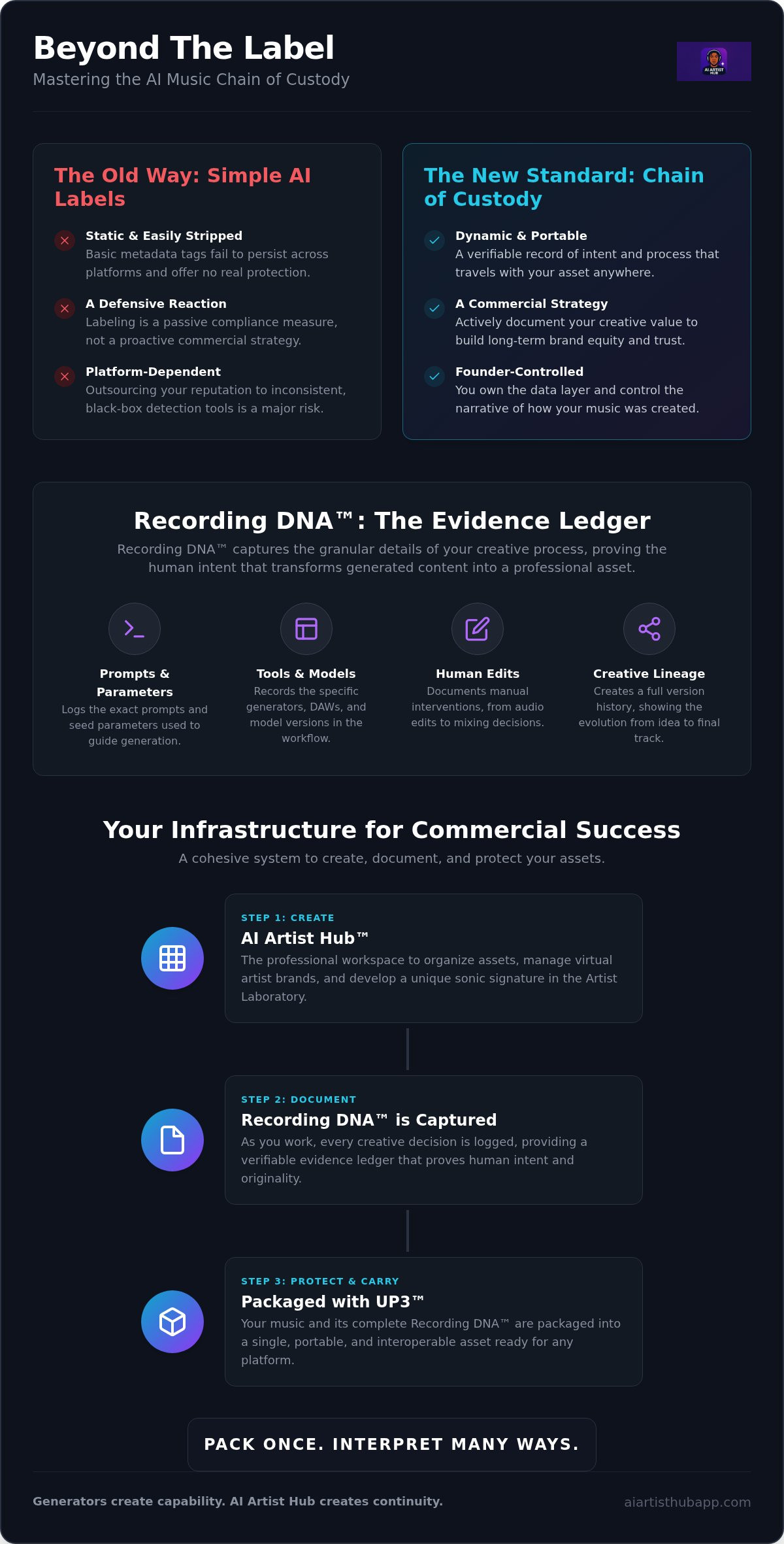
From AI Artist Hub™ to UP3 PLAY™
Inside the JJW AI Studios™ ecosystem, the architecture can already be demonstrated across multiple products.
AI Artist Hub™ can establish creator, artist, recording, credit, provenance, ownership-context, permission, and Recording DNA™ information.
A creator can then issue the work as a UP3™ Passport.
The Passport can be interpreted by the UP3 Reader.
And UP3 PLAY™ demonstrates how another Passport-aware environment can receive and interpret that work from its own perspective.
The goal is not to trap a creator inside one application.
It is the opposite.
The work travels.** The truth travels. The rights context travels. **The Reader understands the Backpack.
The Next Era of Music Needs More Than Portable Audio
The MP3 helped make music portable.
Streaming made listening nearly universal.
Generative AI is making creation accessible at an entirely different scale.
But the next infrastructure problem is bigger than moving audio.
It is moving identity, provenance, contributions, permissions, evidence, integrity, and creator context with the work itself.
That is the problem UP3 is building for.
A song should not have to become disconnected from its story simply because it moved to another system.
The music can travel—and now the Passport can travel with it.

Article by
Julius J. White (VVS Jules)
Julius J. White (VVS Jules) is the Founder & CEO of JJW AI Studios™ and builder of AI Artist Hub™, a creator-first operating platform for the emerging AI music economy. A musician, songwriter, producer, entrepreneur, and systems builder, he developed the AI Music Pocket Label™ framework around a simple idea: generation is only the beginning. His work focuses on the identity, provenance, credits, ownership context, permissions, artist development, direct-to-fan relationships, commerce, trust infrastructure, and business systems creators need to build durable AI artist brands, organized catalogs, and long-term creative ventures.
Disclaimer
This article is provided for general educational and informational purposes only and does not constitute legal, financial, tax, investment, or other professional advice. Laws, regulations, platform policies, technology, and industry practices may change over time. References to AI Artist Hub™, UP3™, UP3 PLAY™, provenance, verification, ownership assertions, permissions, creator tools, protected media, streaming or platform policies, or AI-related rules describe general information and current product capabilities where verified. They do not constitute government registration, legal adjudication, third-party rights clearance, regulatory approval, copyright ownership, guaranteed authenticity, or guaranteed permission for commercial use. Readers should independently verify current requirements, review applicable platform and rights terms, and consult qualified professionals when appropriate.
